Sinon was the Greek left behind when the fleet withdrew to Tenedos, to persuade the Trojans to bring the wooden horse into Troy. In the epic Sack of Ilion he gave the fire signal to the returning Greeks (Proclus’ summary, paraphrased).
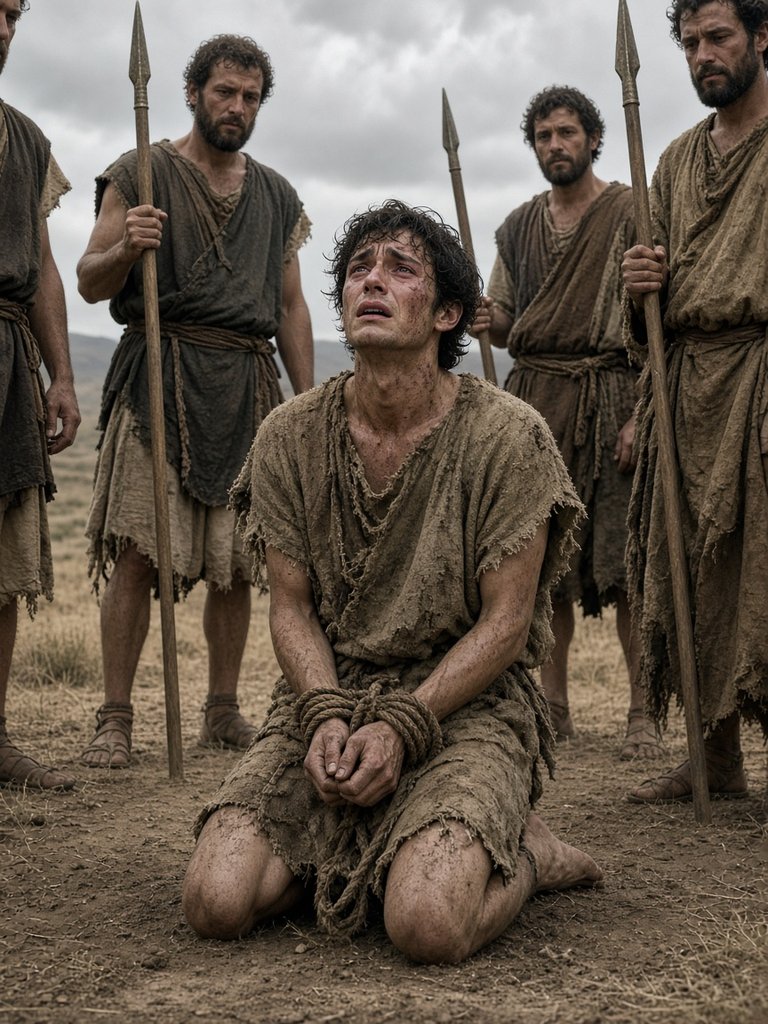
In Virgil, Trojan herdsmen dragged him before Priam with his hands bound. With false tears he told how Odysseus had hated him as a friend of Palamedes, and had arranged that he be chosen as a human sacrifice for the fair wind home; he had escaped, he said, and hidden in a marsh (Aeneid 2.57–144, paraphrased).
Freed by Priam, he swore that the horse was an offering to Athena, built huge so that it could not be taken into the city, for if the Trojans brought it in, Troy would win. The death of Laokoon seemed to confirm him; that night Sinon opened the horse and let the Greeks out (Aeneid 2.145–267, paraphrased). Quintus Smyrnaeus says the Trojans tortured him, but he held to his story (12.360–388, paraphrased).
Epithets
- Σίνων · Sinōn
- Sinon
Symbols and virtues
Deceit dressed as pity. Symbols: the bound hands, false tears.
Myths
- The fire signal. Proclus, Chrestomathy (Iliou Persis).
- The false tale before Priam. Virgil, Aeneid 2.57–198.
- Opening the horse. Virgil, Aeneid 2.254–267.
- Tortured by the Trojans. Quintus Smyrnaeus 12.360–388.
Sources
Proclus, Chrestomathy (Iliou Persis); Virgil, Aeneid 2.57–267; Quintus Smyrnaeus 12.243–388; Pausanias 10.27.1.
Quotations in public-domain translations (Evelyn-White 1914, Butler 1898/1900, Taylor 1792); other authors paraphrased.