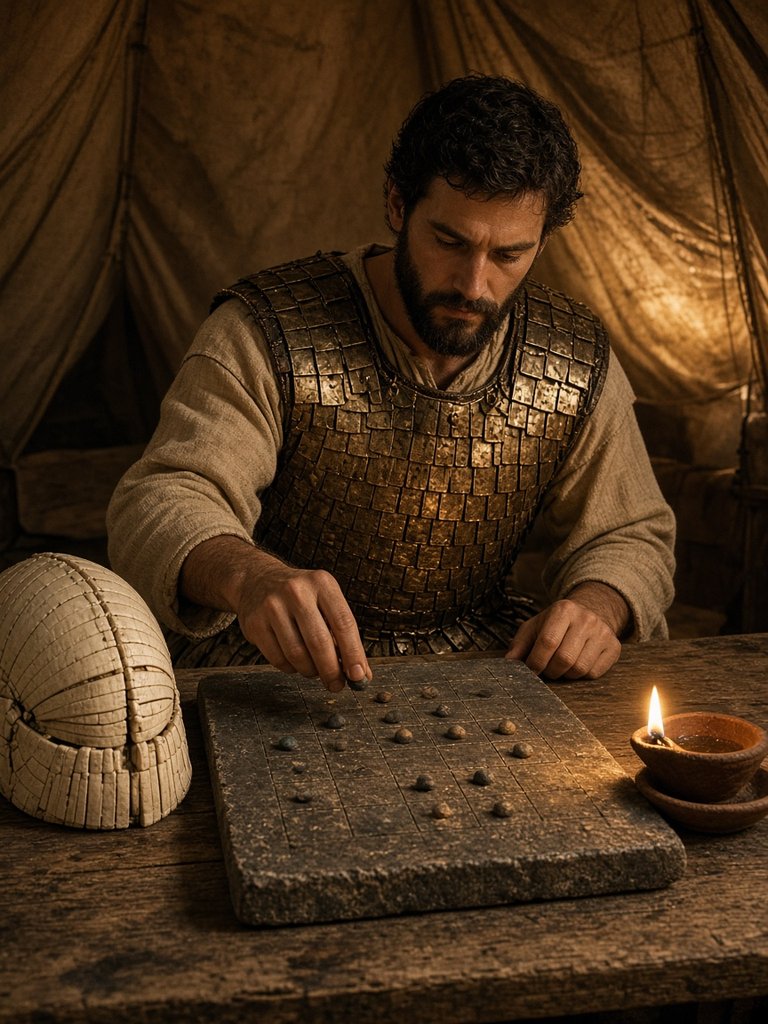
Palamedes, son of Nauplios of Euboea, was the cleverest of the Achaeans at Troy, and the one man who outwitted Odysseus. When Odysseus pretended to be mad to avoid the war, Palamedes put the infant Telemachos in front of his plough, and Odysseus turned aside and revealed his sanity (Apollodorus, Epitome 3.7, paraphrased).
He was credited with inventing letters, numbers, weights and measures, beacons and board games to pass the time in the camp (Gorgias, Defence of Palamedes 30, paraphrased). Pausanias saw at Argos the dice he was said to have dedicated (2.20.3).
Odysseus never forgave him. He buried gold in Palamedes’ tent and forged a letter from Priam, and the Achaeans stoned Palamedes as a traitor (Apollodorus, Epitome 3.8, paraphrased). In the epic Cypria Odysseus and Diomedes drowned him while he was fishing. His father Nauplios took revenge by lighting false beacons that wrecked the returning Greeks on Euboea (Apollodorus, Epitome 6.7–11). Homer does not mention him; Euripides wrote a lost Palamedes.
Epithets
- Παλαμήδης · Palamēdēs
- from palamē, skill of hand
Symbols and virtues
Invention and cleverness destroyed by envy. Symbols: the game board, the letters, the plough.
Myths
- Unmasking Odysseus. Apollodorus, Epitome 3.7.
- The inventions. Gorgias, Defence of Palamedes 30.
- The forged letter. Apollodorus, Epitome 3.8.
- The revenge of Nauplios. Apollodorus, Epitome 6.7–11.
Sources
Cypria (summary by Proclus); Gorgias, Defence of Palamedes; Plato, Apology 41b; Apollodorus, Epitome 3.7–8, 6.7–11; Pausanias 2.20.3, 10.31.1–2.
Quotations in public-domain translations (Evelyn-White 1914, Butler 1898/1900, Taylor 1792); other authors paraphrased.