Magna Graecia, Greater Greece
From about 770 BC, Greek cities sent out colonists across the sea to southern Italy and Sicily. Euboeans settled first at Pithekoussai and Kyme on the Bay of Naples; Corinth founded Syracuse in 733 BC; Achaeans built Sybaris and Kroton; and Sparta founded its only colony, Taras, in 706 BC. Within two centuries the coasts were ringed with Greek cities, so rich and so many that the Romans called the region Magna Graecia, Greater Greece.
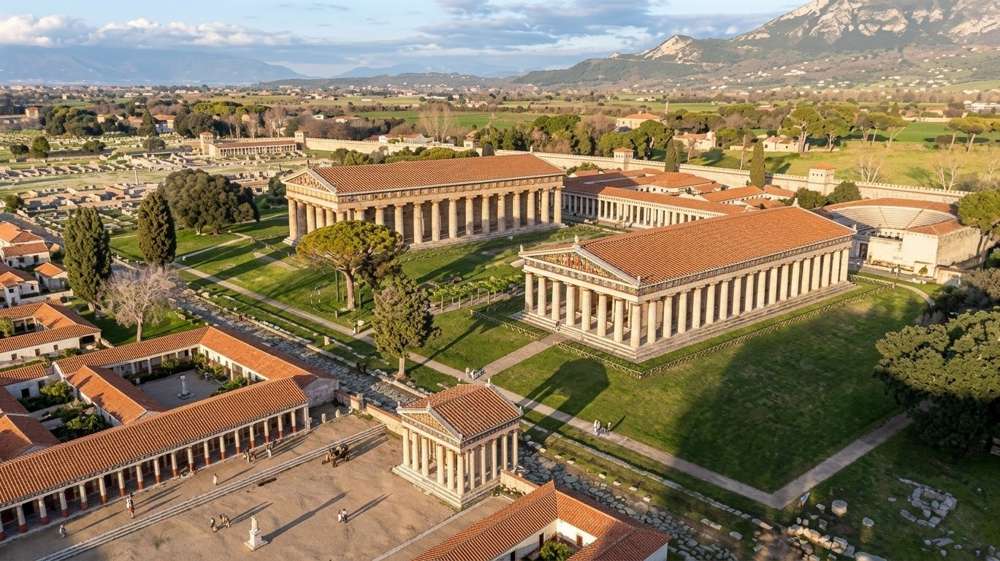
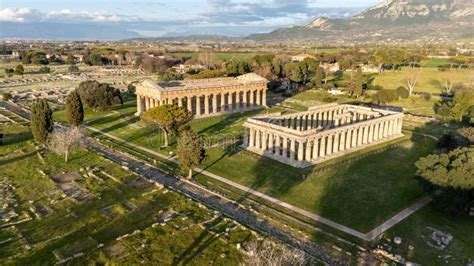
These cities carried the gods with them. Some of the finest Greek temples that still stand are not in Greece but here: at Poseidonia (Paestum), Akragas (Agrigento), Selinous and Segesta. Pythagoras taught at Kroton, Parmenides at Elea, and Archimedes worked at Syracuse. Through Magna Graecia the worship, art and learning of Hellas passed to Rome, which is why Italy stands beside Greece in this revival.
The temples of Paestum
The Last Hellenes of Mani
In the late ninth century, more than five hundred years after Constantine gave the Church the favour of the throne, there were still Hellenes in Laconia who worshipped the gods of their fathers. They lived in Mani, the rough middle finger of the Peloponnese, south of Sparta, where the Taygetos runs down into the sea at Cape Tainaron. I was raised in Athens and Sparta. These were the last of my own people to keep the old faith in the open, and their story is worth telling plainly.
What the emperor wrote
Our witness is an emperor. Constantine VII Porphyrogennetos, writing about 950 for his son, describes the people of Maina. They are not Slavs, he says, but descendants of the older inhabitants of the land, and the people around them still call them Hellenes, because in former times they worshipped images after the fashion of the ancient Hellenes. They were baptized, he adds, in the reign of his grandfather Basil I, who ruled from 867 to 886 (De Administrando Imperio 50).
That one sentence says a great deal. By the ninth century the word Hellēn no longer meant a Greek. It meant a pagan. The Greeks of the empire called themselves Rhōmaioi, Romans. The Maniots were called Hellenes because they had kept what the rest had given up. Their name and their worship had survived together.
The gods of Mani
They had a great deal to keep. When Pausanias walked this coast in the second century, he found it full of the gods. At Tainaron stood the sanctuary of Poseidon, with the cave the Greeks took for a gate to Hades (3.25.4). At Kainepolis there was a temple of Demeter and, by the sea, one of Aphrodite (3.25.9). At Oitylos Apollo Karneios had his sanctuary, the god of the great Spartan festival (3.25.10). At Thalamai there was an oracle of Ino, where those who sought counsel slept in the shrine and were answered in dreams, and the open court held bronze figures of Pasiphae and of Helios (3.26.1). This was not a backwater without a religion. It was a sacred landscape, as old as Sparta.
How long it lasted
The empire had outlawed the old worship long before. Theodosius forbade sacrifice and closed the temples in 391 and 392. Justinian went further. His law ordered those who had not been baptized to come to the churches with their households and be instructed; those who refused lost their property and were sent into exile, and a baptized man found sacrificing in secret could be put to death (Codex Justinianus 1.11.10). Laws are not the same as their enforcement, and in the mountains of Mani enforcement came late. The coast had churches early. The interior, as far as the ruins show, did not.
The conversion that Constantine records under Basil was not the end of it. A century later the monk Nikon, called the Metanoeite for his one sermon, “Repent,” was still preaching through Laconia in the last decades of the tenth century. Some historians hold that the old worship lingered in Mani until about the year 1000. Whatever the exact date, the gods were honoured in Laconia for some six hundred years after Constantine.
Why they gave way
We do not have the Maniots’ own account. No Hellene of Mani wrote down why his people took baptism, or what they thought of it. We have only the record of the empire that baptized them, which counted their conversion a victory. That silence should make us careful.
There were reasons beyond preaching. Through the ninth century the Arab emirate of Crete sent raiders across the Aegean and around the Peloponnese, and the coasts of Mani lay open to them. A small people on a hard shore had good reason to want the protection of the imperial fleet, and the price of that protection was the emperor’s faith. Conversion under such pressure is not the same as conversion of the heart.
What Mani shows
The usual story says the old religion faded quietly, a tired faith giving way to a living one. Mani does not fit that story. Here the gods were worshipped openly for centuries after the law forbade it, by a people who kept the name Hellene when the rest of the Greeks had dropped it. They yielded to an empire, not to an argument.
An emperor’s baptism did not baptize his subjects. In Mani it took five centuries of law, and in the end a fleet. Whoever tells the end of the gods as a change of heart has to leave Mani out. In Mani the old faith lasted longer than anywhere else in Greece, among the mountains of Laconia, and that is why Hemera is dedicated to them.
Sources. Constantine VII Porphyrogennetos, De Administrando Imperio 50, ed. Gy. Moravcsik, tr. R. J. H. Jenkins (Dumbarton Oaks, 1967). Codex Justinianus 1.11.10. Codex Theodosianus 16.10.10–12. Pausanias, Description of Greece 3.25.4, 3.25.9, 3.25.10, 3.26.1. The Life of Saint Nikon, ed. and tr. Denis F. Sullivan (Hellenic College Press, 1987). By P.G.