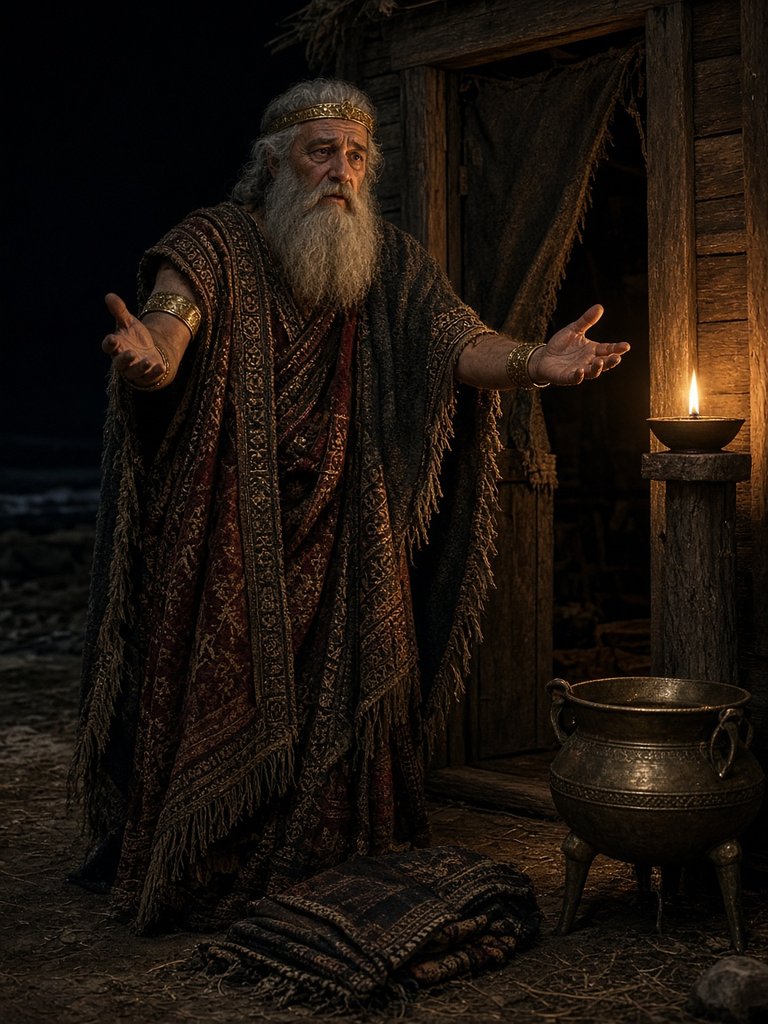
Priam, son of Laomedon, is the old king of Troy, father of Hektor, Paris, Kassandra and fifty sons in all (Iliad 24.493–497, paraphrased), and husband of Hekabe. He is kind to Helen, calling her to sit beside him on the wall and name the Achaean leaders (Iliad 3.161–244).
After the death of Hektor he goes by night to the hut of Achilles with a wagon of ransom, guided by Hermes. Kneeling, he says: “Think on your own father and have compassion upon me, who am the more pitiable, for I have steeled myself as no man yet has ever steeled himself before me, and have raised to my lips the hand of him who slew my son” (Iliad 24.503–506, tr. Butler). The two weep together, and Achilles gives back the body.
At the sack of Troy he was killed by Neoptolemos, son of Achilles, at the altar of Zeus Herkeios in his own courtyard (Euripides, Trojan Women 16–17; Virgil, Aeneid 2.506–558, paraphrased).
Epithets
- Δαρδανίδης · Dardanidēs
- descendant of Dardanos
- ἐϋμμελίης · eummeliēs
- of the good ash spear
Symbols and virtues
A father’s grief and courage; kingship that ends in ruin. Symbols: the ransom, the sceptre, the altar of Zeus Herkeios.
Myths
- On the walls with Helen. Iliad 3.161–244.
- The ransom of Hektor. Iliad 24.
- Death at the altar. Euripides, Trojan Women 16–17; Virgil, Aeneid 2.506–558.
In the poets
“Think on your own father and have compassion upon me, who am the more pitiable, for I have steeled myself as no man yet has ever steeled himself before me, and have raised to my lips the hand of him who slew my son.”Homer, Iliad 24.503–506, tr. Samuel Butler (1898), public domain.
Sources
Homer, Iliad 3.146–244, 22.25–91, 24; Euripides, Trojan Women; Virgil, Aeneid 2.506–558.
Quotations in public-domain translations (Evelyn-White 1914, Butler 1898/1900, Taylor 1792); other authors paraphrased.