Aretē and the ascent to Beauty
The Greek symposium was a gathering of the mind as much as of the cup: poetry, music, art and philosophy were its true courses, and wine only their companion, poured in honour of Dionysos. Plato set his greatest teaching on love at one, and the temple's study circles still meet as the Greeks did, for conversation, art and argument.
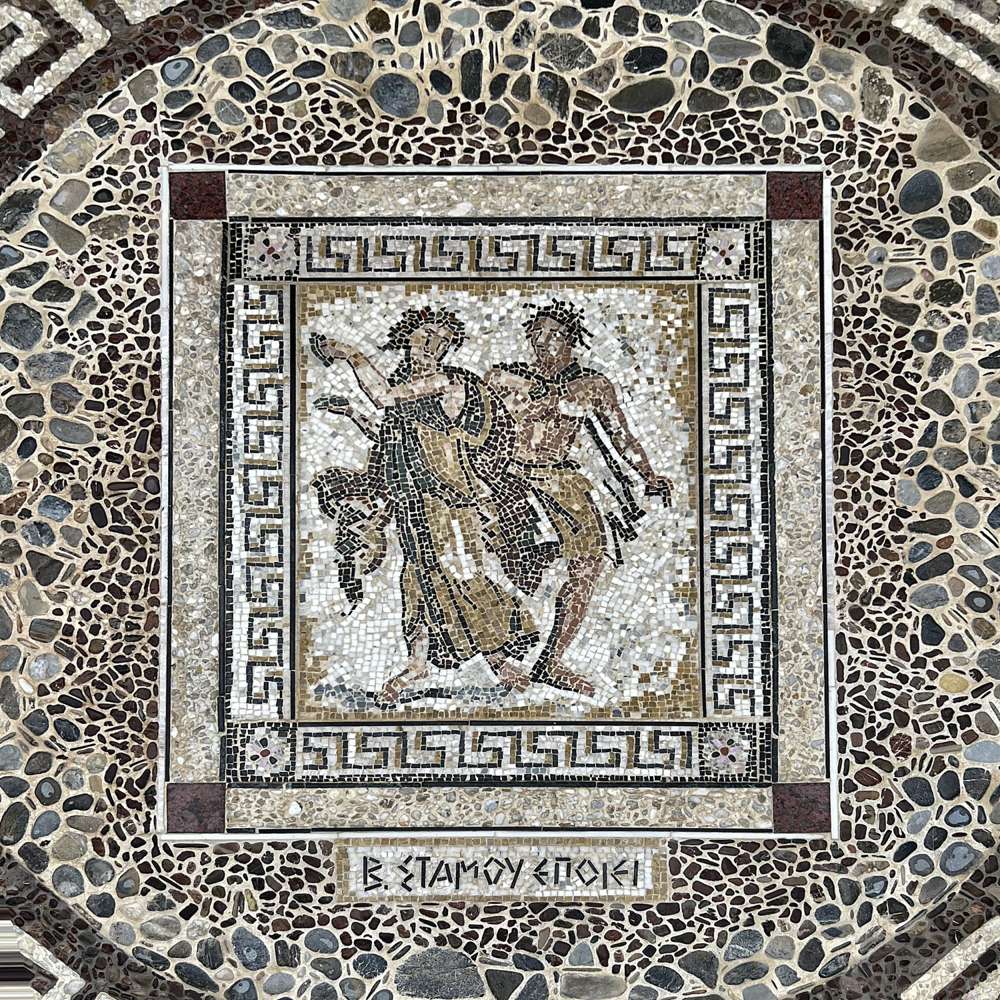
Read Plato's Symposium in English (full text, Jowett, Project Gutenberg) → Read Plato's Symposium in Ancient Greek (full text, Wikisource) →
The symposium as institution and rite
The symposion, "drinking together," followed the meal. The tables were cleared, the floor swept, hands washed, and the guests crowned with garlands of myrtle, ivy or roses and anointed with perfume. It took place in the andrōn, the men's room of the house, a square chamber with a raised border on which stood the couches, klinai, usually seven, eleven or fifteen of them, their number fixed by the walls, with the door set off-centre to fit them. Each guest reclined on his left elbow, a cup in his right hand, two to a couch, in a ring where every man could see and hear every other. The circle was the form of the gathering: equals facing each other, with no head of the table.
The party was governed by a symposiarch, "ruler of the drinking," often chosen by a throw of the dice. He decided the strength of the mixture, the number of cups and the entertainment, and Plato makes the sober symposiarch the image of the lawgiver who keeps a gathering in order (Plato, Laws 640c–641a; Plutarch, Table Talk 1.4). Wine was never drunk neat: to drink unmixed was the habit of Scythians, and the Spartans said Kleomenes went mad from it (Herodotus 6.84). It was mixed with water in the krater, the great mixing bowl at the centre of the room, commonly three or two parts water to one of wine (Athenaeus 10.426b–427a), cooled in the psykter, a mushroom-shaped vessel floated in snow or cold water, ladled out and drunk from the kylix, the wide shallow cup whose painted interior was revealed as the wine went down. Much of the finest Attic painting was made for these cups and bowls, and their scenes are of the symposium itself: drinkers, musicians, dancers, satyrs and Dionysos. For typology, photographs and measured drawings of the vessels, see Symposium Wine Vessels in the Treasury.
The rite began with libation. A little unmixed wine was poured and tasted in honour of the Good Daimon; then the first krater was offered to Zeus Olympios and the Olympians, the second to the heroes, the third to Zeus Sōtēr, Zeus the Saviour, whose "third cup" became a proverb for the thing that completes and saves (Plato, Philebus 66d; Aeschylus, Suppliants 26–27). The guests sang the paean to Apollo, and only then did the drinking begin (Plato, Symposium 176a). Dionysos himself sets the measure in the comic poet Eubulus: "Three kraters only do I mix for the wise: one for health, which they drink first; the second for love and pleasure; the third for sleep, and when it is drunk the wise guests go home. The fourth is no longer ours but belongs to insolence; the fifth to shouting; the sixth to revel; the seventh to black eyes; the eighth to the summons; the ninth to bile; the tenth to madness and the throwing of furniture" (Eubulus fr. 93 K-A, in Athenaeus 2.36b–c).
Then came song and play. The skolia, "zigzag songs," passed around the couches with a branch of myrtle, each guest taking up the song in turn; the most famous honoured Harmodios and Aristogeiton, who "made Athens a city of equal law" (Athenaeus 15.695a–b). The elegies of Theognis, addressed to his young friend Kyrnos, were made for this room, and they teach the measure of wine: drink while you remain master of your tongue, and go home before the wine masters you (Theognis 467–510, 873–884). In kottabos a drinker flicked the last drops from his kylix at a target, a small disc balanced on a stand or saucers floating in a basin, and named his beloved as he threw. Women entered as musicians and companions: the aulētris, the girl who played the double pipe, and the hetairai, the educated courtesans whose wit was famous. The citizen wife did not attend.
The poet Xenophanes wrote down what a proper symposium should be, and the temple takes his poem as its rule. The floor is clean, hands and cups are washed; garlands and perfume are brought, the krater stands full of good cheer, water cool and sweet, golden loaves and honey, and in the centre the altar is covered with flowers. "First, men of good sense should hymn the god with holy words and pure speech, pour libation and pray for the power to do what is right." Then drink as much as lets a man reach home without a servant to lead him, unless he is very old, and praise the one who, having drunk, brings noble things to light from memory and striving for excellence: not battles of Titans, Giants and Centaurs, the fictions of the ancients, nor violent factions, in which there is no use; but always to hold the gods in honour (Xenophanes fr. 1 DK, in Athenaeus 11.462c–f). The symposium is a rite: begun with libation and hymn, kept in measure, and offered to the god of wine. The wider ritual frame of libation and hymn is set out under Ritual.
Aretē, the purpose of the gathering
The symposium existed to make men better. Xenophanes sets the rule for the well-ordered feast: after the libations and the prayer to the god, praise the guest who, having drunk, brings noble things to light, "as memory and striving for aretē" lead him, and not tales of Titans and Giants (Xenophanes fr. B1.19–23). Theognis's elegies to Kyrnos, sung at the drinking-table, are lessons in excellence: keep company with the good and learn good from them, for the bad will corrupt the mind you have (Theognis 31–36). Plato's Athenian Stranger defends the rightly governed symposium as a school of character, where self-command is tested and trained before the eyes of friends (Laws 641a–d). And Plato's own Symposium ends its ascent in aretē: the one who beholds Beauty itself will beget "not images of aretē but true aretē," and become dear to the gods (Symposium 212a). Wine served the same end. The symposiarch set the mixture of water to wine in the krater and the number of cups, and the wine was poured out watered and in measured doses that kept the company relaxed but never drunk, so the cup loosened the tongue without loosening the mind; unmixed wine was the mark of barbarians (Plato, Laws 637e). Eubulus has Dionysos allow the sensible only three kraters, for health, for love and pleasure, and for sleep (Eubulus fr. 93 K-A). There were riotous, erotic and drunken symposia too, ending in the kōmos, the reeling procession through the streets; but that was the symposium undone, not its design. Art, poetry, music and philosophy were the means; aretē was the end. The temple's study circles keep that aim: see the Path of Aretē.
Plato's Symposium: the setting
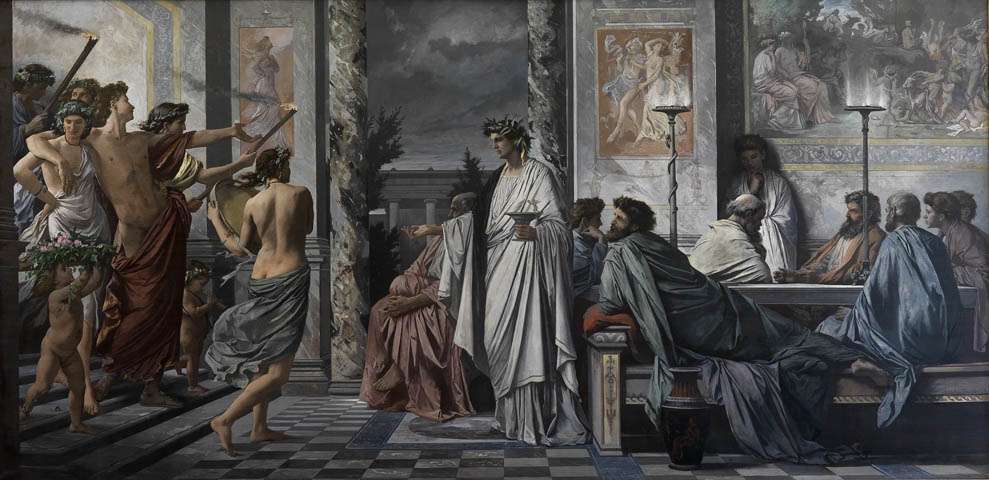
Plato's Symposium is a story told at third hand, as the Mysteries were told by those who had heard them. Apollodorus, a devoted follower of Socrates, tells an unnamed friend what he learned from Aristodemus, who was there (172a–174a). The party was held at the house of the tragic poet Agathon the day after his first victory, in 416 BC, when he had already given the victory sacrifice (173a, 174a). Socrates, washed and wearing sandals for once, brought Aristodemus uninvited and then fell behind on the road, standing lost in thought in a neighbour's porch until the meal was half over (174a–175d). Because the guests were still suffering from the previous night's drinking, they agreed to drink only as each wished, the physician Eryximachus sent away the pipe-girl to play to the women of the house, and they resolved to spend the evening in speeches (176a–e). Phaedrus had complained that poets had hymned every god but Eros, so each guest in turn, moving from left to right around the couches, would deliver an encomium of Love (177a–e).
The speeches in praise of Eros
Phaedrus (178a–180b). Eros is the eldest of the gods, on the witness of Hesiod and Parmenides (the genealogy is set out under The First Powers), and the greatest giver of goods: a lover would rather die than be seen to act shamefully before his beloved, so that an army of lovers would be invincible. Love alone makes people willing to die for another: Alcestis, who died for her husband and was sent back by the gods; Achilles, who avenged Patroklos knowing he must die, and was sent to the Isles of the Blessed. Orpheus, who went down to Hades alive rather than die for Eurydice, was shown only a phantom.
Pausanias (180c–185c). There are two Aphrodites, so there are two Loves. Aphrodite Ourania, the Heavenly, is the elder, daughter of Ouranos with no mother; Aphrodite Pandemos, the Common, is the younger, daughter of Zeus and Dione. The common Eros loves bodies more than souls and takes what it can; the heavenly Eros loves the mind and character and seeks a lasting bond whose aim is virtue. Pausanias reads the laws of Athens as honouring love that is offered for the sake of excellence. The two goddesses are treated on Aphrodite.
Eryximachus (185e–188e). Aristophanes has the hiccups, so the doctor speaks out of turn and prescribes holding the breath, gargling and sneezing (185c–e). He widens the two Loves to the whole cosmos: in the body, medicine is the art of reconciling opposites, hot and cold, wet and dry; in music, harmony is the agreement of high and low; in the seasons, the right blend brings health and the wrong one plague; and divination and sacrifice are the art of keeping the Love between gods and men in good order (188b–d). Eros is the power of harmony itself.
Aristophanes (189c–193d). The comic poet tells a myth. Humans were once round, with four arms, four legs and two faces, of three kinds: male, born of the Sun; female, born of the Earth; and androgynous, born of the Moon. They were strong and proud and attacked the gods, so Zeus cut them in half like sorb-apples, and Apollo turned their faces and drew the skin together at the navel (190b–191a). Ever since, each half searches for its other, and when they find each other they wish never to be parted; if Hephaistos offered to weld them into one, none would refuse (192d–e). "Love is the name for the desire and pursuit of the whole" (192e–193a). Piety toward the gods is the way to find our own.
Agathon (194e–197e). The host praises the god himself rather than his gifts. Eros is the youngest of the gods, not the oldest, the most delicate, dwelling in the softest of places, the souls of gods and men; the most beautiful, the most just, temperate, brave and wise, a poet who makes others poets, and the maker of all the arts. The speech closes in a cascade of rhyming praise and is cheered by all.
Socrates and Diotima
Eros lacks. Socrates begins by questioning Agathon. Love is always love of something; one desires what one does not have; Love loves beauty; so Love lacks beauty, and since good things are beautiful, he lacks the good as well (199c–201c). Agathon concedes. Socrates then tells what he learned from Diotima of Mantineia, a wise woman who once, by sacrifices, delayed the plague at Athens for ten years (201d).
Eros the daimōn. Lacking beauty does not make Eros ugly, nor does lacking wisdom make him ignorant. He is in between, metaxy: neither mortal nor immortal but a great daimōn, the messenger between gods and men, carrying prayers and sacrifices up and commands and gifts down, binding the whole together; through the daimonic go all divination, the art of priests, sacrifices, initiations and spells, for god does not mingle with man (202d–203a). The temple reads this as the theology of its own rites (see Ritual).
The child of Poros and Penia. On the day Aphrodite was born the gods held a feast, and Poros, Resource, son of Metis, drunk on nectar, fell asleep in the garden of Zeus. Penia, Poverty, came begging, and lay with him to have a child by him. So Eros is Aphrodite's attendant, born on her birthday and lover of beauty; from his mother he is always poor, hard, barefoot and homeless, sleeping in doorways and in the road; from his father he schemes after the beautiful and the good, brave, eager, a hunter and a lover of wisdom all his life (203b–204a). Eros is the philosopher, between wisdom and ignorance (204a–b).
Begetting in beauty. Love is the desire for the good to be one's own forever (206a), and its work is "giving birth in beauty, in body and in soul" (206b). Mortal nature seeks immortality the only way it can, by generation: some through children; others, pregnant in soul, through poems, laws and the education of the young, as Homer and Hesiod, Lycurgus and Solon left offspring more lasting than any child (208e–209e).
The lesser and the final mysteries. Here Diotima speaks as a Hierophant. "Into these matters of love, Socrates, even you might be initiated; but whether you could be initiated into the final and highest mysteries, ta telea kai epoptika, for which these are the preparation, I do not know" (209e–210a). The word is the word of Eleusis: the epopteia was the final vision granted to the initiates of the second year (The Mysteries of Eleusis). The ascent follows. The lover, rightly led, first loves one beautiful body and begets beautiful words there; then sees that the beauty of all bodies is one and loves them all; then holds beauty of soul more precious than beauty of body; then sees beauty in practices and laws; then in the branches of knowledge, until, turned toward "the great sea of beauty," he gives birth to many glorious words and thoughts in unstinting love of wisdom (210a–d). And then, at the end, "suddenly," exaiphnēs, he will catch sight of a beauty wonderful in its nature: one that always is, neither coming to be nor passing away, neither waxing nor waning; not beautiful in one respect and ugly in another, nor at one time and not at another; not appearing as a face or hands or any bodily thing, nor as a word or a knowledge, nor in anything else, but itself by itself with itself, single in form and eternal, in which all other beautiful things share (210e–211b). "There, if anywhere, life is worth living for a human being, in the contemplation of Beauty itself" (211d). Whoever sees it begets not images of virtue but true virtue, becomes dear to the gods, and if any human being is immortal, it is he (212a). The ladder of love is the path of the temple's teaching on beauty; its place in the wider doctrine of the One is set out in The One and the Many.
Alcibiades and the dawn
There is knocking at the door, the sound of a pipe-girl and revellers, and Alcibiades enters, very drunk, crowned with ivy and violets and ribbons, to crown Agathon (212c–e). Finding Socrates beside the host, he takes back some ribbons to crown Socrates too, and is made symposiarch; he orders a wine-cooler filled and drains it, and Socrates drains it after him without effect (213e–214a). He will not praise Eros but Socrates, and he will speak the truth.
Socrates, he says, is like the Silenus figures in the statuaries' shops, made with pipes or flutes in their hands, which open down the middle to show images of the gods inside (215a–b). He is like the satyr Marsyas, but he enchants with bare words, without instruments, and when Alcibiades hears him his heart leaps and he weeps (215b–e). Outside he is ugly and plays at ignorance; within he is full of temperance and gold. Alcibiades tells how he tried to win Socrates with his beauty and spent a night under his cloak, and rose "as if I had slept with my father or an elder brother" (217a–219d). He tells of Socrates' endurance on campaign at Potidaea, barefoot on the ice, and of the day and night he stood in thought until sunrise, then prayed to the sun and went away (219e–220d); of his courage in saving Alcibiades' life, and in the retreat from Delium (220d–221c). He is like no other man, and his words, opened up, are the only ones with sense inside them, full of images of virtue (221c–222a).
A second band of revellers bursts in and disorder takes the room. Many leave or fall asleep. When Aristodemus wakes at cockcrow, only Agathon, Aristophanes and Socrates are awake, drinking from a great bowl passed to the right, and Socrates is compelling them to agree that the same man should know how to write comedy and tragedy. Aristophanes falls asleep, then Agathon as day breaks; Socrates rises, goes to the Lyceum, washes, spends the day as usual, and goes home to rest in the evening (223b–d). The night of wine ends in clear sight: the philosopher alone has drunk all night and remains master of himself, the image of the soul that has climbed the ladder.
Xenophon's Symposium
Xenophon wrote his own Symposium, set in 422 BC at the house of the rich Kallias in Piraeus, after the boy Autolykos won the pankration at the Great Panathenaia (Xenophon, Symposium 1.2). It is lighter and closer to life. A Syracusan impresario brings a pipe-girl, a dancing-girl who tumbles among swords and a handsome boy who plays the lyre and dances (2.1–2.11). Each guest says what he is proudest of, and Socrates claims to be proudest of being a matchmaker (3.10, 4.56–64); he holds a mock beauty contest with Kritoboulos over whose face is finer (5.1–10). In the eighth chapter he speaks, like Pausanias in Plato, of the two Aphrodites and praises the love of soul over the love of body (8.9–43). The evening ends with a mime of Dionysos and Ariadne, after which the married guests ride home to their wives (9.2–7). It is the symposium in its everyday form: wit, music and friendship, with philosophy in the middle.
Read Xenophon's Symposium in English (full text, Dakyns, Project Gutenberg) → Read Xenophon's Symposium in Ancient Greek (full text, Wikisource) →
Plutarch and Athenaeus
Plutarch of Chaironeia, priest of Apollo at Delphi, gathered the conversations of a lifetime of dinners into the Table Talk, Quaestiones Convivales, nine books dedicated to his friend Sosius Senecio. The first question is whether philosophy belongs at the wine at all, and Plutarch answers that it does, so long as it fits the company and the hour (1.1). Others follow on everything a symposium might ask: whether the host should seat his guests or let them choose (1.2), why the alpha stands first in the alphabet (9.2), which came first, the hen or the egg (2.3), why Plato said that god always geometrizes (8.2), and why the Jews abstain from pork (4.5). In the Dinner of the Seven Sages Plutarch imagines Periander, tyrant of Corinth, hosting Thales, Bias, Solon, Chilon, Pittacus and Kleoboulos, with Anacharsis the Scythian and Aesop, in a banquet of riddles, sayings and stories, among them the tale of Arion saved by the dolphin (Moralia 146b–164d).
Around AD 200 Athenaeus of Naukratis wrote the Deipnosophistae, "The Sophists at Dinner," fifteen books of conversation at the table of the Roman patron Larensius. Its guests discuss every food, wine, cup, perfume, song and entertainment of the Greek table and quote some eight hundred authors to do it. Much of what we know of the symposium survives only because Athenaeus quoted it: the poem of Xenophanes, the kraters of Eubulus and the Attic skolia above all come down to us through his pages.
The legacy and the temple's circles
The symposium returned with Plato. In Florence Marsilio Ficino, who translated the whole of Plato into Latin for Cosimo de' Medici, wrote his commentary on the Symposium, De Amore, in 1469. He framed it as a banquet held at the Medici villa of Careggi on 7 November, the day of Plato's birth and death, revived after twelve hundred years: nine guests, each taking a speech of Plato's dialogue to expound (Ficino, De Amore, prologue). From this book the Renaissance learned the phrase "Platonic love" and the doctrine of love as the soul's ascent to divine beauty, which passed into the poetry of Michelangelo and the painting of Botticelli. Shelley translated the dialogue in 1818, and every age since has gone back to Agathon's table.
The temple keeps the symposium as its form of study. Its circles meet in homes, around a table of wine and food, as equals in a ring. They pour the three libations, to Zeus Olympios and the Olympians, to the heroes, and to Zeus Sōtēr, and sing a hymn before drinking. A symposiarch sets the mixture and the theme; each member speaks in turn on it, as Agathon's guests spoke on Eros; and the measure of Xenophanes and Eubulus is kept, so that each goes home on his own feet. The aim is Diotima's: to beget beautiful words and true virtue in the company of friends, and to climb together toward Beauty itself. Membership opens the circles to every member.
Holding a symposium today
Worshippers of any ancestry may keep the symposium as the ancient Greeks kept it: as a rite with a fixed order, opened and closed with the gods. What follows is the Temple's order for a gathering at home or in a study circle, with the words to be spoken. Where a formula is attested in an ancient text, its source is given; where the Temple has composed a prayer on the ancient pattern, it is marked as the Temple's own. Wine is always mixed with water and taken in moderate measure. Worshippers who abstain pour and drink grape juice or water; the libation is equally valid, for the gods receive the act of reverence.
- Clear the meal and purify. When the deipnon is finished, clear the tables, sweep, and wash hands. Bring garlands and perfume, set the krater with water and wine, and light incense on a small altar decked with flowers, as Xenophanes describes (Xenophanes fr. 1 West, DK 21 B1, in Athenaeus 11.462c–f).
- The unmixed taste for the Good Daimon. Pour a few drops of unmixed wine (or juice), taste a little, and pour the rest. Theophrastus and Philochorus record the custom: after the food, a taste of unmixed wine as "a sample of the power of the good god," and thereafter only mixed wine (Athenaeus 15.693c–e). The formula appears in comedy: λαβὲ δὴ καὶ σπεῖσον ἀγαθοῦ δαίμονος, "take it, then, and pour for the Good Daimon" (Aristophanes, Knights 106; cf. 85, Wasps 525).
Recited (attested formula)
Ἀγαθοῦ Δαίμονος.
Agathoû Daímonos.
"[This is] for the Good Daimon." - The three libations. The first krater is mixed for Zeus Olympios and the Olympians, the second for the heroes, the third for Zeus Sōtēr. The order is preserved in the ancient scholia on Pindar, and Pindar himself prays for "a third [krater] to pour for the Saviour, Olympian [Zeus]": εἴη δὲ τρίτον σωτῆρι πορσαίνοντας Ὀλυμπίῳ … σπένδειν (Isthmian 6.1–9). Guests at Athenaeus's banquet call for "the cup of the Good Daimon" and "of Zeus Sōtēr" (Athenaeus 15.692f–693c), and "the third for the Saviour" became a proverb (Plato, Philebus 66d; Republic 583b).
Recited (the Temple's formulas on the ancient pattern)
Διὶ Ὀλυμπίῳ καὶ θεοῖς Ὀλυμπίοις.
Dií Olympíōi kaì theoîs Olympíois.
"To Zeus Olympios and the Olympian gods."Ἥρωσιν.
Hḗrōsin.
"To the heroes."Τὸ τρίτον τῷ Σωτῆρι· Διὶ Σωτῆρι.
Tò tríton tôi Sōtêri; Dií Sōtêri.
"The third to the Saviour: to Zeus Sōtēr." (The first phrase is the attested proverb, Philebus 66d.) - The paean. After the libations the company sings to the god together; only then does the drinking begin (Plato, Symposium 176a; Xenophon, Symposium 2.1: "they poured libations and sang the paean").
Recited (attested cry, Aristophanes, Wasps 869–874)
ὦ Φοῖβ᾽ Ἄπολλον … ἰήιε Παιάν.
Ô Phoîb' Ápollon … iḗie Paián.
"O Phoibos Apollo … hail, Paian!" - Invoke Dionysos. The wine is his gift; greet him with the close of the Homeric Hymn to Dionysos.
Recited (Homeric Hymn 26.11–13; English after H. G. Evelyn-White)
Καὶ σὺ μὲν οὕτω χαῖρε, πολυστάφυλ᾽ ὦ Διόνυσε·
δὸς δ᾽ ἡμᾶς χαίροντας ἐς ὥρας αὖτις ἱκέσθαι,
ἐκ δ᾽ αὖθ᾽ ὡράων εἰς τοὺς πολλοὺς ἐνιαυτούς.
Kaì sù mèn hoútō chaîre, polystáphyl' ô Diónyse; dòs d' hēmâs chaírontas es hṓras aûtis hikésthai, ek d' aûth' hōráōn eis toùs polloùs eniautoús.
"And so hail to you, Dionysos, god of abundant clusters! Grant that we may come again rejoicing to this season, and from that season onwards for many a year." Homeric Hymns in English (full text, Project Gutenberg) → - Choose the symposiarch and set the mixture. One person is chosen, by lot or consent, to rule the drinking; Alcibiades "elects himself ruler of the drinking" (Plato, Symposium 213e), and Plutarch asks what such a ruler should be (Table Talk 1.4). The symposiarch announces the proportion of water to wine and the number of cups, and may allow each to drink as they wish, as Eryximachus proposes (Plato, Symposium 176e).
- The skolia and the myrtle. Pass a sprig of myrtle around the circle; whoever holds it sings or recites a short poem, then passes it on. Plutarch describes the custom: first all sang to the god together, then "the myrtle was handed to each in turn" (Table Talk 1.1.5, 615b–c); Athenaeus preserves the Attic skolia themselves (15.693f–696a).
- The topic. The symposiarch sets a theme for discourse, as Phaedrus's complaint set the praise of Eros (Plato, Symposium 177a–e). Speak in turn, left to right.
- The last libation, to Hermes. Before parting, pour to Hermes, guide of travellers and of sleep, as the Phaeacians did: σπένδοντας δεπάεσσιν ἐϋσκόπῳ Ἀργεϊφόντῃ, ᾧ πυμάτῳ σπένδεσκον, ὅτε μνησαίατο κοίτου, "pouring from their cups to the keen-sighted Slayer of Argos, to whom they poured last, when they turned their minds to bed" (Odyssey 7.136–138). Odyssey in English (full text, Butler, Project Gutenberg) →
Recited (the Temple's prayer)
Ἑρμῇ. Ἑρμῆ, ἡγεμών, πέμπε ἡμᾶς οἴκαδε σῶς καὶ δὸς ὕπνον ἀγαθόν.
Hermêi. Hermê, hēgemṓn, pémpe hēmâs oíkade sôs kaì dòs húpnon agathón.
"To Hermes. Hermes, guide, send us home safe and grant good sleep."
Xenophanes' rule of the symposium (fr. 1.13–16 West, DK 21 B1; the Temple's close translation)
χρὴ δὲ πρῶτον μὲν θεὸν ὑμνεῖν εὔφρονας ἄνδρας
εὐφήμοις μύθοις καὶ καθαροῖσι λόγοις,
σπείσαντας δὲ καὶ εὐξαμένους τὰ δίκαια δύνασθαι
πρήσσειν.
"First, people of good sense should hymn the god with reverent stories and pure words, and, having poured libation, pray for the power to do what is just." The prayer asks not for wealth or luck but for the strength to act rightly; the Temple makes it the prayer of every symposium.
Θεοί, δότε ἡμῖν τὰ δίκαια δύνασθαι πρήσσειν.
Theoí, dóte hēmîn tà díkaia dúnasthai prḗssein.
"Gods, grant us the power to do what is just." (The Temple's prayer, built on Xenophanes' words.)
The Temple's order of the symposium
1. Tables cleared, hands washed, garlands and perfume, incense on the altar.
2. Unmixed taste: Ἀγαθοῦ Δαίμονος.
3. First krater: Διὶ Ὀλυμπίῳ καὶ θεοῖς Ὀλυμπίοις.
4. Second krater: Ἥρωσιν.
5. Third krater: Τὸ τρίτον τῷ Σωτῆρι.
6. Paean together: ἰήιε Παιάν.
7. Hymn to Dionysos: χαῖρε, πολυστάφυλ᾽ ὦ Διόνυσε.
8. Prayer: Θεοί, δότε ἡμῖν τὰ δίκαια δύνασθαι πρήσσειν.
9. Symposiarch chosen; mixture and number of cups announced.
10. Myrtle passed; songs and poems in turn.
11. The topic set; discourse left to right.
12. Last libation: Ἑρμῇ. Go home on your own feet.
Sources: Plato, Symposium 172a–223d (Stephanus pages), tr. W. R. M. Lamb (Loeb, Perseus); Plato, Laws 640c–641a and Philebus 66d; Xenophon, Symposium, tr. O. J. Todd (Loeb, Perseus); Xenophanes fr. 1 DK; Theognis 467–510, 873–884; Eubulus fr. 93 Kassel–Austin; Aeschylus, Suppliants 26–27; Herodotus 6.84; Athenaeus, Deipnosophistae 2.36b–c, 10.426b–427a, 11.462c–f, 15.695a–b; Plutarch, Table Talk (Moralia 612c–748d) and Dinner of the Seven Sages (Moralia 146b–164d); Marsilio Ficino, Commentarium in Convivium Platonis, De Amore (1469). Image: Anselm Feuerbach, Das Gastmahl des Platon (1869), Staatliche Kunsthalle Karlsruhe, public domain via Wikimedia Commons.