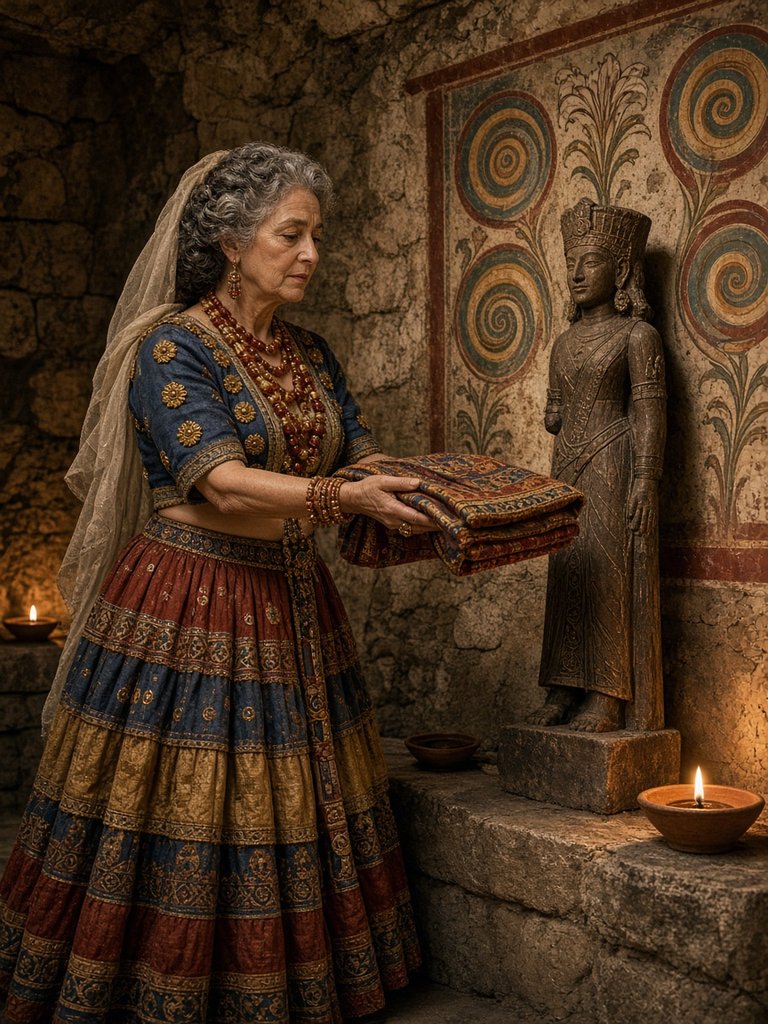
Hekabe (Hecuba), daughter of Dymas of Phrygia (Iliad 16.718–719), is the wife of Priam and mother of Hektor, Paris, Kassandra and many others. When Hektor asks her to lead the Trojan women to the temple of Athena, “Hecuba took out the largest robe, and the one that was most beautifully enriched with embroidery, as an offering to Minerva: it glittered like a star, and lay at the very bottom of the chest” (Iliad 6.293–295, tr. Butler). The goddess refuses the prayer.
From the walls she begs Hektor not to face Achilles, baring the breast that nursed him (Iliad 22.79–89, paraphrased), and she leads the lament over his body (Iliad 24.747–759, paraphrased).
In tragedy she becomes the image of the captive queen. In Euripides’ Hecuba she avenges her murdered son Polydoros on the Thracian king Polymestor, and is foretold to be changed into a dog, her grave named Kynossema, the Dog’s Tomb, on the Hellespont (Euripides, Hecuba 1259–1273, paraphrased); in the Trojan Women she is given as a slave to Odysseus.
Epithets
- Δυμαντίς · Dumantis
- daughter of Dymas
- πότνια μήτηρ · potnia mētēr
- lady mother (Iliad 6.264)
Symbols and virtues
Motherhood and endurance in loss; grief turned to vengeance. Symbols: the embroidered robe offered to Athena.
Myths
- The robe for Athena. Iliad 6.269–311.
- Pleading with Hektor. Iliad 22.79–89.
- Lament for Hektor. Iliad 24.747–759.
- Vengeance on Polymestor. Euripides, Hecuba.
Cult and places
- Kynossema. Her tomb on the Thracian Chersonese (Euripides, Hecuba 1271–1273).
In the poets
“Hecuba took out the largest robe, and the one that was most beautifully enriched with embroidery, as an offering to Minerva: it glittered like a star, and lay at the very bottom of the chest.”Homer, Iliad 6.293–295, tr. Samuel Butler (1898), public domain.
Sources
Homer, Iliad 6.251–311, 16.718–719, 22.79–89, 24.747–759; Euripides, Hecuba; Trojan Women.
Quotations in public-domain translations (Evelyn-White 1914, Butler 1898/1900, Taylor 1792); other authors paraphrased.