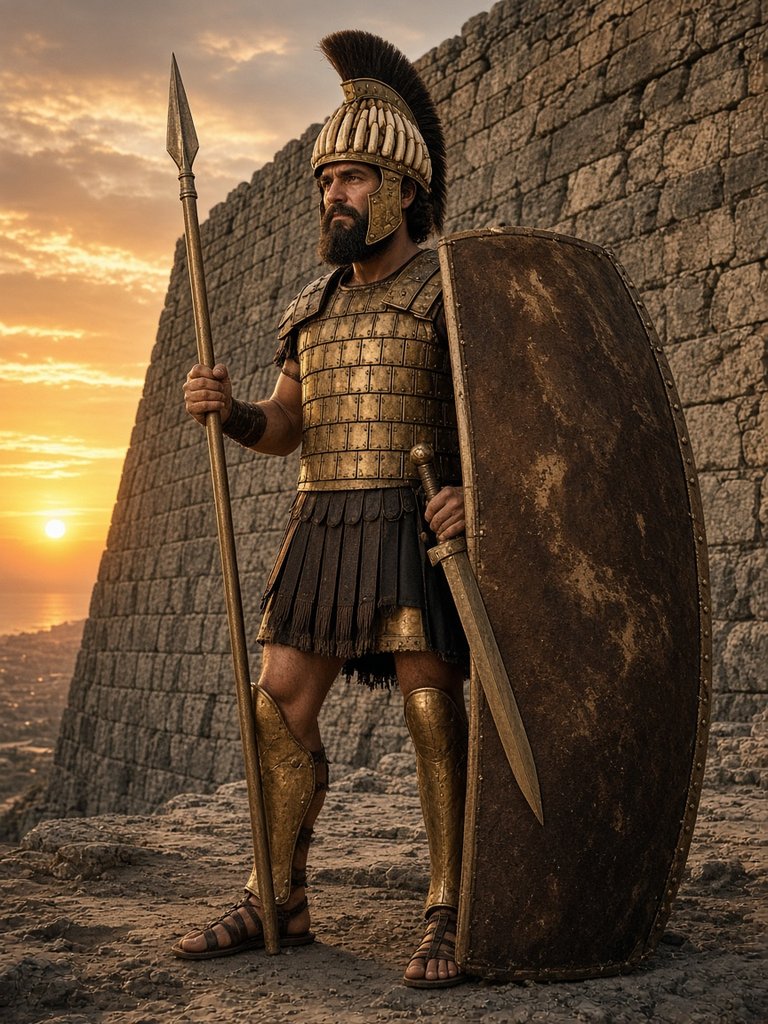
Hektor, eldest son of king Priam and Hekabe, is the chief defender of Troy and the husband of Andromache. When a bird-sign seems to warn against attack he answers: “There is one omen, and one only—that a man should fight for his country” (Iliad 12.243, tr. Butler).
His farewell to Andromache and their baby son Astyanax on the walls is the most tender scene of the Iliad. The child shrinks from the nodding plume of his helmet, his parents laugh, and Hektor takes it off and prays: “grant that this my child may be even as myself, chief among the Trojans; let him be not less excellent in strength, and let him rule Ilius with his might” (Iliad 6.476–478, tr. Butler). He tells her that he knows the day will come when Troy will fall (Iliad 6.447–449).
Hektor killed Patroklos, and Achilles killed him before the Skaian gates and dragged his body behind his chariot; the gods kept it unharmed, and at last Priam came by night to ransom it (Iliad 22, 24). The Iliad ends with his funeral: “Thus, then, did they celebrate the funeral of Hector tamer of horses” (Iliad 24.804, tr. Butler). The Thebans of Boeotia showed his grave by the spring of Oidipous, saying that an oracle had told them to bring his bones from Troy (Pausanias 9.18.5, paraphrased).
Epithets
- κορυθαίολος · koruthaiolos
- of the flashing helmet
- ἱππόδαμος · hippodamos
- tamer of horses (Iliad 24.804)
- ἀνδροφόνος · androphonos
- slayer of men
Symbols and virtues
Duty to city and family, courage that knows it will fail. Symbols: the plumed helmet, the great shield, the walls and Skaian gates of Troy.
Myths
- One omen. Iliad 12.243.
- Farewell to Andromache. Iliad 6.390–502.
- Death of Patroklos. Iliad 16.
- Death at the hands of Achilles. Iliad 22.
- Ransom and funeral. Iliad 24.
Cult and places
- Thebes, Boeotia. His grave by the spring of Oidipous (Pausanias 9.18.5).
In the poets
“Jove,” he cried, “grant that this my child may be even as myself, chief among the Trojans; let him be not less excellent in strength, and let him rule Ilius with his might.”Homer, Iliad 6.476–478, tr. Samuel Butler (1898), public domain.
Sources
Homer, Iliad 6.237–502, 12.230–250, 16, 22, 24; Pausanias 9.18.5.
Quotations in public-domain translations (Evelyn-White 1914, Butler 1898/1900, Taylor 1792); other authors paraphrased.