THE GODS OF OLYMPUS
One page for each god: epithets, myths, sanctuaries, festivals, offerings and a hymn, with the ancient sources.
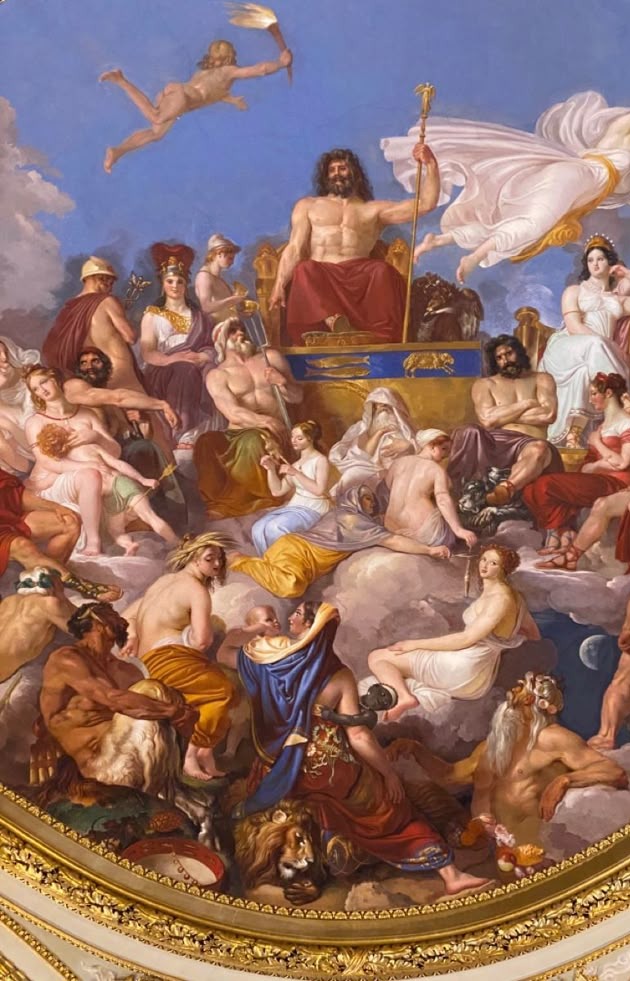
The Index of the Gods: every god with a card, the Olympians first, then A to Z ›
Hestia, goddess of the hearth, is honoured first and last at every rite.
Trace every god's ancestry back to Chaos in Hesiod's Theogony: the family tree of the gods.
Every other god of Hellas, from the Primordials and Titans to the Nereids, the Furies and the gods of The Odyssey (“The Hellenic Bible”), is gathered in one place: The Index of the Gods.
Greek and Roman names
The Temple uses the Greek names. Rome matched its own gods to those of Hellas, most formally in 217 BC, when six pairs of gods were set out on couches for a public feast (Livy 22.10.9). Many Roman gods were originally separate Italic deities with their own cults and characters, not the same gods as their Greek counterparts; only Apollo came to Rome under his Greek name.
“It is a phenomenon for which I know of no analogy, that foreign ideas, both mythical and religious, without any compulsion, solely through the superiority of the foreign civilization … can attach themselves to one’s own divine figures and alter their nature to the point of unrecognizability.”
Ulrich von Wilamowitz-Moellendorff, Der Glaube der Hellenen II, p. 328, on how Greek ideas reshaped the Roman gods (shared on X by @Athanasius_45)
The Ladder of Ascent
At the summit stands the One, and shining from it Nous, the Divine Mind (Plotinus, Enneads V.1). The soul came down from that source, and its goal is to return: Henōsis (ἕνωσις), union with the One.
The ladder is the four virtues, practised with aretē, excellence. The gods are not the ladder; they help the soul up it, a hand at every rung.
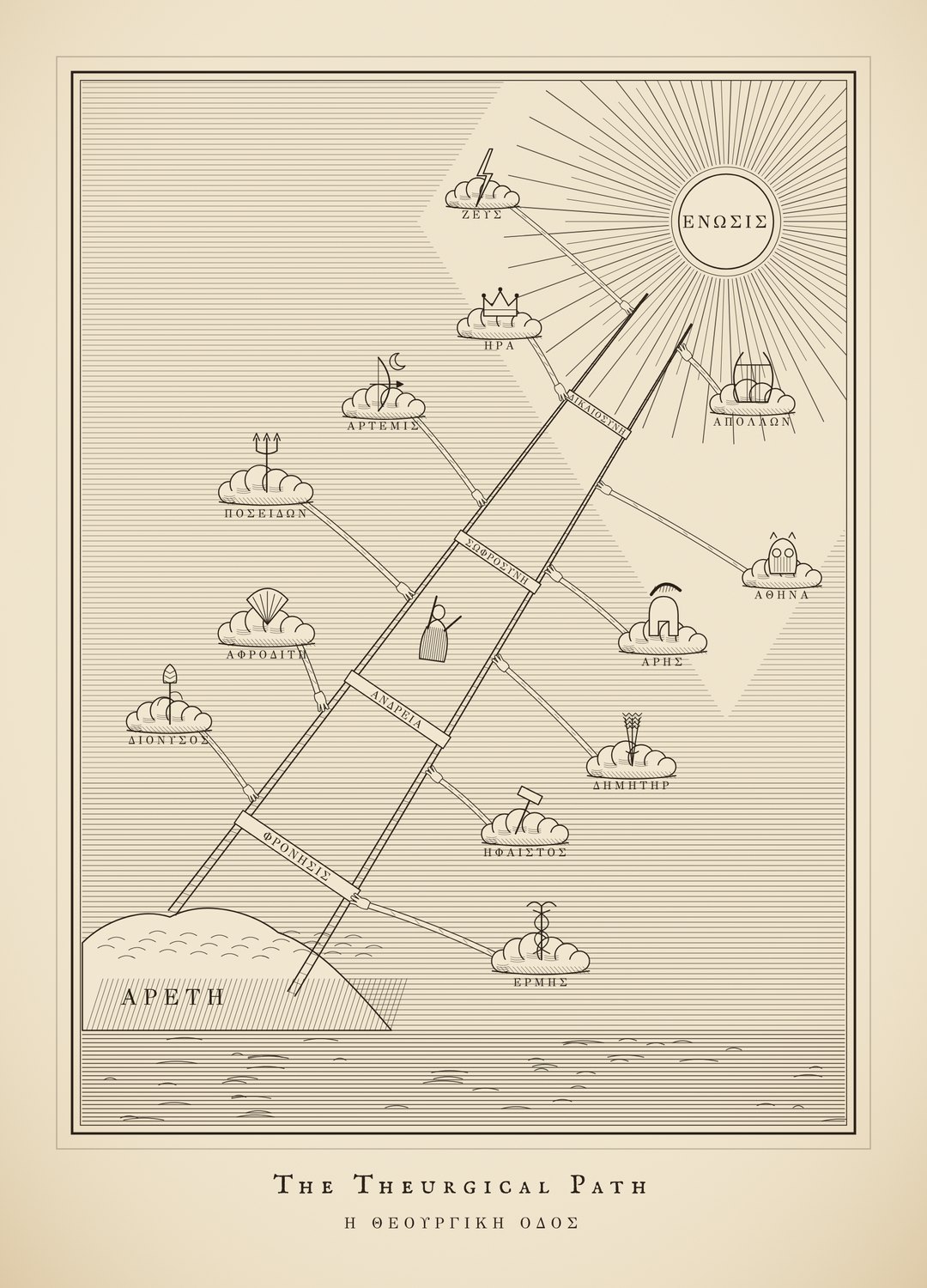
The four rungs
- Φρόνησις, Wisdom. To see what is true and what is fitting, and to choose by it. Athena teaches it; Hermes, guide of souls, takes the climber’s hand at the foot of the ladder.
- Ἀνδρεία, Courage. To hold to the good through fear and pain. Ares and Artemis teach it; Herakles, who climbed from earth to Olympos, is its pattern.
- Σωφροσύνη, Temperance. Measure in all things: the Delphic “Nothing in excess.” Apollo teaches it, and Hestia keeps its order in the home.
- Δικαιοσύνη, Justice. Each part of the soul doing its own work, in harmony (Plato, Republic 443c–e); the kept word and the right dealt to every person. Zeus guards it, with Dike at his side.
The same four virtues are climbed again at every stage. Porphyry names the stages: first the civic virtues, which govern a life among others; then the purifying virtues, which free the soul from the body; then the contemplative, which turn it to Intellect; and the paradigmatic, in Intellect itself (Sentences 32). Iamblichus adds the theurgic virtues above them, where the gods themselves lift the soul.
How the gods help
- They teach. Each god is the model of an excellence. To honour a god is to practise that god’s aretē.
- The rites lift. Prayer, hymn, offering and festival turn the soul toward the gods, who draw it upward. Iamblichus insists the soul does not rise by thought alone but through the sacred rites the gods themselves gave (On the Mysteries 2.11).
- Initiation leads through darkness into light, as at Eleusis (see the Mysteries), and over every road stands the Delphic word ΓΝΩΘΙ ΣΑΥΤΟΝ, Know thyself.
- Contemplation completes the climb. At the top the soul lays everything aside, “take away everything” (ἄφελε πάντα, Enneads V.3.17), and rests in the One.
The schools that built this teaching, from Pythagoras to Damascius, are on the Philosophy page.
Goal and means: keep them distinct
Henōsis is the goal: union with the One. Theurgy (θεουργία, “divine work”) is a means: the rites, symbols and offerings by which the gods raise the soul toward that goal. Aretē is the other means, and the two work together. The Christian analogue keeps the same distinction: Theosis (θέωσις, deification, “partakers of the divine nature”, 2 Peter 1:4) corresponds to Henōsis, the goal; the sacraments correspond to Theurgy, the means. Dionysius the Areopagite, a reader of Proclus, even calls the sacraments theourgiai.
For the full path, step by step, read The Path to Henōsis.
Immortal still
Homer calls the gods ἀθάνατοι, the deathless ones (Iliad, “The Hellenic Bible”, 5.339–342). Their worship was silenced by the laws of Theodosius (391–392), but, as Sallustius teaches, worship is “paid for our own benefit … It is we who gain some communion with them” (On the Gods 15). When the temples closed, we lost the gods; the gods did not lose themselves. The ladder still stands.
The One and the Many Gods
The gods are many, real and distinct, and they are never separate from the First Cause, “just as thoughts are not separate from mind” (Sallustius, On the Gods 3). To honour the many is to honour the One: Plotinus warns that we show the might of God “not by crushing the divine unto a unity but by displaying its exuberance” (Enneads II.9.9). The full essay, from Thales to Proclus, is on its own page: The One and the Many Gods.
Why the Hellenes made images of the gods, what they meant when they stood before them, and why the charge of idolatry missed its mark: The Broken Token.
Sources and translations are listed on that page.
The Twelve and the Turning Year
The year is not a heap of days. It is a circle, and the circle has twelve seats. The Greeks numbered twelve gods on Olympus, the astronomers divided the sun’s road into twelve signs, and the moon completes twelve courses between one summer and the next. These are not three facts that happen to share a number. They are one order, and the gods stand at its head.
Manilius, the Roman poet of the stars, writing under Augustus, set the order down plainly in the second book of his Astronomica: Pallas Athena (Minerva) guards the Ram, Aphrodite of Cythera (Venus) the Bull, Phoibos Apollo the lovely Twins; Hermes of Kyllene (Mercury) holds the Crab, Zeus (Jupiter) rules the Lion; the Virgin with her ear of grain is Demeter’s (Ceres’), the Scales are Hephaistos’ (Vulcan’s), who forged them; the fierce Scorpion clings to Ares (Mars); Artemis (Diana) cherishes the archer; Hestia (Vesta) tends the narrow stars of Capricorn; Aquarius, opposite Zeus, is Hera’s (Juno’s); and Poseidon (Neptune) knows his own Fishes in the sky. Every sign has its keeper, and every keeper is an Olympian.
Above the twelve stands the source of all order. Plato named it the Good, which “is not essence, but far exceeds essence in dignity and power” (Republic 509b): the One beyond being. Aristotle named it Nous, the unmoved mover that turns the heavens: “the actuality of thought is life, and God is that actuality,” and “its thinking is a thinking on thinking” (Metaphysics 1072b, 1074b). Plotinus joined the two: from the One comes Nous, and from Nous comes Soul. Plato’s Demiurge serves this order; he is not its source: “He was good, and the good can never have any jealousy of anything” (Timaeus 29e). Looking to the eternal pattern, he brought the visible world “out of disorder” into order (29a, 30a). The dark, ignorant maker of matter, Ialdabaoth, belongs to the later Gnostics of the Apocryphon of John, and Plotinus rejected that teaching in Against the Gnostics (Enneads 2.9). Arete is the soul’s ascent from the pull of matter toward the One. India names the pure consciousness of the One and Nous Brahman; Hellas reached it by her own road. The twelve gods, around it on our wheel, are its ordered expressions, each holding one month of the turning year. On the wheel’s outer band sit the twelve apostles, each in the seat of the god whose place the Church gave him; the table below the wheel names them and gives the reason for each.
Our Temple honours the later canon of the twelve, in which Dionysos takes the seat that Hestia yields. Hestia never leaves the house; she is honoured first and last at every rite. Her sign, Capricorn, passes to Dionysos, and the calendar agrees: Gamelion, the month of that sign, holds his Lenaia.
The months of Athens keep the same rhythm. Boedromion brings Demeter’s Greater Mysteries under the Virgin who carries her grain. Pyanepsion closes with the Chalkeia, the smiths’ festival, under Hephaistos’ Scales. Poseideon bears the sea-god’s name. The sun, the moon and the gods turn together.
The Church understood this order and set out to overwrite it. Twelve gods ruled the heavens, so twelve apostles were seated beneath a new throne. Medieval cathedrals carved the zodiac and the labours of the months over their doors; the new religion could not abolish the twelvefold year, so it occupied it. The table below restores the seats to their owners and shows, sign by sign, which fisherman, tax collector and zealot was made to sit in a god’s chair. Peter took the keys of the sky-king. Thomas the Twin took the place of Apollo’s twin. And when Judas fell and Matthias was chosen in his stead, the apostles repeated, without knowing it, the oldest substitution on Olympus.
The wheel turns as it always has. The names laid over it are borrowed.
* Aries, the Ram, is the zodiac sign and not Ares the god. Following Manilius (Astronomica 2.439–447), the Ram belongs to Pallas Athena, and Ares (Mars) holds Scorpio.
| Sign | God, Greek / Roman (Manilius) | Attic month | Gregorian month | Apostle (Matt. 10:2–4) | Why |
|---|---|---|---|---|---|
| Aries | Athena / Minerva | Mounichion | April | Bartholomew | Nathanael, “an Israelite in whom is no guile” (John 1:47), the clear-sighted recogniser: Pallas’s wisdom, first sign of the year. |
| Taurus | Aphrodite / Venus | Thargelion | May | Thaddeus (Jude) | Called the author of the letter that bids “keep yourselves in the love of God” (Jude 21): love goes to the goddess of love. |
| Gemini | Apollo / Apollo | Skirophorion | June | John son of Zebedee | The evangelist of “the light of men” (John 1:4) and the seer of Revelation: Phoebus’s light and prophecy, borrowed. |
| Cancer | Hermes / Mercury | Hekatombaion | July | Matthew | The tax collector at the toll booth (Matt. 9:9): coin, roads and trade belong to Hermes. |
| Leo | Zeus / Jupiter | Metageitnion | August | Peter | The “rock” handed the keys of heaven (Matt. 16:18–19): the sky-king’s throne, claimed for a fisherman. |
| Virgo | Demeter / Ceres | Boedromion | September | Philip | Asked by Jesus where to buy bread for the five thousand (John 6:5–7): the grain is Demeter’s. Boedromion holds her Greater Mysteries. |
| Libra | Hephaistos / Vulcan | Pyanepsion | October | Simon the Zealot | Shown in Christian art with the saw of his martyrdom, a craftsman’s tool: the smith’s sign, the scales Vulcan forged. Pyanepsion ends with the Chalkeia, the smiths’ feast. |
| Scorpio | Ares / Mars | Maimakterion | November | James son of Zebedee | A “son of thunder” (Mark 3:17) and the first apostle killed by the sword (Acts 12:2): Ares’s blade. |
| Sagittarius | Artemis / Diana | Poseideon | December | Thomas | Called Didymus, “the Twin” (John 11:16): he takes the seat of Apollo’s twin sister, the archer. |
| Capricorn | Dionysos / Bacchus (Hestia / Vesta’s seat) | Gamelion | January | Judas Iscariot → Matthias | The seat that changed hands: Judas was replaced by Matthias (Acts 1:26) as Hestia yielded her place to Dionysos. Gamelion holds the Lenaia of Dionysos. |
| Aquarius | Hera / Juno | Anthesterion | February | James son of Alphaeus | Tradition makes him James the Just, kinsman of Jesus who presided over the Jerusalem church: the queen of the household’s seat. |
| Pisces | Poseidon / Neptune | Elaphebolion | March | Andrew | A fisherman casting his net in the sea (Matt. 4:18): the fish of Neptune, who “knows his own Pisces in the sky.” |
Sources: Plato, Republic 509b (tr. Jowett), Timaeus 29a, 29e–30a (tr. Jowett); Plotinus, Enneads 5.1 and 2.9 (Against the Gnostics); the Apocryphon of John (2nd century AD); Aristotle, Metaphysics 12.7 1072b and 12.9 1074b (tr. Ross); Manilius, Astronomica 2.439–447 (Latin text: The Latin Library / Bibliotheca Augustana); Matthew 10:2–4; Mark 3:17; John 1, 6, 11; Acts 1:26, 12:2; Jude 21. The Attic months are lunar and drift against the solar calendar; each is set beside the Gregorian month it chiefly overlaps. The apostle column is the Temple’s own reading, drawn from the Gospels and Christian iconography. The Divine Mind and Immortal Still: Anaxagoras, fr. B12 (tr. J. Burnet, Early Greek Philosophy, 1920); Plato, Philebus 28c and Timaeus 30b (tr. Jowett), Aristotle, Metaphysics Λ 1074b34 (Greek); Plotinus, Enneads V.1, V.3.17, V.8.3, V.8.9; Aitareya Upaniṣad 3.3; Chāndogya Upaniṣad 6.8.7 (tr. F. Max Müller, SBE 1); John 1:1, Philippians 2:5, 1 Corinthians 2:16 and 10:20 (KJV); Udāna 8.3 (tr. Ṭhānissaro Bhikkhu, Access to Insight); Meister Eckhart, Sermon 13b (tr. M. O’C. Walshe); Paul Tillich, Systematic Theology, vol. 1 (1951); Hesiod, Theogony 924, and Homeric Hymn 28.4–9 and Hymn to Demeter 101, 275–280 (tr. H. G. Evelyn-White, 1914); Pindar, Olympian 7.35–37 (tr. D. Svarlien, Perseus); Homer, Iliad 5.339–342 and 20.131, Odyssey 2.267–268, 3.1ff and 5.92–93 (tr. S. Butler); Ovid, Metamorphoses 3.308–309 (tr. H. T. Riley); Apollodorus, Library 3.4.3 (tr. J. G. Frazer); Sallustius, On the Gods and the World 2, 15–16, 18 (tr. G. Murray); Proclus, Commentary on the Republic, Essay 6 (paraphrased); Codex Theodosianus 16.10.10–12 (paraphrased); Plutarch, De defectu oraculorum 17 (tr. F. C. Babbitt); Eusebius, Life of Constantine 3.54–58 (tr. E. C. Richardson, NPNF); Rufinus, Ecclesiastical History 11.22–30; Eunapius, Lives of the Sophists (Antoninus; Maximus; tr. W. C. Wright, 1921); Libanius, Oration 30, For the Temples (paraphrased); Shenoute of Atripe, writings against the pagans of Panopolis (paraphrased); Zosimus, New History 5.5–6. Eusebius, Life of Constantine 3.55, 3.56, 3.58; Socrates Scholasticus, Ecclesiastical History 5.16 (tr. A. C. Zenos, NPNF); Demeas inscription, IEph 1351 (Ephesos 3085, PHI Greek Inscriptions); Narratio de aedificatione templi S. Sophiae (Patria IV; traditional, not contemporary); on the Parthenon metopes, the Acropolis Restoration Service; on Olympia, the German Archaeological Institute excavation reports; Liber Pontificalis 78 (Vitalian; paraphrased); Niketas Choniates, De signis (paraphrased); Ficino, preface to the Latin Plotinus (1492; paraphrased) and letter to Paul of Middelburg (1492); Pliny, Natural History 36.37 (tr. J. Bostock and H. T. Riley, Perseus); Palladio, I quattro libri dell’architettura (1570); Stuart and Revett, The Antiquities of Athens, vol. 1 (1762); on the Artemision bronze and the Riace Warriors, the National Archaeological Museum, Athens, and the Museo Nazionale della Magna Grecia, Reggio Calabria.