The sacred bands of the head
Before the Greek worshipper approached the altar, the head was bound: with a ribbon of wool, a fillet of linen, or a wreath of the god's own plant. The binding is small, but it is the first sign of the rite: it sets the wearer apart for the god for as long as the rite lasts.
To bind the head for the god
The Greeks had many words for what was tied about the head, and each carried its own honour. The oldest image of it in Greek literature is a priest's. Chryses comes to the ships of the Achaeans "bearing in his hands the fillets of far-shooting Apollo," stemmat' echōn en chersin hekēbolou Apollōnos, upon a golden staff (Homer, Iliad 1.14–15). Agamemnon refuses him and warns that "the staff and the fillet of the god" will not protect him (Iliad 1.28). The stemma was not an ornament but a token of belonging: the priest who carried it carried something of Apollo's, and to dishonour him was to dishonour the god, as the plague that follows makes plain.
This is the heart of the custom. To bind the head is to consecrate it. The band marks a boundary, as the boundary-stone marks a precinct: within it, for the time of the rite, the person belongs to the sacred and not to ordinary life. Priests wore the fillet; so did suppliants, who carried wool-wound branches to an altar or a hearth and placed themselves under the god's protection; so did the animal led to sacrifice, garlanded and bound with ribbons so that it went to the altar as a gift already marked for the god. The same ribbons were tied to altars, to sacred trees, to herms at the crossroads and to the stelai of the dead. Wherever the band was tied, it said: this belongs to the gods, or has been given to them.
The names of the bands
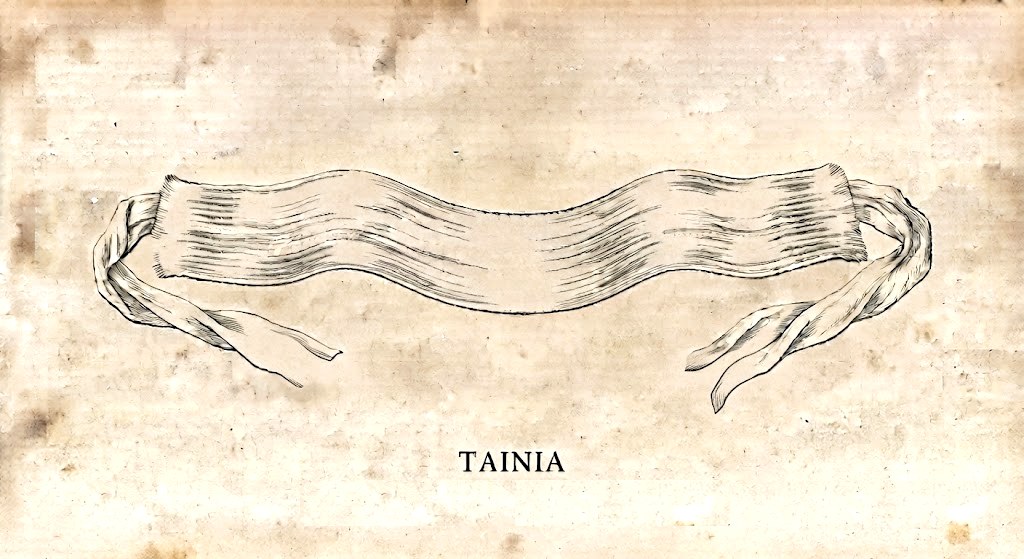
Stemma (στέμμα)
The woollen fillet of the sacred: worn or carried by priests, as by Chryses (Iliad 1.14, 1.28), wound on the branches of suppliants, and tied on victims and altars. From stephō, "to encircle, to crown."
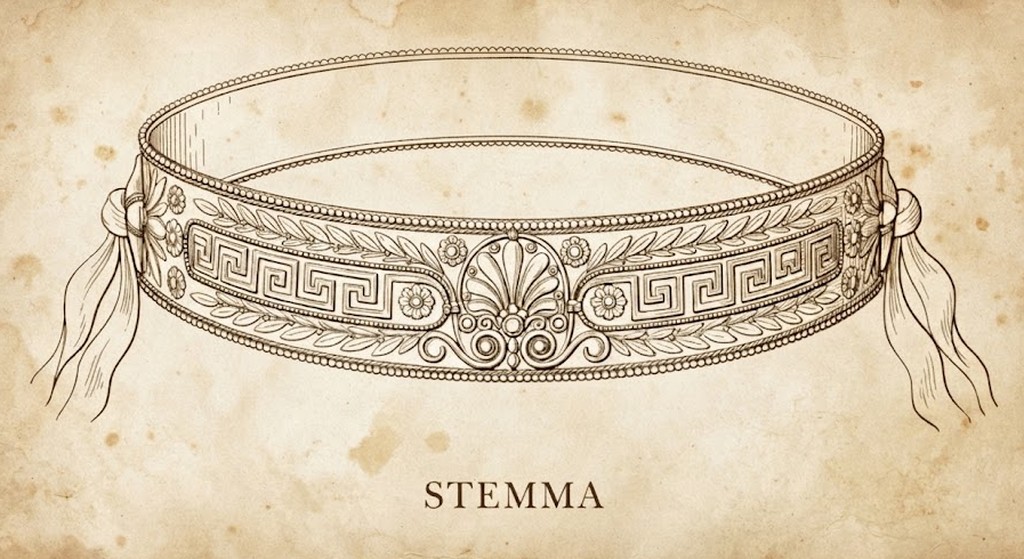
Tainia (ταινία)
A ribbon or fillet, of wool or linen, tied round the head. It was the band of the victor and of the banquet, and the ribbon tied on offerings and grave stelai.
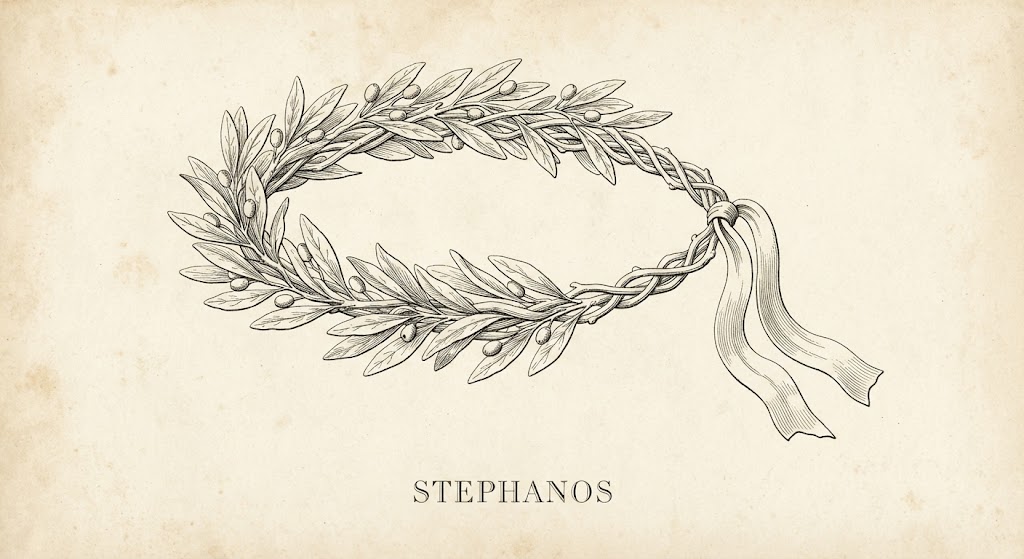
Stephanos (στέφανος)
The wreath or crown, woven of leaves and flowers, or in later times made of gold. It was worn at sacrifice, at the symposium and in procession, and given as the prize of the sacred games.
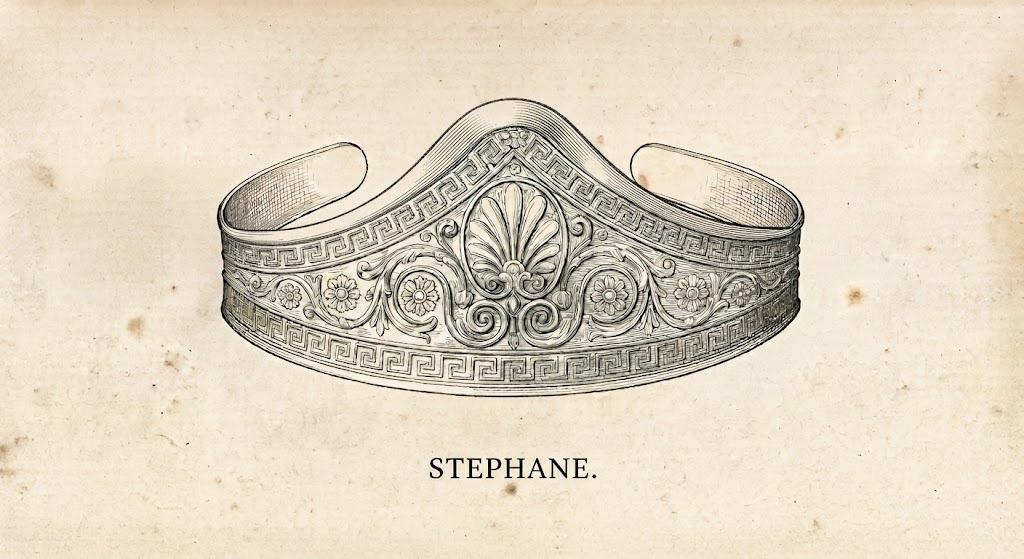
Stephanē (στεφάνη)
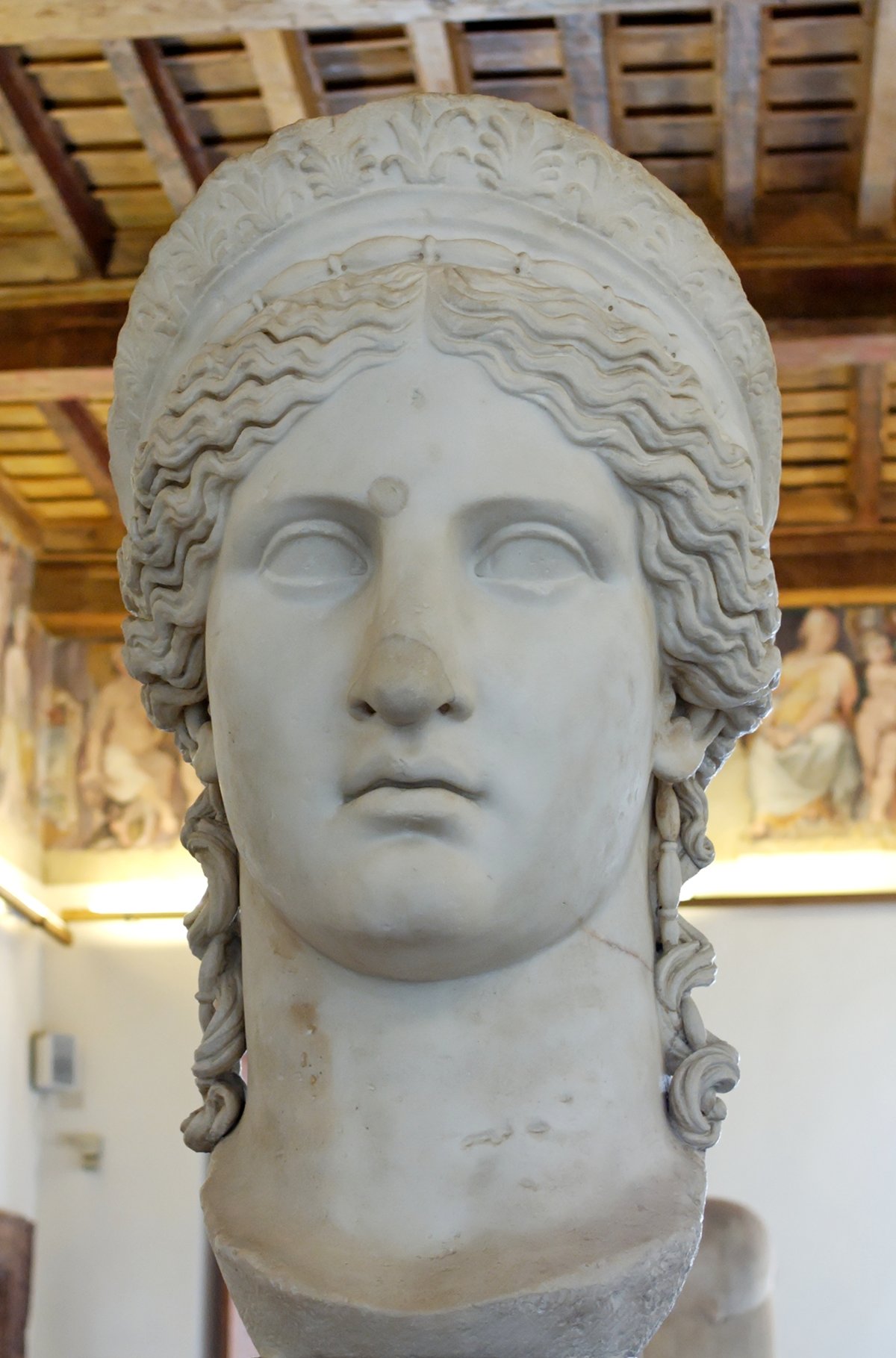
A raised band or diadem rising above the brow, worn by women and above all by goddesses. Hesiod's Athena sets a golden stephanē on the head of Pandora (Hesiod, Theogony 578); in sculpture it is the crown of Hera.
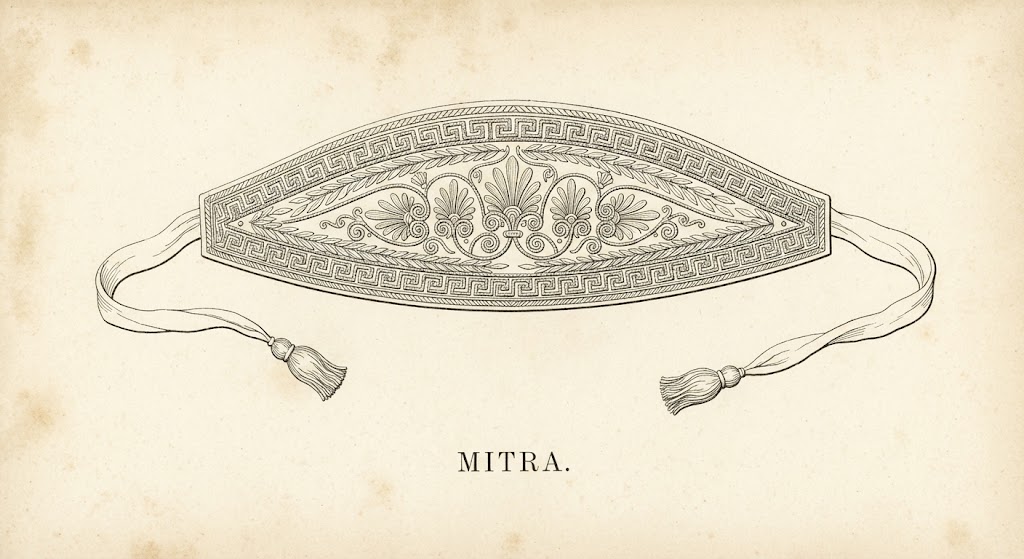
Mitra (μίτρα)
A headband or snood of cloth, often bright and patterned; Sappho speaks of a many-coloured mitrana, a little mitra, newly come from Sardis, and laments that she has none to give her daughter Kleis (Sappho fr. 98a.10–11, 98b.1–3). It belonged especially to women and to Dionysos and his company.
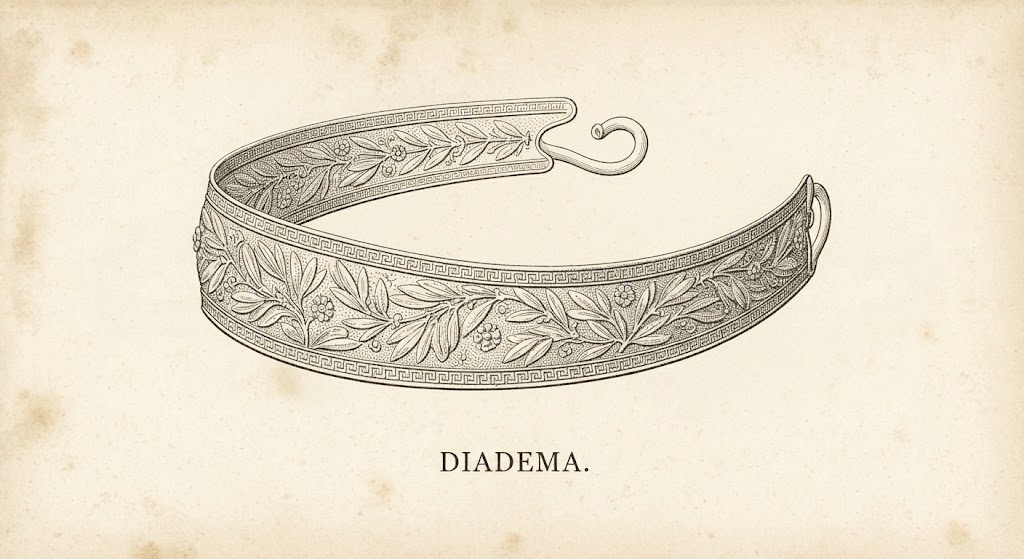
Diadēma (διάδημα)
Literally "that which is bound round," a flat ribbon tied at the back with its ends hanging free. After Alexander it became the sign of kingship.
The wreath of each god
The wreath belongs to the god who gave its plant, and to wear it is to wear the god's own sign. The laurel is Apollo's, the tree of Delphi and the crown of the Pythian Games. The wild olive is Zeus's at Olympia, where the Eleans told Pausanias that Herakles of Ida first crowned a victor in the footrace with wild olive, a tree said to have been brought into Greece by Herakles from the land of the Hyperboreans (Pausanias 5.7.7); the cultivated olive is Athena's, her gift to Athens. Herodotus tells how the Persians, learning that the Greeks competed at Olympia "for a crown of olive," and Tigranes son of Artabanus cried out: what men are these, who contend not for money but for excellence? (Herodotus 8.26.2–3). Myrtle is Aphrodite's, and the initiates of Eleusis wore myrtle in their procession: the chorus of initiates in Aristophanes' Frogs calls on Iakchos to come, shaking the myrtle crown about his head (Frogs 326–331). Ivy is Dionysos's, the oak Zeus's, ears of wheat Demeter's. At the Isthmus the crown was of pine and, at some periods, of dry celery, and at Nemea of fresh celery; Plutarch records the ancient debate between the two plants (Plutarch, Table Talk 5.3.1–3, Moralia 675d–677b).
The worshipper therefore did not choose a wreath at random. To put on the plant of the god being honoured was a small act of kinship: the crown of the rite was made from the god's own life.
The victor's fillet
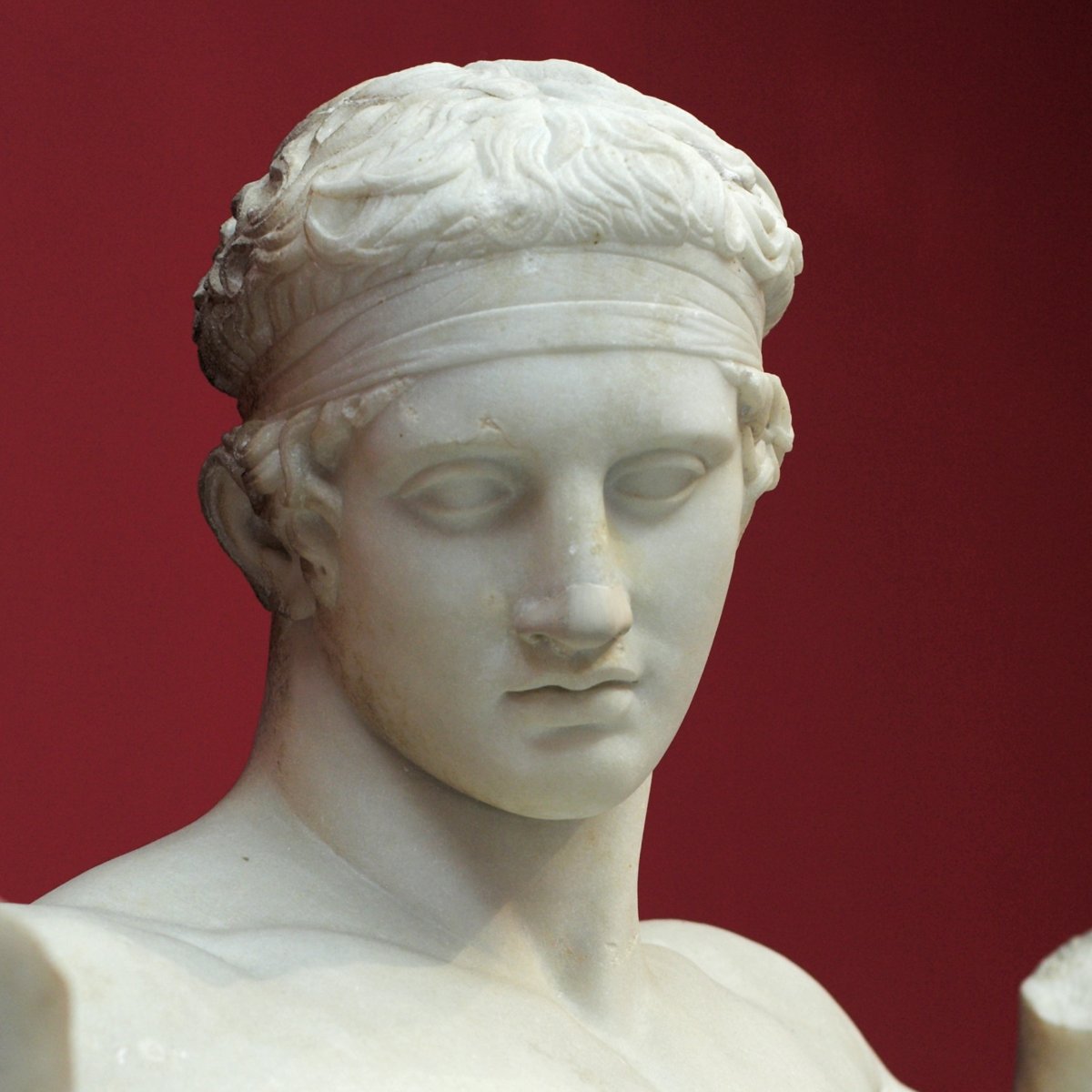
When an athlete won, ribbons were tied on him by his friends and admirers, and leaves and flowers thrown over him. Thucydides gives the clearest picture of it, though for a general and not an athlete: the people of Skione crowned Brasidas with a golden crown, and private citizens "tied ribbons on him and came up to him as to an athlete" (Thucydides 4.121.1). The victory was the god's gift, and the band marked the victor as one whom the god had favoured. Polykleitos made the moment of the binding into one of the most famous statues of antiquity, the Diadoumenos, a youth raising both hands to tie the fillet; Pliny says it was valued at a hundred talents (Pliny, Natural History 34.55). The marble copy from Delos, above, keeps the band itself, wide and flat, pressed into the curls.
The wreath set aside
Because the wreath belongs to the god and to rejoicing, it is taken off in grief. Diogenes Laertius tells the story of Xenophon: he was sacrificing, wreathed, when word came that his son Gryllos had fallen at Mantineia. He took off the wreath; when he learned that the young man had fallen gloriously, he put it on again (Diogenes Laertius 2.54). Some say, Diogenes adds, that he did not even weep, but said only, "I knew my son was mortal" (2.55). The gesture shows the meaning of the band exactly: it was the sign of a person given over to the god's festival, and one who is struck by death steps out of that state until the rite can be resumed with a clean heart.
The diadem of kings
The diadēma took a new meaning with Alexander, who adopted the white royal band after his conquest of Persia. The Hellenistic kings who followed him all wore it, and on their coins it is the sign of a king. Arrian tells the story that, as Alexander sailed through the marshes near Babylon, a gust of wind carried off his hat and the diadem bound round it; the diadem caught on a reed growing by the tomb of an ancient Assyrian king, and this was held to be an omen of what was to come (Arrian, Anabasis 7.22.1–5). Even as a sign of rule, the band kept its older sense: the king was set apart, bound to the gods who had given him his throne.
The Temple's practice
The temple keeps the custom in a modest form. At the rites of the temple a worshipper may bind the head with a simple fillet of undyed wool, or wear a wreath of the plant of the god being honoured: laurel for Apollo, olive for Athena or Zeus, myrtle for Aphrodite, ivy for Dionysos, ears of wheat for Demeter. The band is put on after purification and before the prayer, and taken off when the rite is ended. Those who are in mourning do not wear it, as Xenophon set his aside. The fillet may also be tied on an image, an altar or an offering, as the Greeks tied it, to mark what has been given to the gods.
Sources: Homer, Iliad 1.14–15, 1.28; Hesiod, Theogony 578; Sappho fr. 98; Herodotus 8.26.2–3; Thucydides 4.121.1; Aristophanes, Frogs 326–331; Pausanias 5.7.7; Plutarch, Table Talk 5.3 (Moralia 675d–677b); Pliny, Natural History 34.55; Diogenes Laertius 2.54–55; Arrian, Anabasis 7.22. The Ludovisi head, long called "Juno Ludovisi," is now generally thought to be a portrait of a Roman lady of the imperial house, probably Antonia Minor, in the guise of a goddess.
The rites of the gods
How the ancient Greeks honoured the gods, and how the temple honours them now: worship and veneration, prayer, hymn, purification, offering, sacrifice, festival, theatre, the household cult and the asking of oracles. The rites belong to no single people: the gods receive all who honour them, of every nation and ancestry. Anyone who comes to them in good faith is welcome at the altar, whatever their birth.
Worship and veneration
Every religion that makes images is asked the same question: do you worship the stone? The Orthodox Church answered it at the Second Council of Nicaea in 787 AD. Its definition distinguishes latreia, true worship, which belongs to the divine nature alone, from proskynēsis and douleia, the honour and veneration given to holy images, which are kissed, censed and lit with lamps. The council grounded this in a sentence of St Basil: "the honour paid to the image passes to the prototype" (Basil, On the Holy Spirit 18.45). St John of Damascus had argued the same a generation earlier: the icon is matter that the believer honours for the sake of the one it shows, and through it the honour rises to its source (John of Damascus, On the Divine Images 1.16, 3.41).
Hellenic practice drew this line a thousand years before. The cult statue was called an agalma, a word from agallō, "to delight": a thing given to the god for the god's pleasure, an offering in the most beautiful form a city could make. It was dedicated, not deified. Heraclitus mocked anyone who confused the two: people "pray to these statues as if one were to talk to houses, not knowing what gods or heroes are" (Heraclitus fr. B5 DK). Dio Chrysostom, standing before Pheidias's Zeus at Olympia, explained why the statue was made at all: mankind longs to be near the god, to honour and serve him close at hand, as small children separated from father and mother stretch out their hands to them in dreams (Dio Chrysostom, Olympic Oration 12.60–61). Porphyry wrote a whole treatise, On Images, to show that statues are symbols, "making the invisible visible" through forms and materials chosen for their meaning, so that the wise read them like letters in a book. Plotinus gave the philosophical account: the ancient sages, wishing the gods to be present to them, built temples and statues, knowing that the divine is everywhere easy to draw and that a fitting image receives its influence, as a mirror catches a form (Plotinus, Enneads 4.3.11). Sallustius, in the fourth century, put it in a sentence: the gods need nothing, and our honours are for our own benefit; temples imitate heaven, altars the earth, statues life, prayers the intellect (Sallustius, On the Gods and the World 15–16).
This is the temple's position. The worshipper who crowns an image, pours wine before it or lights its lamp gives honour that passes to the god, exactly as the Orthodox faithful honour an icon. The charge of idolatry applies to the Hellenes no more than it applies to the veneration of icons. Worship belongs to the gods; images, altars and shrines receive the honour that leads to them.
Prayer
Prayer, euchē, was spoken aloud and standing. To the gods of the sky the worshipper lifted both arms with the palms turned upward: Chryses "lifted up his hands" to pray to Apollo (Homer, Iliad 1.450), and Achilles prayed to Zeus of Dodona looking up to heaven (Iliad 16.231–232). To the gods below the earth the palms were turned down, toward the ground; Althaia knelt and beat the earth with her hands to call on Hades and Persephone (Iliad 9.568–571). To gods of the sea, hands reached toward the water.
A Greek prayer had a shape, and the first prayer in Greek literature shows it whole. Chryses, priest of Apollo, prays: "Hear me, god of the silver bow, who stand over Chryse and holy Killa and rule Tenedos with might, Smintheus: if ever I roofed a temple pleasing to you, or burned for you fat thigh-pieces of bulls or goats, fulfil for me this wish: let the Danaans pay for my tears with your arrows" (Iliad 1.37–42). There is the invocation ("hear me"), the epithets and places that name the god exactly ("god of the silver bow," "Smintheus," the cult sites he holds), the hypomnesis, the reminder of past gifts and the bond they make ("if ever I roofed a temple"), and the request. The logic is reciprocity, charis: a relationship of grace and gratitude kept up on both sides over time. Apollo heard him.
A prayer that summons the god to come is called kletic, from kaleō, "to call." Sappho's hymn to Aphrodite is the model: "come to me now, if ever before you heard my voice from far away and came" (Sappho fr. 1). The god is called from a favourite place, reminded of earlier visits, and asked to be present now. Many of the Orphic Hymns are kletic, closing with the call to come "with kindly mind" to the rite.
How to pray to the gods
Every prayer of the temple follows the ancient order. Anyone who comes in reverence may pray it, whatever their ancestry or language.
- Purify. Wash the hands in khernips, lustral water, and sprinkle a few drops on the face (see Purification below).
- Take the posture. Stand. Raise both arms, palms up, to the Olympians and the gods of the sky; turn the palms down toward the earth for the chthonic gods; reach toward the water for the gods of the sea.
- Invoke. Call the god by name, epithets and cult seat, and ask to be heard: klythi moi, "hear me." Name the god exactly: Athena Polias of the Akropolis, Apollo Pythios of Delphi.
- Make the claim, the hypomnesis. Recall the bond: "if ever I poured wine for you," or "if ever before you heard me" (Iliad 1.37–42; Sappho fr. 1).
- Ask. State the request plainly and in few words.
- Offer or vow. Pour a libation, burn incense, or promise a gift on fulfilment, a euchē paid as a votive.
- Close. Give thanks, pour out the rest of the libation, and greet the god: chaire, "rejoice," "hail."
The Temple's model prayer, to Hestia
Klythi moi, Hestia, eldest daughter of Kronos and Rhea, keeper of the hearth, first and last in every sacrifice, who sit at the centre of every house and of the Prytaneion of the city: hear me. If ever I have given you the first of the bread and the first drops of the wine, and kept your flame clean, be present now. Keep this house in peace, keep fire on its hearth and bread on its table, and keep those who live here kind to one another. I pour this wine to you and light this lamp, and at the next new moon I will bring you honey. Chaire, Hestia, chaire.
Prayer collections. Hellenion, the Hymnodia Project: hymns and prayers by present-day worshippers, arranged by deity, with ancient texts on each page; Hellenion, Rituals and Practices: daily devotions and festival rites; YSEE, the Supreme Council of Ethnikoi Hellenes: the Athens-based body of Hellenic ethnic religion; Labrys Religious Community: the Greek community of Hellenic polytheism and its rites.
Hymns
A hymn is prayer made into song: praise of the god's names, birth, powers and deeds, sung so that the praise itself is an offering. The Greeks sang to the gods from the epic age to the end of antiquity, and the traditions below are the ones the temple uses and studies.
The Homeric Hymns. Thirty-three hymns in the epic hexameter, composed between the seventh and the fifth century BC and later gathered under Homer's name. Most are short preludes, prooimia, sung by a rhapsode before a recitation of epic; Thucydides calls the Hymn to Apollo a prelude and quotes it for the festival of Delos (Thucydides 3.104). Hear them in reconstructed Greek pronunciation: the Hymn to Demeter (listen on YouTube) and the Hymn to Artemis (listen on YouTube); in English, the long Hymn to Demeter (listen on YouTube). Four are long narratives of a god's coming into the world and into cult. The Hymn to Apollo tells of his birth on Delos and the founding of his oracle at Pytho, where he slays the serpent and brings Cretan sailors as his first priests. The Hymn to Hermes shows the newborn god stealing Apollo's cattle, inventing the lyre from a tortoise shell, and making the first sacrifice, dividing the meat into twelve portions. The Hymn to Aphrodite tells of her love for Anchises and the birth of Aeneas. The Hymn to Demeter tells the rape of Persephone and the founding of the Mysteries, and the pilgrimage quotes it at the sanctuary itself (The night, the cup and the better hope). The short hymns end with a formula of farewell and continuance: "and now I will remember you and another song also." In this the Homeric Hymns teach the first lesson of Hellenic worship: a god is approached by name, place and story. (Greek · English, Evelyn-White · theoi.com)
Pindar: paeans and dithyrambs. Choral song was the great public form of praise, danced and sung by choruses of citizens. The paean belonged to Apollo: the Achaeans sang it all day to appease him after Chryses' prayer was answered (Iliad 1.472–474). Pindar (518–438 BC) composed paeans for Delphi, Delos and other cities; papyri from Oxyrhynchus have restored large parts of them, among them Paean 6, sung at Delphi for the Theoxenia. The dithyramb belonged to Dionysos, sung by a circular chorus of fifty men or boys; Herodotus credits Arion of Corinth with first composing and naming it (Herodotus 1.23), and Pindar's dithyramb for Athens calls the gods to the city's crowded agora in spring (Pindar fr. 75). Pindar's victory odes, the epinicians, are hymns too: each sets a victor's crown in the light of a god and a myth. The First Pythian, "Golden lyre, joint possession of Apollo," is sung to the melody Athanasius Kircher printed in 1650, here by Christodoulos Halaris (listen on YouTube); the Olympian Odes are recited in reconstructed Greek (listen on YouTube). The dithyramb is also the root of the theatre (see Theatre as worship). First Pythian (Greek · English).
The Delphic Hymns to Apollo. Two paeans for Apollo were inscribed on the south wall of the Athenian Treasury at Delphi and found by the French excavators in 1893. The first was composed by an Athenian, Athenaios, around 138 BC; the second by Limenios for the Athenian embassy to Delphi, the Pythaïs, of 128 BC. Above the words the stone carries signs for the melody, the vocal notation in the first and the instrumental notation in the second. They are among the oldest substantial pieces of written music in the world, and they can be sung again: they praise Apollo's birth on Delos, his coming to Parnassos and his defeat of the serpent, and they ask him to guard Athens and Rome.
Read. First Hymn: Greek · English (Attic Inscriptions Online) · performing edition. Second Hymn: Greek · English. Listen. First Delphic Hymn (Athenaios): Stef Conner with Barnaby Brown on the Louvre aulos, edition by Armand D'Angour, University of Reading (YouTube); Petros Tabouris and the Ancient Greek Music Workshop (YouTube); Michael Levy on replica lyre (YouTube). Second Delphic Hymn (Limenios): Christodoulos Halaris (YouTube); a second reconstruction (YouTube).
Kallimachos. At Alexandria in the third century BC the poet and scholar Kallimachos wrote six hymns: to Zeus, to Apollo, to Artemis, to Delos, on the Bath of Pallas and to Demeter. Several are "mimetic": they place the listener inside the festival as it happens, so that in the Hymn to Apollo the laurel shakes, the doors open and the god arrives, and the chorus is told to be ready. (Greek · English, theoi.com)
Kleanthes, Hymn to Zeus. The Stoic Kleanthes (c. 330–230 BC) wrote a hymn that addresses Zeus as the reason, logos, that rules all things: "Most glorious of immortals, many-named, ever all-powerful, Zeus, first cause of nature, steering all things by law, hail." It is preserved by Stobaeus (Eclogae 1.1.12) and is the clearest proof that philosophy and worship were one practice: the philosopher's understanding of the cosmos is offered back to Zeus as song. Text:(Greek, Wikisource · English, Blakeney). Hear it read in Greek at Delphi by Dimitra Liatsa (listen on YouTube) and in English for Modern Stoicism (listen on YouTube).
Mesomedes. The Cretan lyre-singer Mesomedes, court musician to Hadrian, composed hymns to Helios, to Nemesis and to the Muse that survive in medieval manuscripts with their musical notation, a living link between the Delphic stones and the later tradition. Hymn to Helios (Greek · English); Hymn to Nemesis (Greek · English, M. L. West). Listen: Hymn to Helios, Petros Tabouris Ensemble (YouTube); Hymn to Nemesis, Michael Levy (YouTube); Hymn to the Muse, Michael Levy (YouTube).
Proklos. The last head of the Platonic school at Athens, Proklos (412–485 AD), wrote hymns to Helios, Aphrodite, the Muses, all the gods, Lycian Aphrodite, Hekate and Janus, and Athena. His biographer Marinus says he kept the festivals of every people and sang hymns daily, and called the philosopher "the Hierophant of the whole world" (Marinus, Life of Proklos 19). His hymns ask the gods for the ascent of the soul, light for the mind and a calm passage through life. Text (Greek · English, Taylor). All eight are recited in reconstructed Attic Greek by Ioannis Stratakis (listen on YouTube).
The Orphic Hymns. Our rites draw on the Orphic Hymns, prayers and libations of the ancient world. The collection holds eighty-seven hymns and a prelude to Musaeus, composed for a community of initiates in western Asia Minor in the Roman imperial period. Each hymn calls a god by a string of epithets and asks for presence and blessing; most are kletic, ending with the call to come gracious to the initiates. Each is headed by the offering of incense to be burned with it: frankincense and manna for Helios, aromatics for Selene and for the stars, storax for others, and for Earth "every seed except beans and aromatics" (Orphic Hymns 7, 8, 9, 26). The hymn and the smoke rise together. Text (Greek, Wikisource · English, Taylor). Hear them in Ancient Greek: the Hymn to the Muses on the lyre (listen on YouTube) and the Hymn to Hekate sung (listen on YouTube). The temple's order of worship gathers the Orphic Hymns by festival, in Greek and in English. On Orpheus and the Orphic life see The Orphic Mysteries.
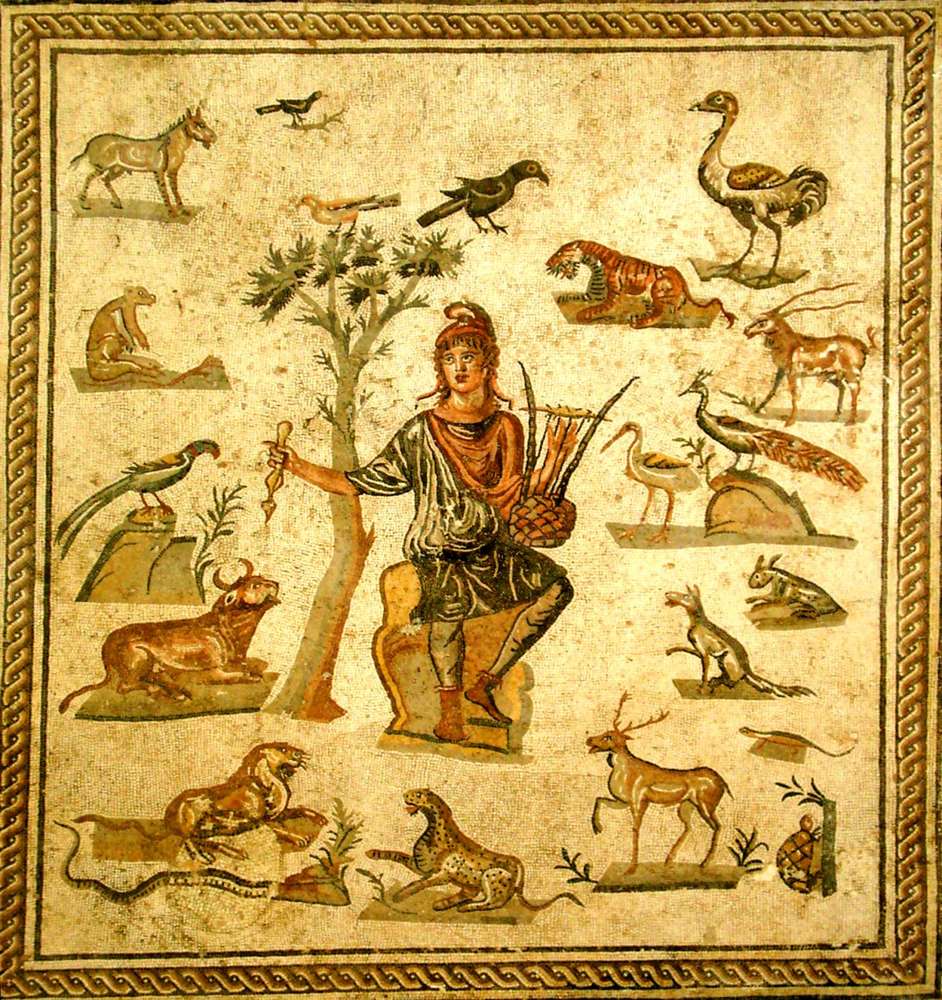
How to write your own hymn
The Homeric and Orphic Hymns share one skeleton, and every worshipper can build on it.
- Open by naming the god and announcing the song. "I begin to sing of rich-haired Demeter, awful goddess" (Homeric Hymn 2.1, trans. Evelyn-White).
- Epithets and titles. Gather the god's names: Hermes is Argeiphontes, diaktoros (guide), eriounios (luck-bringer).
- Genealogy and birth. Say whose child the god is and where the god was born: Hermes of Maia and Zeus, in a cave of Kyllene (Homeric Hymn 4.1–7).
- Domains, powers, haunts and cult places. What the god rules and where the god is honoured.
- Deeds or attributes. Tell one story of the god, as the Homeric Hymns do, or pour out a stream of attributes, as the Orphic Hymns do.
- Turn to petition. "Come, blessed one, kindly," with the request of the prayer (see How to pray).
- Farewell and transition. "And so, farewell, Son of Zeus and Maia; but I will remember you and another song also" (Homeric Hymn 4.579–580): khaire, and the promise to sing again.
Incense. Pair the hymn with an incense, as the Orphic headings do: frankincense for Hermes and the Muses, manna for Apollo, storax for Hermes of the underworld (Orphic Hymns 28, 76, 34, 57). Meter: see Lyric and melody below.
The Temple's composition: Hymn to Hermes
Of Hermes I sing, son of Maia and Zeus,
born at dawn in the cave of Kyllene,
Argeiphontes, guide of souls, giver of luck,
lord of roads and of boundary stones,
keeper of the herds and of the market's scale,
who at noon made the lyre from a tortoise shell
and by evening had driven Apollo's cattle.
Come, kindly, swift-footed, to this threshold;
keep our roads open and our words honest,
and lead us safely home at night.
Khaire, Hermes: I will remember you and another song.
Lyric and melody: setting a hymn to music
Meter. The Homeric and Orphic Hymns are in dactylic hexameter, the six-beat line of epic (DUM-da-da), recited by a rhapsode to the lyre; a worshipper writing today composes in free verse, in English or any language, and the gods receive it. Pindar and the choral poets composed in lyric meters, built in strophe, antistrophe and epode as the chorus danced one way, then back, then stood still. The paean has its refrain, iē paiēon: the Cretans march up to Pytho singing it behind Apollo (Homeric Hymn to Apollo 514–519), and Kallimachos hears hiē hiē paiēon, the refrain the people of Delphi first raised when Apollo shot the serpent (Hymn 2.21, 97–104). The Delphic Hymns move in the cretic and paeonic rhythm, five beats to the foot, long-short-long.
Modes. The harmoniai, Dorian, Phrygian, Lydian and Mixolydian, each carry an ēthos. Plato keeps the Dorian for courage and the Phrygian for prayer and peace, and sets aside the Mixolydian as lamenting and the slack Lydian (Republic 398e–399c). Aristotle calls the Mixolydian mournful, the Dorian steady and moderate, and the Phrygian enthusiastic, the mode of the dithyramb and of Bacchic song (Politics 8.5, 1340a–b; 8.7, 1342a–b).
Instruments. The lyre and kithara belong to Apollo, the instrument of hymn, paean and measured song; the aulos, the double pipe, belongs to Dionysos, to processions and to sacrifice, and Aristotle calls it an instrument of ecstasy (Politics 8.6, 1341a). Both sound in the First Delphic Hymn: "the aulos weaves its melody, and the golden kithara blends with the song."
Melody and the word. Greek had a pitch accent, and melody followed it: an acute accent rose, a circumflex rose and fell. Dionysius of Halicarnassus measures the speaking voice's rise at about a fifth (On Composition 11). The Delphic Hymns and the Seikilos epitaph show it on the stone: the melody climbs on the accented syllable and falls after it.
Chorus, response and dance. Hymns were sung by choruses that danced. The Delian maidens praise Apollo, Leto and Artemis, then sing of the men and women of old and charm the tribes of men (Homeric Hymn to Apollo 156–164); a leader called and the chorus answered with the refrain; the Phaeacian youths dance around Demodocus and his lyre as he sings (Odyssey 8.256–266).
Setting your own hymn.
- Choose a mode fitting the god: Dorian for Zeus, Athena and Ares, Phrygian for Dionysos and the Mother, a bright mode for Apollo and the Muses.
- Keep a steady rhythm: a walking pulse for procession, the five-beat paean for Apollo.
- Let the melody rise and fall with the words: up on the stressed syllable, down after it.
- Use a refrain the whole household can answer: iē paiēon, euhoi, or the god's name.
- Accompany simply, with lyre, frame drum or flute, or sing unaccompanied: chant is complete worship.
Hear and learn. Armand D'Angour, Oxford, demonstrates the reconstruction of Greek music (Rediscovering Ancient Greek Music, YouTube); eMousike explains the modes, notation and surviving scores.
Purification
No one approached the gods in a state of miasma, pollution. Miasma was not sin but a condition: contact with death, birth and bloodshed set a person apart from the sacred until it was washed away. Sacred laws set out the time and manner; the cathartic law of Cyrene lists who must keep away from a sanctuary and for how many days. Purification, katharsis, restored the worshipper to the gods' company.
The simplest rite was washing the hands. Hesiod forbids pouring a libation of wine to Zeus at dawn with unwashed hands (Works and Days 724–726), and Hector, coming from battle, refuses to pour to Zeus with hands spattered with blood and filth (Iliad 6.266–268). The water for this was khernips, lustral water, made holy by plunging into it a burning brand from the altar (Euripides, Herakles 928–929; Athenaeus 9.409b). At the entrance to sanctuaries stood the perirrhanterion, a stone basin on a stand, from which each person sprinkled himself before passing in; the boundary of holy ground was a line of water. Odysseus, after the killing of the suitors, purified his house with fire and sulphur (Odyssey 22.481–494). The temple keeps these forms: hands are washed before every rite, and lustral water is made at the altar.
Note on holy water. The Church kept this rite too. The stoup of holy water at the door of every Catholic church stands where the perirrhanterion stood at the gate of the sanctuary, and the faithful dip their fingers and sign themselves before passing in, as the Greeks sprinkled themselves at the boundary of holy ground. The priest sprinkles the congregation in the rite of the Asperges, and the Orthodox bless the waters at Theophany and sprinkle house and worshipper with a sprig of basil. Water made holy, sprinkled at the threshold to cleanse before approaching the divine: the form is the ancient katharsis, carried over from the worship the Church condemned.
Offerings
An offering is a gift that stays with the god. The Greeks called the lasting gifts anathēmata, "things set up": statues, tripods, cauldrons, weapons, jewellery, painted plaques, and the countless small figures of clay and bronze that fill museum cases from Sparta to Sicily. The plaques from Penteskouphia near Corinth, painted for Poseidon, show potters offering images of their own craft. A city or a person often gave a tithe, dekatē, a tenth of a harvest, a catch or the spoils of war. The treasuries at Delphi were storehouses of such gifts (Delphi, the navel of the world).
Note on the word. To the Greeks an anathēma (ἀνάθημα) was a holy thing, a gift set up in the god's house. The Greek of the Septuagint used its twin form anathema (ἀνάθεμα) to render the Hebrew ḥerem, a thing devoted to destruction (Deuteronomy 7:26), and Paul turned it into a curse: "let him be anathema" (Galatians 1:8–9; 1 Corinthians 16:22). The councils of the Church then made anathema the formal sentence of excommunication, pronounced yearly in the Orthodox Church on the Sunday of Orthodoxy from the Synodikon of 843. So the word that once named a gift to the gods came to name what was accursed, a quiet stigma laid on the very offerings it first described. Yet the offering itself never stopped. In every Orthodox church today worshippers hang tamata (τάματα), small plaques of silver or tin shaped as an eye, a heart, a leg or a child, on the icon of Christ, the Virgin or a saint, to beg healing of a particular illness or to give thanks for it. They are the same anatomical votives that the sick once left for Asklepios, which still fill the museum at Corinth from its Asklepieion. The Church kept the ancient practice while making its ancient name a curse, one more example of the hypocrisy with which the old religion was condemned and borrowed at once.
The first share of every harvest, aparchai, belonged to the gods: the first grain, the first fruits, the first pressing of oil and wine. Cakes were offered in great variety: the pelanos, a mixture of meal, honey and oil poured or baked as an offering, which was also the fee paid at Delphi before consulting the god; the round popana; cakes shaped as animals for those who offered a likeness in place of the beast. Incense was burned on every altar: frankincense and myrrh from Arabia, and in humbler homes a few grains of barley, a branch of laurel or a pinch of salt. Flowers, wreaths, a lock of hair cut at coming of age, the toys of childhood laid before Artemis on marriage: the gods received everything that marks a life.
Sacrifice and libation
Libation. The commonest act of Greek worship was pouring. The spondē was a libation of wine poured from a shallow bowl, the phialē, onto the altar or the ground, with a prayer; every banquet began with a libation, and treaties were themselves called spondai. To the dead and the gods below were poured khoai, given wholly to the earth: honey mixed with milk, then sweet wine, then water, with white barley sprinkled over (Odyssey 10.518–520). Atossa brings to her husband's tomb milk, honey, water from a pure spring, wine and olive oil (Aeschylus, Persians 610–618). For some powers wine was forbidden: the Eumenides at Kolonos received water and honey only, the "wineless" offerings (Sophocles, Oedipus at Kolonos 469–481).
Note on the candle. The Orthodox Church keeps the gift in another form. On entering, the worshipper buys a beeswax candle at the stand in the narthex and lights it before the icon of Christ, the Virgin or a saint, for a prayer, for the living, or for a departed parent. At the grave a lamp of olive oil is kept burning for the dead. Like the libation, the candle is a thing of value given up wholly to the holy and consumed in the giving, offered to the divine and to the family dead alike. It is a sacrifice in all but name, carried over from the rites the Church called idolatry.
The rite of sacrifice. Animal sacrifice, thysia, was the centre of public worship, and its order was fixed. A procession led the animal to the altar, garlanded, its horns sometimes gilded (Odyssey 3.430–438). A maiden, the kanēphoros, carried the basket, kanoun, holding the barley grains and, hidden beneath them, the knife. At the altar the participants washed their hands in khernips and threw barley. Water was sprinkled on the animal's head so that it shook it and seemed to nod: this was taken as consent, and without it the sacrifice did not go forward. Plutarch reports the custom that the victim must give its assent (Plutarch, Moralia 729f), and at Delphi the priests poured cold water on the animal before the oracle was consulted, and required it to tremble in every limb, or no oracle was given (Moralia 437a–b). Hairs were cut from the forehead and thrown on the fire. When the blow fell the women raised the ololygē, the high ritual cry (Odyssey 3.450), marking the moment when a life passed to the god.
The god's portion and the shared meal. The thighbones were wrapped in fat and burned on the altar with wine poured over them, and the savour rose to the gods. Hesiod tells why: at Mekone, when gods and men divided the first ox, Prometheus hid the meat under the stomach and the bones under gleaming fat, and Zeus chose the bones; since then men burn white bones for the immortals on fragrant altars (Hesiod, Theogony 535–557). The inner organs, the splanchna, were roasted on spits and tasted first by those closest to the rite. The rest was cooked and shared among all present. For most Greeks, meat was eaten at the sacred feast: an animal killed was an animal given to a god and eaten in common. To the gods below and to heroes, the whole victim was often burned, a holokautōma, black animals were offered at night over a pit, and nothing was eaten; Xenophon burned whole pigs to Zeus Meilichios (Xenophon, Anabasis 7.8.4–5), and Odysseus fills a pit with blood for the shades (Odyssey 11.23–36).
The sacred and the industrial. The temple states plainly what this rite was. Ancient sacrifice was far more humane than modern factory farming. The animal was raised in the open, led in procession, washed and garlanded, asked for its consent, and killed by a single blow, one at a time, in the sight of the whole community, with prayer. Its life was valued as sacred, directed to the gods, and its flesh was shared at a common table rather than sold. In the modern world the same act has been stripped of all this. In 2024 more than 86 billion land animals were slaughtered for meat worldwide, among them about 78.5 billion chickens and 1.5 billion pigs (FAO data, via Our World in Data), most of them raised in confinement and killed on industrial lines, unseen, uncounted and unthanked. The ancients ended an animal's life with dignity and sanctity; industry has commercialised and commodified it. The charge of cruelty belongs to the factory, not the altar.
Note on the Easter lamb. The Christian emperors outlawed sacrifice: Theodosius forbade anyone to slay an innocent victim or approach the shrines (Codex Theodosianus 16.10.10, in 391), and in 392 made sacrifice punishable as treason (16.10.12). Yet the lamb was never taken off the fire. On Easter Sunday Greek families still slaughter a lamb and roast it whole on the spit, in the name of Christ, the Lamb of God, and share it at a common feast, just as the ancients shared the victim at the altar. In the villages the kourbani, an animal blessed by the priest and slaughtered on a saint's feast, is cooked and given out to all; at Agia Paraskevi on Lesbos, from 1774 until recent years, a bull was garlanded, its horns gilded, led in procession behind the priest and the saint's icon, blessed, and sacrificed on the mountain for Saint Charalambos, its meat boiled with wheat into keskek for all the pilgrims, the ancient thysia step for step. At every Mass the congregation prays the Agnus Dei: "Lamb of God, who takest away the sins of the world, have mercy on us," from the Baptist's words, "Behold the Lamb of God, which taketh away the sin of the world" (John 1:29). Its doctrine is that Christ was the last victim, offered "once for all," so that "there is no more offering for sin" (Hebrews 10:10, 10:18): the sacrifice to end sacrifice. Yet the faithful who pray it slaughter a living lamb to celebrate Easter, and their priests bless the kourbani before the knife, while the Church condemned the altars of the gods as bloody idolatry. That is more than hypocrisy: it is theft. The Church took the pagan rite, the garlanded victim, the blessing, the knife and the shared feast, and wrote its own name over it, as it wrote saints over gods and churches over temples. The law that ended sacrifice to the gods did not end sacrifice; it only changed the name of the one who received it.
Note on the Thanksgiving turkey. The same rite survives outside the church. At Thanksgiving an American family gathers, says grace over a whole bird roasted for the day, gives thanks to God for the harvest and the year, and shares it at one table. That is the thysia of thanksgiving in its old form: an animal killed for a sacred day, thanks offered over it, its meat shared among all present. What has been lost is the rest of the rite. The bird is raised by the million on industrial farms and bought shrink-wrapped, with no procession, no consent, no portion given to the divine and no sense that a life was given. The ancients would have known the feast at once, and would have wondered where the god had gone.
Bloodless sacrifice today. The temple today offers bloodless sacrifice: cakes, grain, fruits, honey, wine, milk, oil and incense. This too is ancient. The Pythagoreans worshipped at the altar of Apollo Genetor on Delos, where nothing with blood was offered (Diogenes Laertius 8.13), and Theophrastus in his book On Piety taught that the first and purest offerings were grass, grain, fruits and incense (preserved in Porphyry, On Abstinence 2.5–32). The bloodless rite is the way for vegetarians and vegans, who may honour the gods fully without taking a life. It is not a judgment on those who eat meat. Sacred animal sacrifice, with the animal raised well, killed with prayer and a single clean blow, and shared at a common table, is no less humane today than it was in ancient times, and far more humane than the factory. Worshippers who keep meat at their table do well to receive it this way, as a life given to the gods and eaten in thanks.
Festivals and processions
The festival, heortē, joined every act above into one day: purification, procession, hymn, sacrifice, feast and contest. Its heart was the procession, pompē, which carried the city to the god: the Panathenaic procession bringing the new robe to Athena, the Sacred Way from Athens to Eleusis, the Hyakinthia's road from Sparta to Amyklai. The temple's own year of festivals, month by month, is set out in the Calendar and day by day in Hemera.
Theatre as worship
The Greek theatre was born at an altar. Tragedy, comedy and the satyr play were offerings to Dionysos, performed at his festivals, in his precinct and in his presence. Aristotle traces tragedy to "those who led the dithyramb," the choral hymn to Dionysos described above (Hymns), and comedy to the leaders of the phallic songs (Aristotle, Poetics 1449a).
At Athens the plays belonged to two festivals of the god. The City Dionysia, in the month of Elaphebolion (March–April), was the great festival, attended by all the Greek world. Before it the statue of Dionysos Eleuthereus, brought long before from the border town of Eleutherai, was carried out to a shrine near the Academy and led back by torchlight into the city, re-enacting the god's first arrival (Pausanias 1.29.2, 1.38.8). The festival opened with a great procession, the pompē, of citizens, metics carrying offerings, ephebes escorting a bull for the god, and phalloi borne aloft, and with sacrifice at the god's altar. Then came the contests: dithyrambic choruses of men and boys, then comedy, and on three days the tragedians, each with three tragedies and a satyr play. The Lenaia, in Gamelion (January–February), was a smaller winter festival of Dionysos with contests in comedy and tragedy.
The theatre of Dionysos Eleuthereus stood on the south slope of the Acropolis beside his temple, in the same sacred precinct. In the centre of the front row stands still the carved marble throne inscribed for the priest of Dionysos Eleuthereus; around it were the seats of honour, the proedria, for other priests and officials. The god himself watched: his statue was set in the theatre for the festival. Every performance was therefore a rite in front of the god's own priest and image.
The play was a gift, and its gear was dedicated. Victorious choregoi set up monuments to carry their bronze tripods, as on the Street of the Tripods below the Acropolis, and actors and poets dedicated their masks to Dionysos in his sanctuary. Theatres stood within the great sanctuaries: at Epidauros beside the healing sanctuary of Asklepios, at Delphi above the temple of Apollo, at Dodona below the sacred oak of Zeus. The contests at these festivals were part of the honour paid to the god of the place.
Every surviving play. All the complete ancient Greek dramas that survive, each with a link to the full text of the play in Ancient Greek and in an English translation.
Aeschylus
- The Persians (Πέρσαι, 472 BC): Greek · English (E. D. A. Morshead)
- Seven Against Thebes (Ἑπτὰ ἐπὶ Θήβας, 467 BC): Greek · English (E. D. A. Morshead)
- The Suppliants (Ἱκέτιδες, c. 463 BC): Greek · English (E. D. A. Morshead)
- Agamemnon (Ἀγαμέμνων, 458 BC): Greek · English (E. D. A. Morshead)
- The Libation Bearers (Χοηφόροι, 458 BC): Greek · English (E. D. A. Morshead)
- The Eumenides (Εὐμενίδες, 458 BC): Greek · English (E. D. A. Morshead)
- Prometheus Bound (Προμηθεὺς Δεσμώτης, date and authorship disputed): Greek · English (E. D. A. Morshead)
Sophocles
- Ajax (Αἴας): Greek · English (R. C. Jebb)
- Antigone (Ἀντιγόνη, c. 441 BC): Greek · English (R. C. Jebb)
- The Women of Trachis (Τραχίνιαι): Greek · English (R. C. Jebb)
- Oedipus the King (Οἰδίπους Τύραννος, c. 429 BC): Greek · English (R. C. Jebb)
- Electra (Ἠλέκτρα): Greek · English (R. C. Jebb)
- Philoctetes (Φιλοκτήτης, 409 BC): Greek · English (R. C. Jebb)
- Oedipus at Colonus (Οἰδίπους ἐπὶ Κολωνῷ, 401 BC, posthumous): Greek · English (R. C. Jebb)
Euripides
- Alcestis (Ἄλκηστις, 438 BC): Greek · English (A. S. Way)
- Medea (Μήδεια, 431 BC): Greek · English (A. S. Way)
- The Children of Heracles (Ἡρακλεῖδαι, c. 430 BC): Greek · English (A. S. Way)
- Hippolytus (Ἱππόλυτος, 428 BC): Greek · English (E. P. Coleridge)
- Andromache (Ἀνδρομάχη, c. 425 BC): Greek · English (A. S. Way)
- Hecuba (Ἑκάβη, c. 424 BC): Greek · English (A. S. Way)
- The Suppliants (Ἱκέτιδες, c. 423 BC): Greek · English (E. P. Coleridge)
- Electra (Ἠλέκτρα): Greek · English (A. S. Way)
- Heracles (Ἡρακλῆς μαινόμενος): Greek · English (A. S. Way)
- The Trojan Women (Τρῳάδες, 415 BC): Greek · English (A. S. Way)
- Iphigenia in Tauris (Ἰφιγένεια ἐν Ταύροις): Greek · English (A. S. Way)
- Ion (Ἴων): Greek · English (E. P. Coleridge)
- Helen (Ἑλένη, 412 BC): Greek · English (A. S. Way)
- The Phoenician Women (Φοίνισσαι): Greek · English (A. S. Way)
- Orestes (Ὀρέστης, 408 BC): Greek · English (A. S. Way)
- The Bacchae (Βάκχαι, 405 BC, posthumous): Greek · English (A. S. Way)
- Iphigenia at Aulis (Ἰφιγένεια ἐν Αὐλίδι, 405 BC, posthumous): Greek · English (A. S. Way)
- Cyclops (Κύκλωψ, satyr play): Greek · English (A. S. Way)
- Rhesus (Ῥῆσος, attributed to Euripides, authorship disputed): Greek · English (A. S. Way)
Aristophanes
- The Acharnians (Ἀχαρνῆς, 425 BC): Greek · English (anonymous translation, Athenian Society 1912)
- The Knights (Ἱππῆς, 424 BC): Greek · English (anonymous translation, Athenian Society 1912)
- The Clouds (Νεφέλαι, 423 BC, revised later): Greek · English (anonymous translation, Athenian Society 1912)
- The Wasps (Σφῆκες, 422 BC): Greek · English (anonymous translation, Athenian Society 1912)
- Peace (Εἰρήνη, 421 BC): Greek · English (anonymous translation, Athenian Society 1912)
- The Birds (Ὄρνιθες, 414 BC): Greek · English (anonymous translation, Athenian Society 1912)
- Lysistrata (Λυσιστράτη, 411 BC): Greek · English (anonymous translation, Athenian Society 1912)
- Women at the Thesmophoria (Θεσμοφοριάζουσαι, 411 BC): Greek · English (anonymous translation, Athenian Society 1912)
- The Frogs (Βάτραχοι, 405 BC): Greek · English (anonymous translation, Athenian Society 1912)
- Assemblywomen (Ἐκκλησιάζουσαι, c. 391 BC): Greek · English (anonymous translation, Athenian Society 1912)
- Wealth (Πλοῦτος, 388 BC): Greek · English (anonymous translation, Athenian Society 1912)
Menander
- The Grouch (Δύσκολος, 316 BC): Greek · English: not available online in full (no public-domain translation)
- The Woman from Samos (Σαμία, nearly complete): Greek · English: not available online in full (no public-domain translation)
Household worship
Most Greek worship happened at home. The hearth was the house's altar, and Hestia, its goddess, received the first and the last offering at every sacrifice and meal (Homeric Hymn 29). A new child was carried around the hearth to bring it into the family, and a new bride was welcomed there. In the storeroom stood the jar of Zeus Ktesios, guardian of property: a two-handled jar, crowned with white wool, filled with pure water, olive oil and fruits, kept as the god's presence among the household stores (Athenaeus 11.473b–c, citing Antikleides). At the door stood a herm of Hermes, who guards thresholds and journeys, or the pillar of Apollo Agyieus, honoured with garlands and incense (Aristophanes, Wasps 875). And at each new moon the household set out Hekate's suppers, deipna, at the crossroads: cakes, eggs and small offerings for the goddess of thresholds and roads, which the poor were said to take away once the household had left (Aristophanes, Wealth 594–597). The temple asks every member to keep a household shrine: a hearth flame or lamp, a jar for Zeus Ktesios, and the new-moon supper for Hekate.
Divination and oracle
The gods answer. The Greeks consulted them at the oracles, chief among them Apollo at Delphi and Zeus at Dodona, where the god spoke through the rustling of his oak; in the signs of birds and the livers of victims, read by seers before every battle (Xenophon, Anabasis 6.4.12–25); and in dreams sought by sleeping in the sanctuaries of Asklepios and Amphiaraos. How the Pythia prophesied, and what the god's sayings at Delphi teach, is set out at the pilgrimage stop (Delphi, the navel of the world; The Delphic E).
Sources: Second Council of Nicaea, Definition (787 AD); Basil of Caesarea, On the Holy Spirit 18.45; John of Damascus, On the Divine Images; Heraclitus fr. B5 (Diels–Kranz); Dio Chrysostom, Oration 12; Porphyry, On Images (fragments) and On Abstinence 2; Plotinus, Enneads 4.3.11; Sallustius, On the Gods and the World 15–16; Homer, Iliad 1, 6, 9, 16 and Odyssey 3, 10, 11, 22; Sappho fr. 1; Homeric Hymns; Thucydides 3.104; Herodotus 1.23; Pindar, Paeans and fr. 75; the Delphic Hymns (Fouilles de Delphes III.2, 137–138); Kallimachos, Hymns; Kleanthes, Hymn to Zeus (Stobaeus 1.1.12); Mesomedes, Hymns; Proklos, Hymns; Marinus, Life of Proklos; Orphic Hymns; Hesiod, Theogony 535–557 and Works and Days 724–726; Euripides, Herakles 928–929; Athenaeus 9.409b, 11.473b–c; Aeschylus, Persians 610–618; Sophocles, Oedipus at Kolonos 469–481; Plutarch, Moralia 437a–b, 729f; Xenophon, Anabasis 6.4, 7.8; Diogenes Laertius 8.13; Aristotle, Poetics 1449a; Pausanias 1.29.2, 1.38.8; Aristophanes, Wasps 875 and Wealth 594–597. Modern figure: FAO, FAOSTAT production data, as compiled by Our World in Data, "Yearly number of animals slaughtered for meat" (2024).