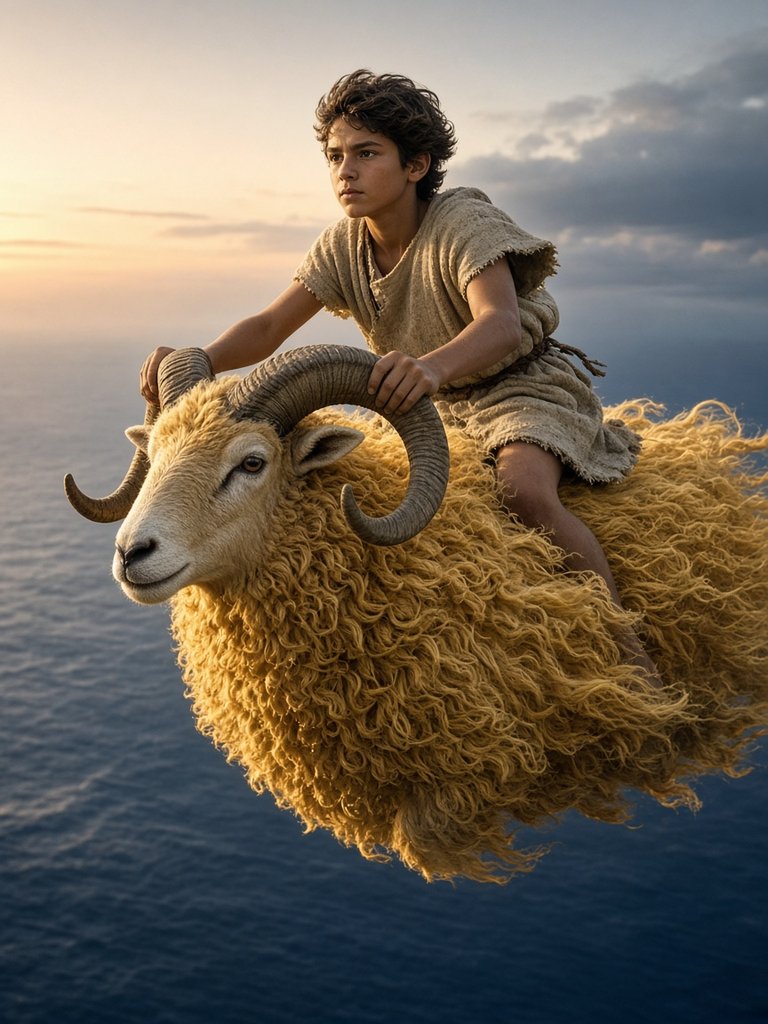
Phrixos was the son of Athamas, king in Boiotia, and of the cloud-goddess Nephele, and brother of Helle. Their stepmother Ino persuaded the women to parch the seed corn so that nothing grew, then bribed the messengers sent to Delphi to report that the famine would end only if Phrixos were sacrificed to Zeus (Apollodorus 1.9.1, paraphrased).
As he stood at the altar, Nephele snatched up her children and gave them a ram with a golden fleece, a gift of Hermes, which carried them through the sky. Helle fell into the sea on the way, but Phrixos reached Kolchis, where King Aietes received him and gave him his daughter Chalkiope (Apollodorus 1.9.1, paraphrased).
Phrixos sacrificed the ram to Zeus Phyxios, god of escape, and gave its fleece to Aietes, who nailed it to an oak in the grove of Ares; it was this fleece that Iason later came to win. His sons by Chalkiope, shipwrecked on their way to Greece, were rescued by the Argonauts and guided them to Kolchis (Apollodorus 1.9.1; Apollonius, Argonautica 2.1093–1230, paraphrased).
Epithets
- Φρίξος · Phrixos
- Phrixus
Symbols and virtues
Rescue from a false sacrifice, and the origin of the Golden Fleece. Symbols: the golden ram, the altar.
Myths
- Ino’s plot. Apollodorus 1.9.1.
- The golden ram. Apollodorus 1.9.1.
- Arrival in Kolchis. Apollodorus 1.9.1; Apollonius, Argonautica 2.1141–1156.
- His sons and the Argonauts. Apollonius, Argonautica 2.1093–1230.
Sources
Herodotus 7.197; Apollonius, Argonautica 2.1093–1230; Apollodorus 1.9.1; Ovid, Metamorphoses 7.7; Hyginus, Fabulae 2–3.
Quotations in public-domain translations (Evelyn-White 1914, Butler 1898/1900, Taylor 1792); other authors paraphrased.