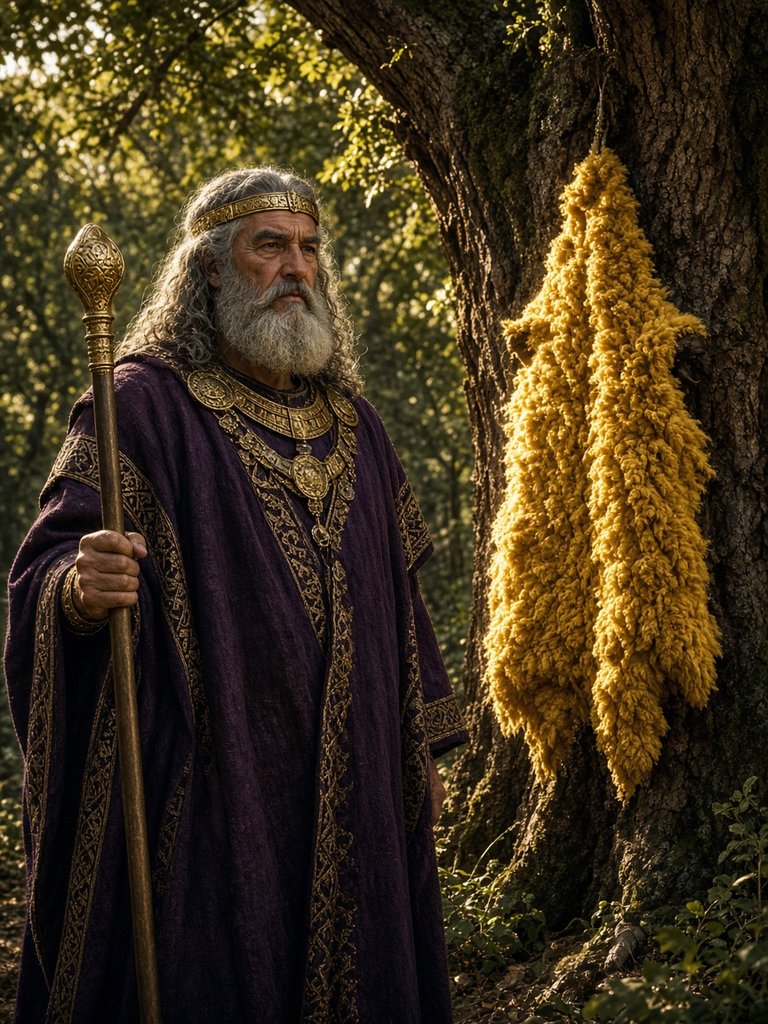
Aietes, king of Kolchis at the eastern end of the Black Sea, is a son of Helios. Hesiod writes: “And Perseis, the daughter of Ocean, bare to unwearying Helios Circe and Aeetes the king” (Theogony 956–957, tr. Evelyn-White); he married Idyia, daughter of Okeanos, and their daughter was Medeia (Theogony 958–962, paraphrased). In the Odyssey Kirke is “own sister to the magician Aeetes” (Odyssey 10.137, tr. Butler).
When Phrixos fled from Boiotia on the golden ram, Aietes received him, gave him his daughter Chalkiope, and hung the ram’s fleece on an oak in the grove of Ares, guarded by a sleepless serpent (Apollodorus 1.9.1, paraphrased). When Iason came for it, Aietes promised the fleece if the hero could yoke his fire-breathing bronze-footed bulls and sow the serpent’s teeth (Apollonius, Argonautica 3.401–421; Apollodorus 1.9.23, paraphrased).
With Medeia’s help Iason succeeded, took the fleece and fled with her; she killed her brother Apsyrtos to delay her father’s pursuit (Apollodorus 1.9.23–24, paraphrased). Hesiod says Iason led Medeia away “from Aeetes” (Theogony 992–993). Later Aietes was deposed by his brother Perses, and Medeia, returning, restored him (Apollodorus 1.9.28, paraphrased).
Epithets
- Αἰήτης · Aiētēs
- man of Aia
- ὀλοόφρων · oloophrōn
- of baneful mind (Odyssey 10.137)
Symbols and virtues
Royal power and jealous guardianship. Symbols: the Golden Fleece, the fire-breathing bulls.
Myths
- Son of Helios, father of Medeia. Theogony 956–962.
- Brother of Kirke. Odyssey 10.135–139.
- Phrixos and the fleece. Apollodorus 1.9.1.
- The tasks set for Iason. Apollonius, Argonautica 3.401–421.
- Deposed and restored. Apollodorus 1.9.28.
In the poets
“And Perseis, the daughter of Ocean, bare to unwearying Helios Circe and Aeetes the king.”Hesiod, Theogony 956–957, tr. H. G. Evelyn-White (1914), public domain.
Sources
Homer, Odyssey 10.135–139, 12.70; Hesiod, Theogony 956–962, 992–993; Apollonius, Argonautica 3; Apollodorus 1.9.1, 1.9.23–28.
Quotations in public-domain translations (Evelyn-White 1914, Butler 1898/1900, Taylor 1792); other authors paraphrased.