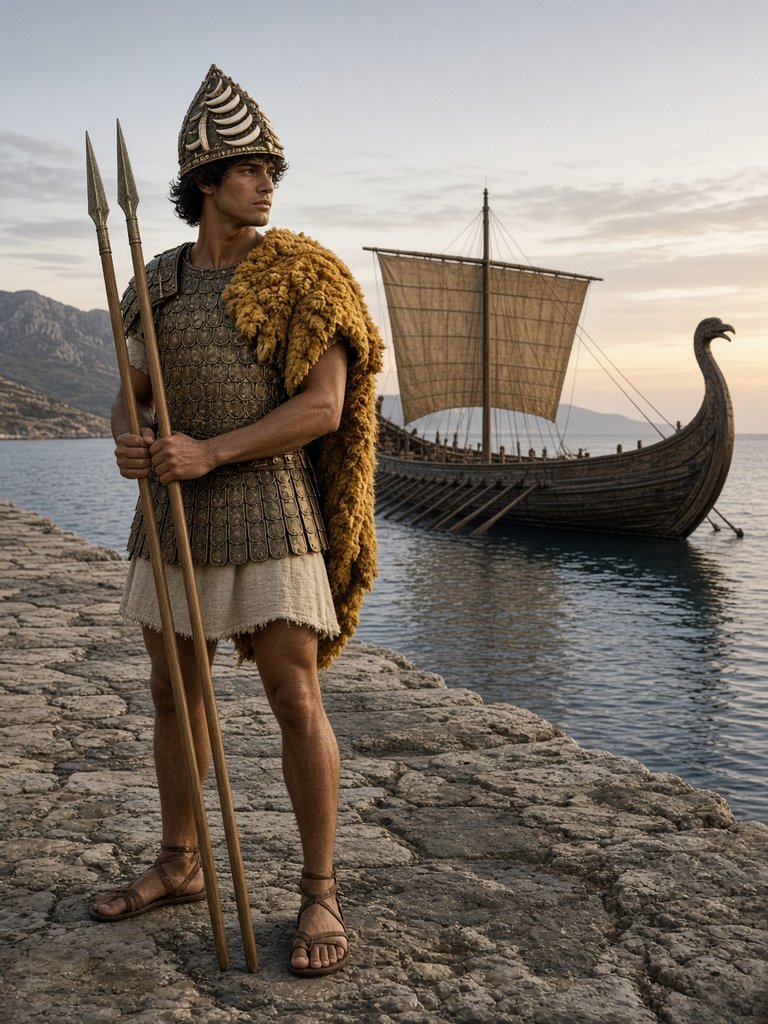
Iason (Jason) is the son of Aison, rightful heir of Iolkos in Thessaly, whose throne was seized by his half-brother Pelias. He was raised by the centaur Cheiron on Mount Pelion, and came down to claim his kingdom wearing a single sandal, the sign of which Pelias had been warned; Pelias sent him to fetch the Golden Fleece from Kolchis at the end of the Black Sea (Pindar, Pythian 4.70–168, paraphrased).
Hesiod tells the end of the voyage in a single sentence: “the son of Aeson by the will of the gods led away from Aeetes, [Medea] the daughter of Aeetes the heaven-nurtured king, when he had finished the many grievous labours which the great king, over bearing Pelias, that outrageous and presumptuous doer of violence, put upon him” (Theogony 992–996, tr. Evelyn-White). The ship Argo carried the best of the heroes — Herakles, the Dioskouroi, Orpheus, Peleus and many more — and Circe tells Odysseus that it alone passed the Wandering Rocks, “only that Juno piloted her past them for the love she bore to Jason” (Odyssey 12.69–72, tr. Butler). In Kolchis, with the help of king Aietes’ daughter Medeia, he yoked the fire-breathing bulls, sowed the dragon’s teeth and took the fleece (Apollonius, Argonautica 3–4, paraphrased).
Home at Iolkos, Medeia tricked the daughters of Pelias into killing their father. Driven out, the pair lived at Corinth, until Iason put Medeia aside to marry the king’s daughter, with the terrible end Euripides told (Euripides, Medea, paraphrased). Medeia foretells that he will die struck by a timber of the old Argo (Medea 1386–1388, paraphrased). Hesiod gives them a son, Medeios, brought up by Cheiron in the mountains (Theogony 1000–1002).
Epithets
- Αἰσονίδης · Aisonidēs
- son of Aison (Theogony 993)
- ποιμὴν λαῶν · poimēn laōn
- shepherd of the people (Theogony 1000)
- μονοσάνδαλος · monosandalos
- the one-sandalled (Pindar, Pythian 4.75)
Symbols and virtues
The leader who wins by gathering others and by the help of a wiser ally. Symbols: the single sandal, the ship Argo with its speaking beam from Dodona, the Golden Fleece, the dragon’s teeth.
Myths
- Raised by Cheiron. Pindar, Pythian 4.102–115.
- The single sandal. Pindar, Pythian 4.75–96.
- The Argo and the Wandering Rocks. Odyssey 12.69–72.
- The fleece and Medeia. Theogony 992–1002; Apollonius, Argonautica 3–4.
- Corinth. Euripides, Medea.
In the poets
“The only vessel that ever sailed and got through, was the famous Argo on her way from the house of Aetes, and she too would have gone against these great rocks, only that Juno piloted her past them for the love she bore to Jason.”Homer, Odyssey 12.69–72, tr. Samuel Butler (1900), public domain.
Sources
Hesiod, Theogony 992–1002; Homer, Odyssey 12.69–72; Pindar, Pythian 4; Euripides, Medea; Apollonius of Rhodes, Argonautica; Apollodorus, Library 1.9.16–28.
Quotations in public-domain translations (Evelyn-White 1914, Butler 1898/1900, Taylor 1792); other authors paraphrased.