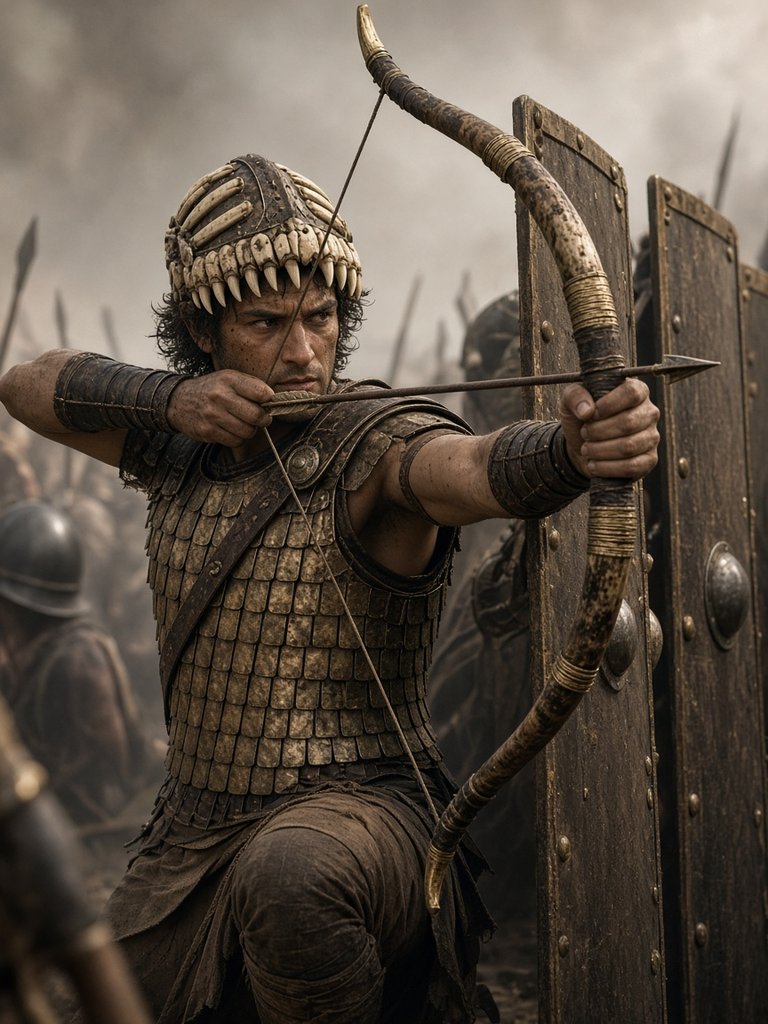
Pandaros leads the men of Zeleia below Mount Ida, Trojans by blood: “these were led by Pandarus son of Lycaon, whom Apollo had taught to use the bow” (Iliad 2.826–827, tr. Butler).
During the truce after the duel of Paris and Menelaos, Athena in the form of Laodokos persuades him to shoot at Menelaos and win glory. His bow “was made from the horns of a wild ibex which he had killed as it was bounding from a rock” (Iliad 4.105–107, tr. Butler). Athena turns the arrow so that it only grazes Menelaos, but the oaths are broken and the war begins again (Iliad 4.86–147, paraphrased).
He wounds Diomedes and boasts of it, then rides against him with Aineias, and Diomedes kills him with a spear that Athena guides into his face (Iliad 5.95–296, paraphrased).
Epithets
- Λυκάονος ἀγλαὸς υἱός · Lukaonos aglaos huios
- glorious son of Lykaon
- τοξότης · toxotēs
- the archer
Symbols and virtues
Broken oaths and the price of vain glory. Symbols: the bow of ibex horn, the arrow.
Myths
- Leader of Zeleia. Iliad 2.824–827.
- The arrow that broke the truce. Iliad 4.86–147.
- Death by Diomedes. Iliad 5.166–296.
In the poets
“Pandarus son of Lycaon, whom Apollo had taught to use the bow.”Homer, Iliad 2.826–827, tr. Samuel Butler (1898), public domain.
Sources
Homer, Iliad 2.824–827, 4.86–147, 5.95–120, 5.166–296.
Quotations in public-domain translations (Evelyn-White 1914, Butler 1898/1900, Taylor 1792); other authors paraphrased.