Aineias (Aeneas) is the son of the Trojan prince Anchises and Aphrodite. Hesiod tells that “Cytherea with the beautiful crown was joined in sweet love with the hero Anchises and bare Aeneas on the peaks of Ida with its many wooded glens” (Theogony 1008–1010, tr. Evelyn-White). In the Homeric Hymn the goddess tells Anchises: “you shall have a dear son who shall reign among the Trojans, and children’s children after him, springing up continually. His name shall be Aeneas” (Hymn to Aphrodite 196–198, tr. Evelyn-White).
In the Iliad he is the foremost Trojan after Hektor. Wounded by Diomedes, he was carried out of battle by his mother and healed by Apollo and Artemis (Iliad 5.297–453, paraphrased); facing Achilles, he was saved by Poseidon, who prophesied that “Aeneas shall reign over the Trojans, he and his children’s children that shall be born hereafter” (Iliad 20.307–308, tr. Butler).
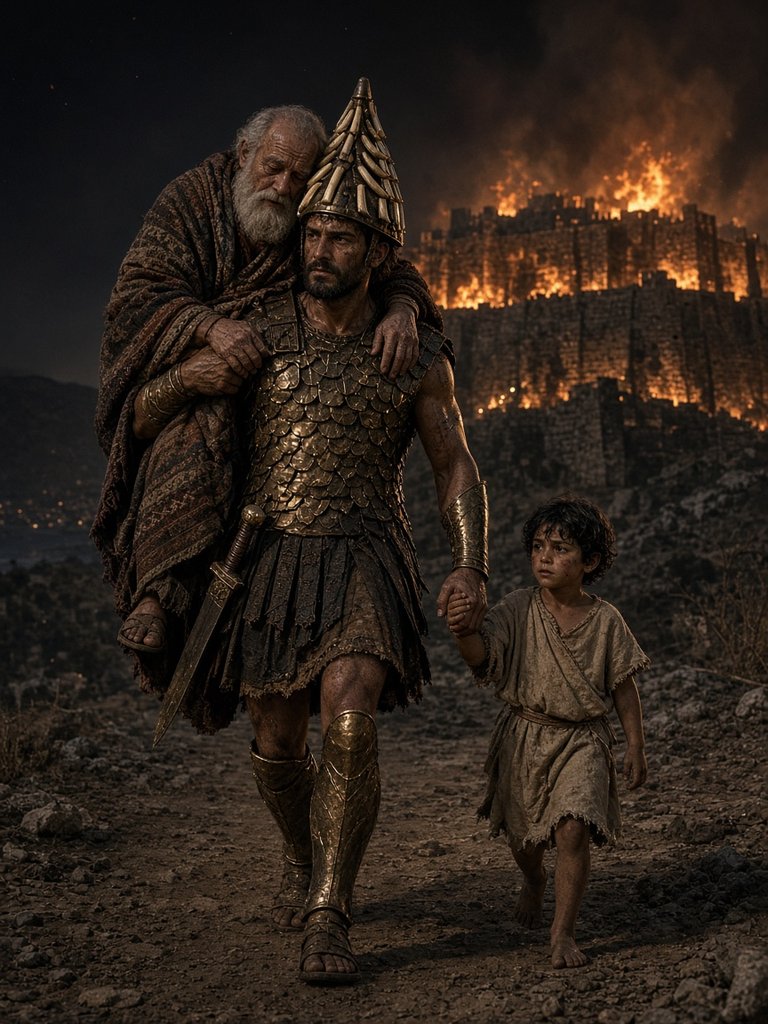
Later poets made him the exile who carried his father on his shoulders and his household gods out of burning Troy and sailed west. Dionysius of Halicarnassus collects the traditions of his wanderings and the cities and shrines that claimed him (Roman Antiquities 1.46–64, paraphrased), and Virgil made him the founder of the Roman line in the Aeneid, ending with his war in Latium against Turnus; Hesiod already places Latinos, a son of Odysseus and Kirke, among the Etruscans (Theogony 1011–1016).
Epithets
- Ἀγχισιάδης · Anchisiadēs
- son of Anchises
- Τρώων βουληφόρος · Trōōn boulēphoros
- counsellor of the Trojans (Iliad 5.180)
Symbols and virtues
Duty to father, gods and people, and the city reborn from ruin. Symbols: his father on his shoulders, the household gods, the ship of exile.
Myths
- Born on Ida. Theogony 1008–1010; Hymn to Aphrodite 53–290.
- Saved by Aphrodite and Apollo. Iliad 5.297–453.
- Saved by Poseidon. Iliad 20.288–340.
- The flight from Troy. Dionysius of Halicarnassus 1.46–48; Virgil, Aeneid 2.
- Latium. Virgil, Aeneid 7–12.
Cult and places
- Lavinium, Latium. Shrine of the Pater Indiges by the river Numicius (Dionysius of Halicarnassus 1.64).
In the poets
“Aeneas shall reign over the Trojans, he and his children’s children that shall be born hereafter.”Homer, Iliad 20.307–308, tr. Samuel Butler (1898), public domain.
Sources
Hesiod, Theogony 1008–1010; Homeric Hymn to Aphrodite 53–290; Homer, Iliad 5.166–453, 20.75–352; Dionysius of Halicarnassus, Roman Antiquities 1.46–64; Virgil, Aeneid.
Quotations in public-domain translations (Evelyn-White 1914, Butler 1898/1900, Taylor 1792); other authors paraphrased.