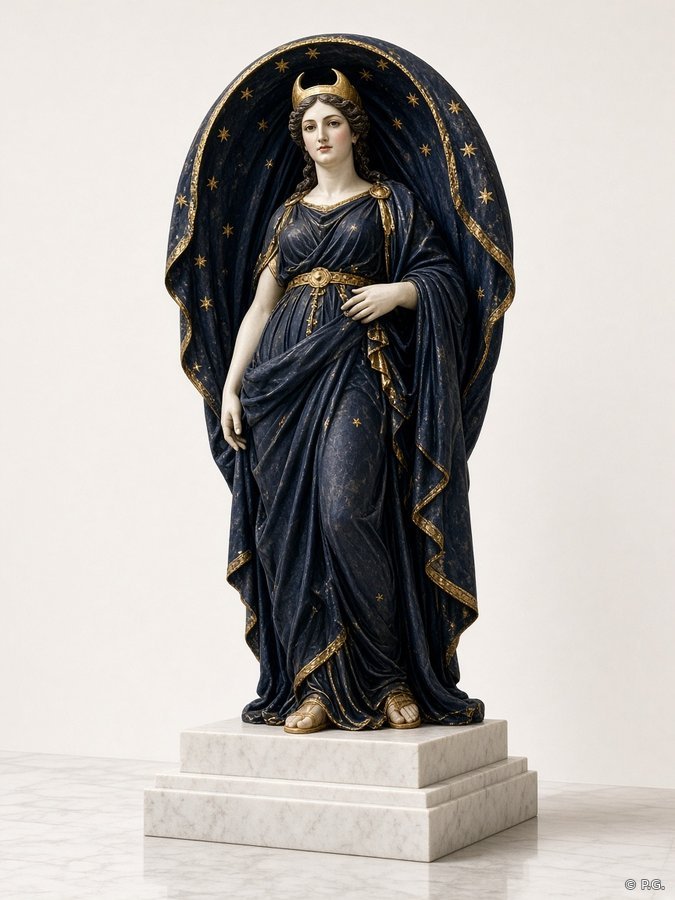
Nyx, black Night, came out of Chaos with Erebos, and from her union with him came Aither and Hemera, the bright air and the Day (Theogony 123–125). Alone she bore Doom, Death, Sleep, the tribe of Dreams, the Hesperides, the Fates, Nemesis and Strife (Theogony 211–225). Her house stands in the depths, where Night and Day greet one another as one goes out and the other comes in (Theogony 744–757). Even Zeus feared to displease swift Night (Iliad 14.258–261).
Epithets
- Μέλαινα · Melaina
- black (Theogony 20)
- Ὀλοή · Oloe
- deadly (Theogony 224)
- Θοή · Thoe
- swift (Iliad 14.261)
Domains and symbols
Night, rest and dreams; the dark from which light is born; the mysteries of the Orphics. Admire: rest, silence. Sacred symbols: the starry veil, the black chariot, the torch.
Myths
- The children of Night. Doom, Ker, Death, Sleep and Dreams, Blame and Woe, the Hesperides, the Fates, Nemesis, Deceit, Love, Old Age and Strife (Theogony 211–225).
- The house of Night. At the edge of Tartaros Night and Day pass each other on the bronze threshold (Theogony 744–757).
- Hypnos rescued. When Zeus sought Sleep in anger, Sleep fled to Night, and Zeus held back, “for he feared to vex swift Night” (Iliad 14.258–261).
- First principle. The old theologians, Aristotle notes, generated the world from Night (Metaphysics 1071b27); the Orphic poems gave her an oracle.
Cult sites
- Megara. An oracle of Night on the acropolis (Pausanias 1.40.6).
- Ephesos. A statue of Night by Rhoikos in the temple of Artemis (Pausanias 10.38.6).
Offerings
Torches and incense at night; black animals in antiquity. Today: a lamp at nightfall and a prayer for good sleep.
Beneath the Divine Mind
Nyx is the Divine Mind as the hidden depth before manifestation, personified and deified as Night, mother of the gods. Like every god she stands beneath the One (The One and the Many).
Honouring Nyx today
- Nightfall. Light a lamp and keep a moment of silence.
- Offerings. Incense, a torch.
- Hymn. Recite the Orphic hymn below.
Hymn
Nyx, parent goddess, source of sweet repose, from whom at first both Gods and men arose … Be present, Goddess, to thy suppliant’s pray’r, desir’d by all, whom all alike revere.Orphic Hymn 3, To Nyx (excerpt). Tr. Thomas Taylor (1792), public domain; divine names as given on Hemera.
Images
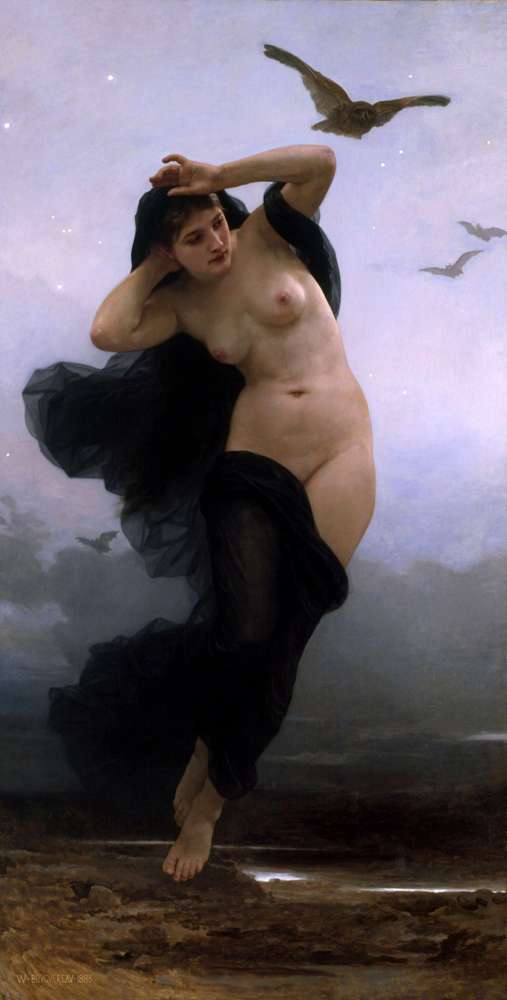
William-Adolphe Bouguereau, Public domain, via Wikimedia Commons

Sources
Hesiod, Theogony 20, 123–125, 211–225, 744–757; Homer, Iliad 14.258–261; Aristotle, Metaphysics 1071b27; Orphic Hymn 3; Pausanias 1.40.6 and 10.38.6.
Quotations in public-domain translations (Evelyn-White 1914, Butler 1898/1900, Taylor 1792); other authors paraphrased.