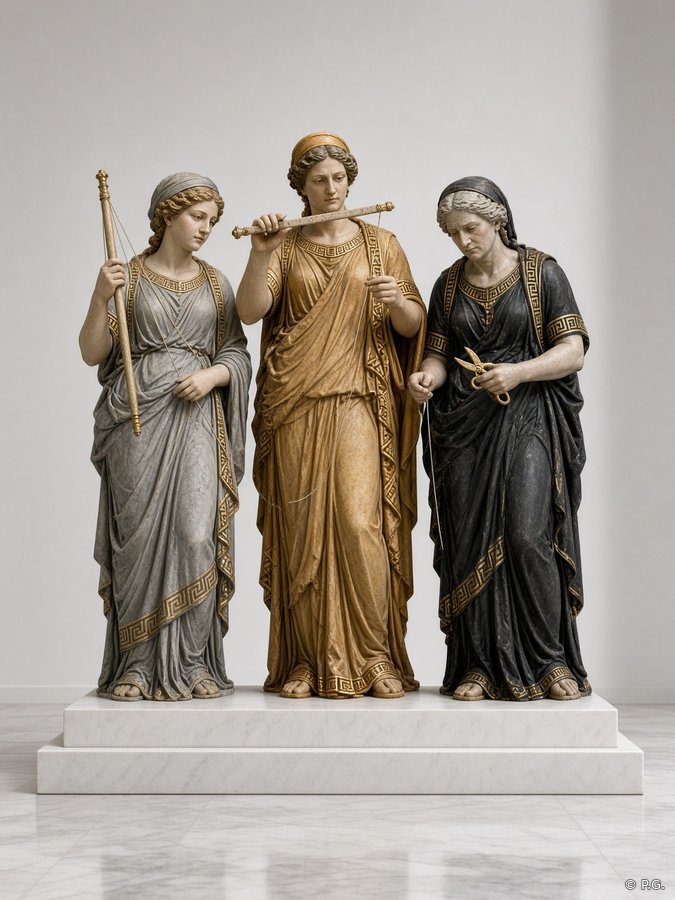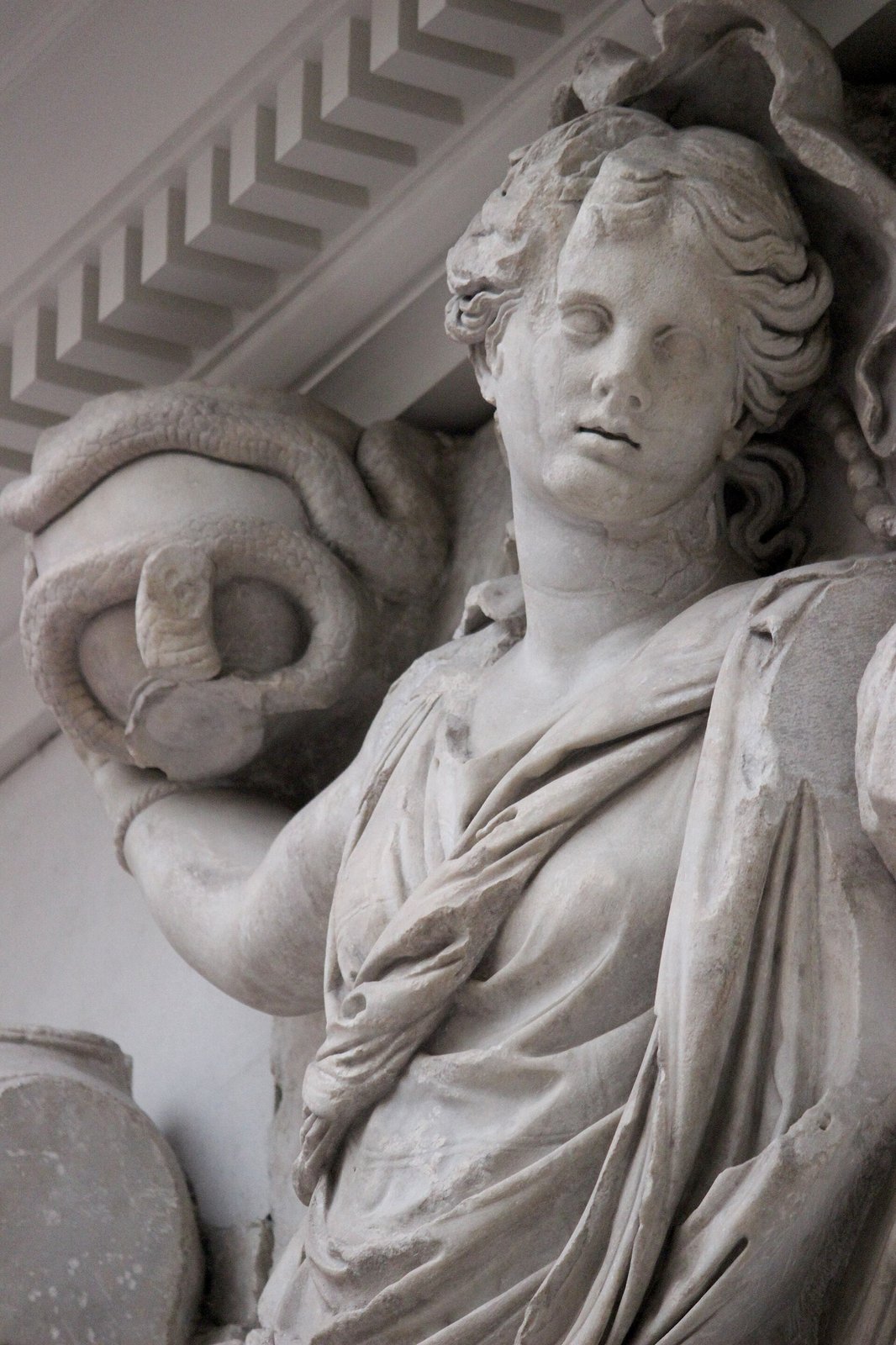
The Moirai, the Fates, are Klotho, Lachesis and Atropos, “who give mortal men evil and good to have” (Theogony 904–906). Hesiod names them twice: as daughters of Night (Theogony 217–222) and as daughters of Zeus and Themis (Theogony 904–906). In Plato’s myth of Er they sit about the spindle of Necessity, their mother: Lachesis sings of what has been, Klotho of what is, and Atropos of what will be (Republic 617b–d).
Epithets
Domains and symbols
The thread of life, its allotment and its end; the order no one escapes. Admire: acceptance of one’s lot, and choosing well within it. Sacred symbols: the spindle, the scroll, the shears.
Myths
- Two births. Daughters of Night (Theogony 217–222) and of Zeus and Themis (Theogony 904–906).
- The spindle of Necessity. Before rebirth each soul receives its lot from Lachesis and chooses its life (Plato, Republic 617b–620e).
- Admetos. Apollo made the Fates drunk so that Admetos might escape death (Aeschylus, Eumenides 723–728).
Cult sites
- Sparta. A sanctuary of the Moirai (Pausanias 3.11.10).
- Delphi. Statues of two Moirai with Zeus and Apollo, Guides of Fate (Pausanias 10.24.4).
- Olympia. An altar of Zeus Moiragetes, Guide of the Fates (Pausanias 5.15.5).
Offerings
Aromatics, as their Orphic hymn asks. Today: pray before a great choice, and accept what cannot be changed.
Beneath the Divine Mind
The Moirai are the Divine Mind as allotment: its measure given to every life, personified and deified as the three Fates. Like every god they stand beneath the One (The One and the Many).
Honouring Moirai today
- Altar. A spindle and thread.
- Reading. Read the myth of Er (Republic 614b–621d).
- Hymn. Recite the Orphic hymn below.
Hymn
Daughters of darkling Nyx, much-nam’d, draw near infinite Moirai, and listen to my pray’r.Orphic Hymn 59, To the Moirai, 1. Tr. Thomas Taylor (1792), public domain; divine names as given on Hemera.
Sources
Hesiod, Theogony 217–222, 904–906; Plato, Republic 614b–621d; Aeschylus, Eumenides 723–728; Pausanias 3.11.10, 5.15.5 and 10.24.4; Orphic Hymn 59.
Quotations in public-domain translations (Evelyn-White 1914, Butler 1898/1900, Taylor 1792); other authors paraphrased.