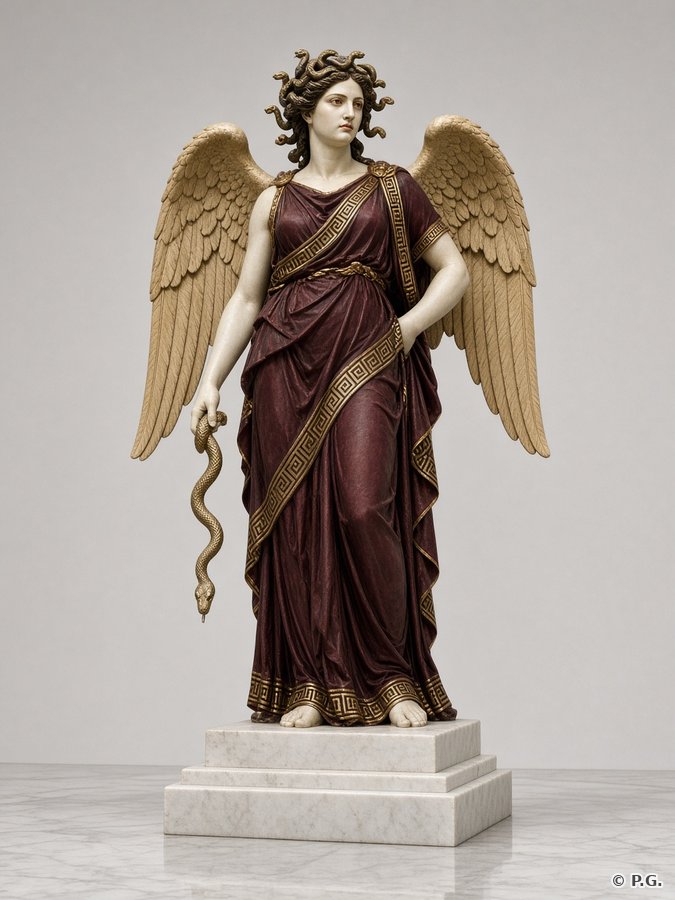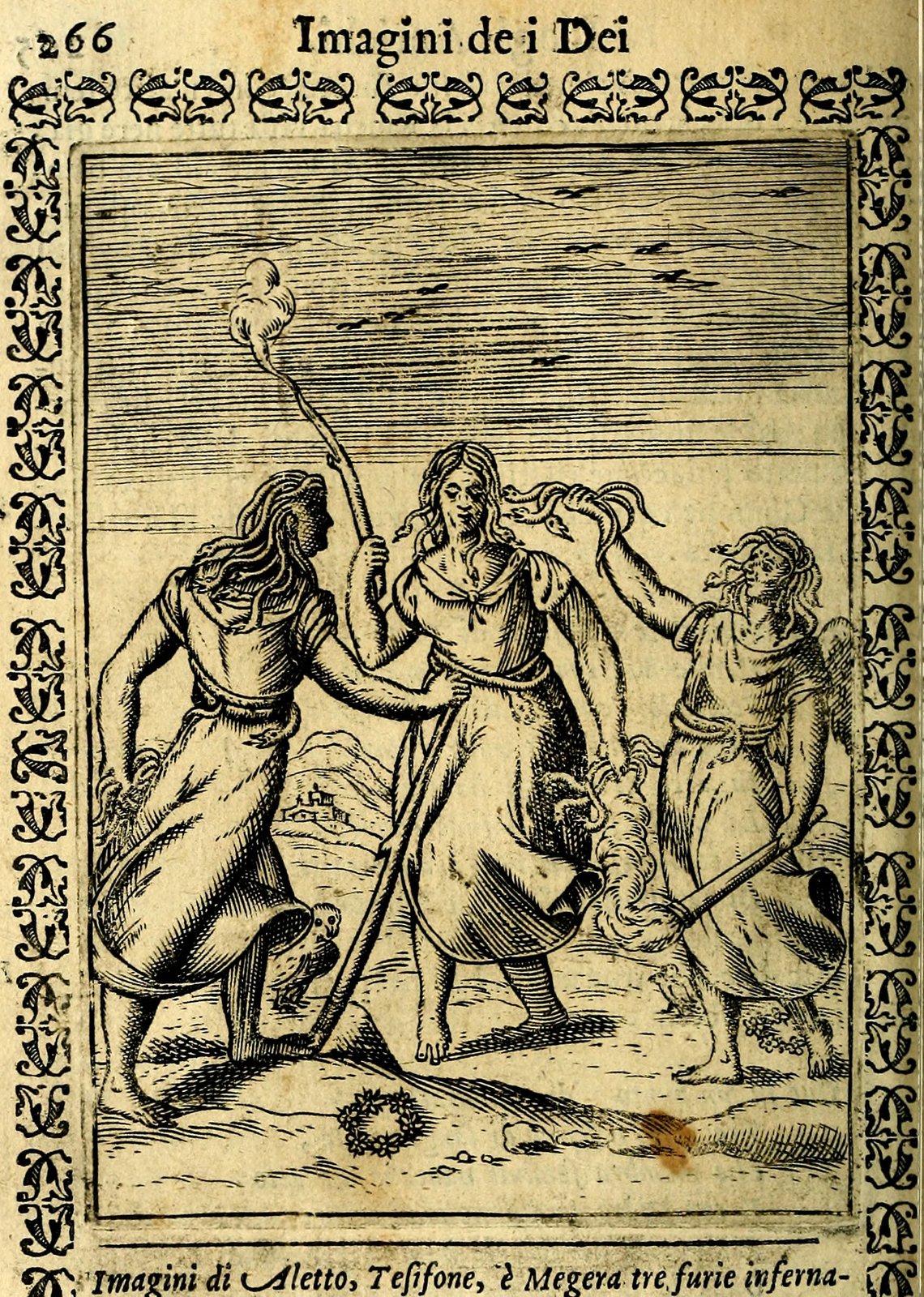
Vincenzo Cartari, Public domain, via Wikimedia Commons

Megaira is one of the three Erinyes, the Furies. Hesiod tells how, when Kronos maimed Ouranos, “all the bloody drops that gushed forth Earth received, and as the seasons moved round she bare the strong Erinyes” (Theogony 183–185). Homer knows them as the powers below who punish broken oaths: Agamemnon swears by “Jove the first and mightiest of all gods”, by Earth and Sun, “and the Erinyes who dwell below and take vengeance on him who shall swear falsely” (Iliad 19.258–260, tr. Butler). Apollodorus gives their three names, Alekto, Tisiphone and Megaira (Library 1.1.4).
Her name comes from μεγαίρειν, to begrudge, to hold a thing too great for another: she is the jealous anger of the gods at wrongdoing and excess. Virgil makes the two Dirae, the Furies who serve Jupiter, twin sisters born of Night at one birth with Tartarean Megaera, all wreathed in snakes and given wings of wind (Aeneid 12.845–848, paraphrased); one of them, sent down as an owl, brings Turnus to his end. Her name is joined with her sisters’ in the Orphic hymn to the Furies.
Epithets
- Μέγαιρα · Megaira
- the grudging, the jealous (μεγαίρειν)
- Ἐρινύς · Erinys
- one of the Erinyes (Apollodorus 1.1.4)
Domains and symbols
The divine grudge against excess and arrogance: the check on what has grown too great. Admire: moderation, refusal of hubris. Sacred symbols: the snakes, the torch, the wings.
Myths
- Born of the blood of Ouranos. From the drops that fell on Gaia (Theogony 183–185; Apollodorus 1.1.4).
- Named as one of three. Alekto, Tisiphone and Megaira (Apollodorus 1.1.4; Orphic Hymn 69).
- Sister of the Dirae. Born of Night with the Dirae who serve Jupiter (Virgil, Aeneid 12.845–848).
- Guardians of oaths. They punish the forsworn below the earth (Iliad 19.258–260).
- On the side of the elder. “The Erinyes always range themselves on the side of the older person” (Iliad 15.204, tr. Butler).
- They silence the horse Xanthos. When the horse of Achilles foretold his death, “the Erinyes stayed his speech” (Iliad 19.418, tr. Butler).
- Orestes and the Kindly Ones. In Aeschylus’ Eumenides they pursue Orestes to Athens; Athena founds the Areopagus court and persuades them to accept honour in the city as the Semnai, the Venerable Goddesses.
Cult sites
- Athens. The sanctuary of the Semnai Theai in the cleft of the Areopagus (Pausanias 1.28.6).
- Kolonos. Their sacred grove, where Oedipus came to rest (Sophocles, Oedipus at Colonus 36–43).
- Megalopolis. A shrine of the goddesses called Maniai, said to be the Eumenides, where Orestes was driven mad (Pausanias 8.34.1–4).
- Keryneia in Achaia. A sanctuary of the Eumenides said to have been founded by Orestes (Pausanias 7.25.7).
Offerings
Sophocles gives the rite at Kolonos: water from an ever-flowing spring carried with clean hands, bowls crowned with lambs’ wool, three libations poured facing the dawn, the last of water and honey, never wine, then thrice nine olive sprigs laid down and a silent prayer (Oedipus at Colonus 466–492). Today: a wineless libation of water and honey, and a kept promise.
Beneath the Divine Mind
Megaira is the Divine Mind as measure: what overreaches its bounds is checked, as Nemesis checks excess. Like every god she stands beneath the One (The One and the Many).
Honouring Megaira today
- Keep oaths. Keep a promise you have made, especially a hard one.
- Measure. Notice where you have taken more than your share, and give some back.
- Wineless libation. Pour water and honey, without wine, as at Kolonos.
- Hymn. Recite the Orphic hymn to the Furies below.
Hymn
Vociferous Bacchanalian Furies, hear! Ye, I invoke, dread pow'rs, whom all revere; Nightly, profound, in secret who retire, Tisiphone, Alecto, and Megara dire.Orphic Hymn 69, To the Furies, opening lines. Tr. Thomas Taylor (1792), public domain.
Sources
Hesiod, Theogony 183–185; Homer, Iliad 9.571–572, 15.204, 19.258–260, 19.418; Aeschylus, Eumenides; Sophocles, Oedipus at Colonus 36–43, 466–492; Apollodorus, Library 1.1.4; Pausanias 1.28.6, 7.25.7, 8.34.1–4; Orphic Hymn 69; Virgil, Aeneid 12.845–886.
Quotations in public-domain translations (Evelyn-White 1914, Butler 1898/1900, Taylor 1792); other authors paraphrased.