LACMA, Public domain, via Wikimedia Commons

Tisiphone is one of the three Erinyes, the Furies. Hesiod tells how, when Kronos maimed Ouranos, “all the bloody drops that gushed forth Earth received, and as the seasons moved round she bare the strong Erinyes” (Theogony 183–185). Homer knows them as the powers below who punish broken oaths: Agamemnon swears by “Jove the first and mightiest of all gods”, by Earth and Sun, “and the Erinyes who dwell below and take vengeance on him who shall swear falsely” (Iliad 19.258–260, tr. Butler). Apollodorus gives their three names, Alekto, Tisiphone and Megaira (Library 1.1.4).
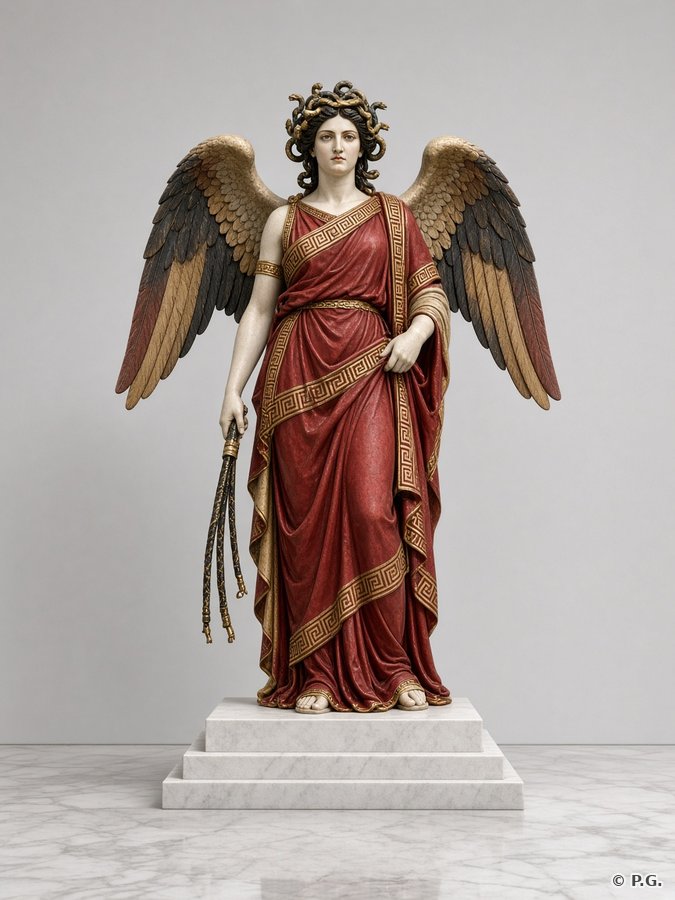
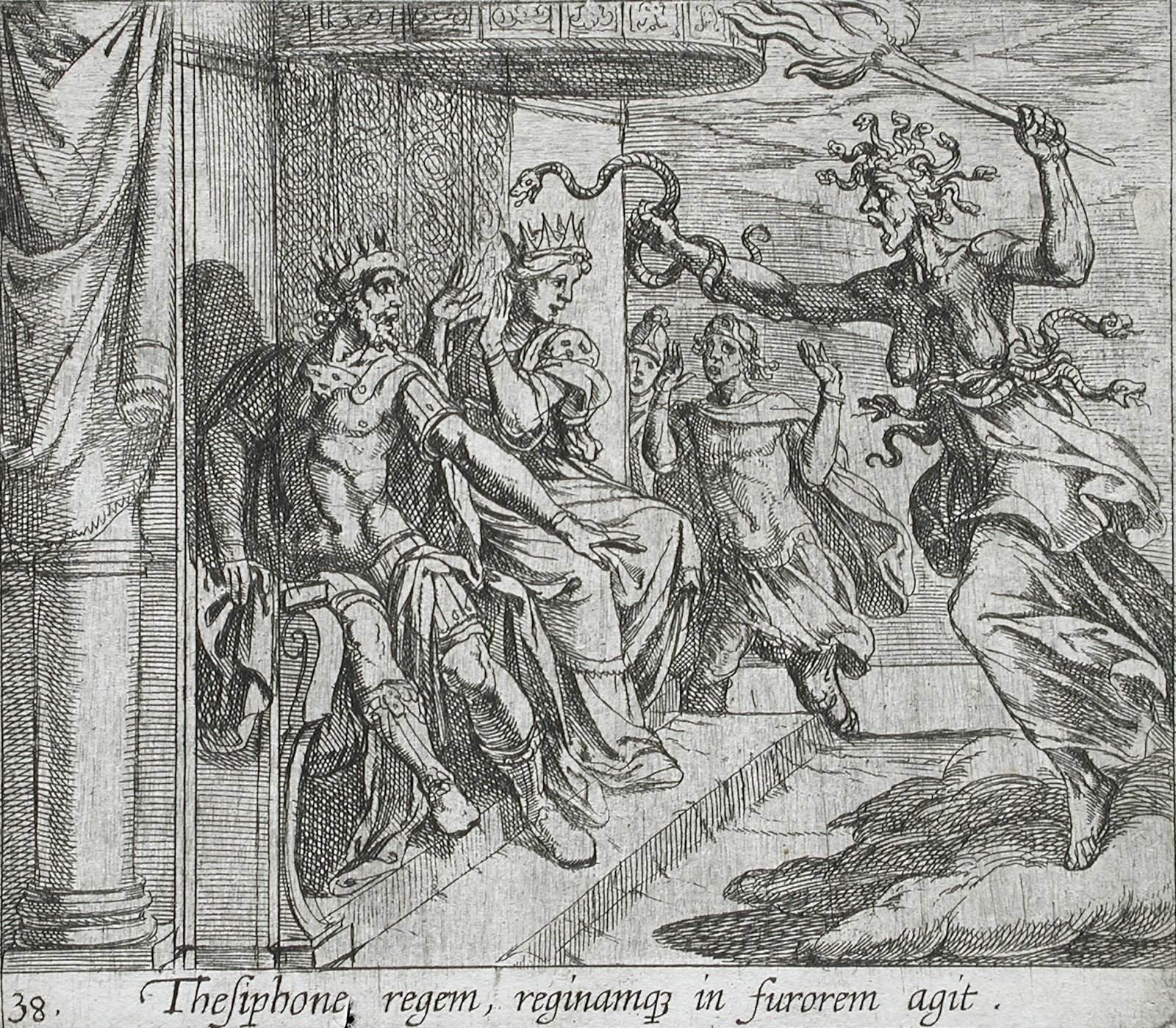
Her name joins τίσις, vengeance, and φόνος, murder: she avenges bloodshed. In Virgil she sits sleepless at the gate of Tartaros in her bloody robe, guarding the threshold, and lashes the guilty with her scourge while her left hand holds out snakes (Aeneid 6.555–556, 6.570–572). In Ovid, Juno sends Tisiphone to the house of Athamas and Ino; she throws her serpents on them and drives Athamas mad, so that Ino leaps into the sea and becomes a goddess (Metamorphoses 4.481–542). In Statius the blinded Oedipus calls on Tisiphone to bring war on his sons (Thebaid 1.56–113).
Epithets
- Τισιφόνη · Tisiphone
- avenger of murder (τίσις + φόνος)
- Ἐρινύς · Erinys
- one of the Erinyes (Apollodorus 1.1.4)
Domains and symbols
Vengeance for blood: the pollution of murder that must be answered. Admire: reverence for human life, the duty to see bloodshed answered by justice. Sacred symbols: the scourge, the snakes, the blood-stained robe.
Myths
- Born of the blood of Ouranos. From the drops that fell on Gaia (Theogony 183–185; Apollodorus 1.1.4).
- Warden of Tartaros. She guards the gate and scourges the guilty (Virgil, Aeneid 6.555–572).
- The madness of Athamas. Sent by Juno against Athamas and Ino (Ovid, Metamorphoses 4.481–542).
- The curse of Oedipus. Oedipus prays to her against his sons (Statius, Thebaid 1.56–113).
- Guardians of oaths. They punish the forsworn below the earth (Iliad 19.258–260).
- On the side of the elder. “The Erinyes always range themselves on the side of the older person” (Iliad 15.204, tr. Butler).
- They silence the horse Xanthos. When the horse of Achilles foretold his death, “the Erinyes stayed his speech” (Iliad 19.418, tr. Butler).
- Orestes and the Kindly Ones. In Aeschylus’ Eumenides they pursue Orestes to Athens; Athena founds the Areopagus court and persuades them to accept honour in the city as the Semnai, the Venerable Goddesses.
Cult sites
- Athens. The sanctuary of the Semnai Theai in the cleft of the Areopagus (Pausanias 1.28.6).
- Kolonos. Their sacred grove, where Oedipus came to rest (Sophocles, Oedipus at Colonus 36–43).
- Megalopolis. A shrine of the goddesses called Maniai, said to be the Eumenides, where Orestes was driven mad (Pausanias 8.34.1–4).
- Keryneia in Achaia. A sanctuary of the Eumenides said to have been founded by Orestes (Pausanias 7.25.7).
Offerings
Sophocles gives the rite at Kolonos: water from an ever-flowing spring carried with clean hands, bowls crowned with lambs’ wool, three libations poured facing the dawn, the last of water and honey, never wine, then thrice nine olive sprigs laid down and a silent prayer (Oedipus at Colonus 466–492). Today: a wineless libation of water and honey, and a kept promise.
Beneath the Divine Mind
Tisiphone is the Divine Mind as the law that life is holy: bloodshed disturbs the order of the whole and is answered. Like every god she stands beneath the One (The One and the Many).
Honouring Tisiphone today
- Keep oaths. Keep a promise you have made, especially a hard one.
- Wineless libation. Pour water and honey, without wine, as at Kolonos.
- Hymn. Recite the Orphic hymn to the Furies below.
Hymn
Vociferous Bacchanalian Furies, hear! Ye, I invoke, dread pow'rs, whom all revere; Nightly, profound, in secret who retire, Tisiphone, Alecto, and Megara dire.Orphic Hymn 69, To the Furies, opening lines. Tr. Thomas Taylor (1792), public domain.
Sources
Hesiod, Theogony 183–185; Homer, Iliad 9.571–572, 15.204, 19.258–260, 19.418; Aeschylus, Eumenides; Sophocles, Oedipus at Colonus 36–43, 466–492; Apollodorus, Library 1.1.4; Pausanias 1.28.6, 7.25.7, 8.34.1–4; Orphic Hymn 69; Virgil, Aeneid 6.555–572; Ovid, Metamorphoses 4.481–542; Statius, Thebaid 1.56–113.
Quotations in public-domain translations (Evelyn-White 1914, Butler 1898/1900, Taylor 1792); other authors paraphrased.