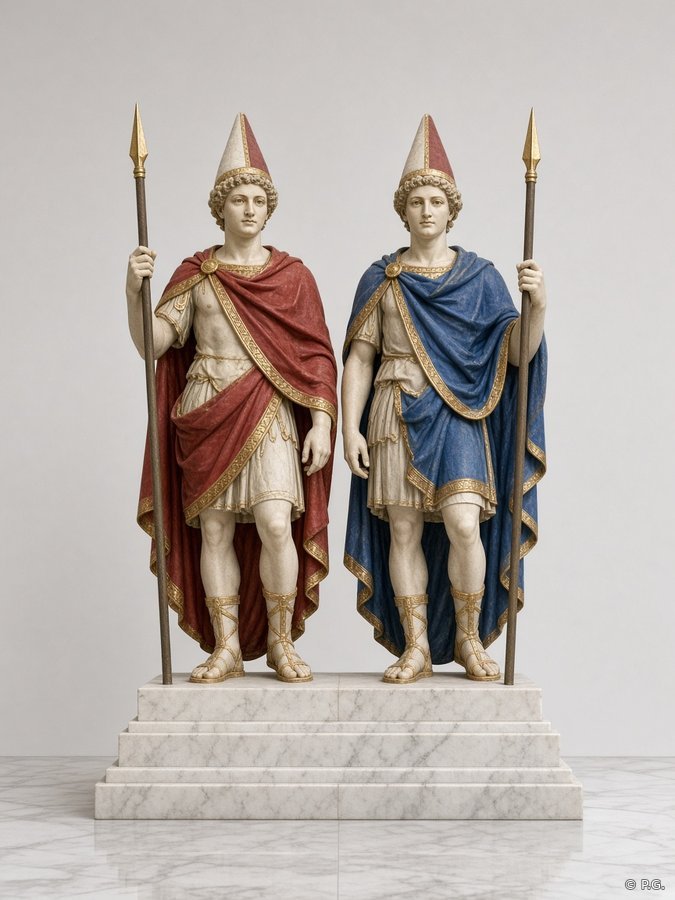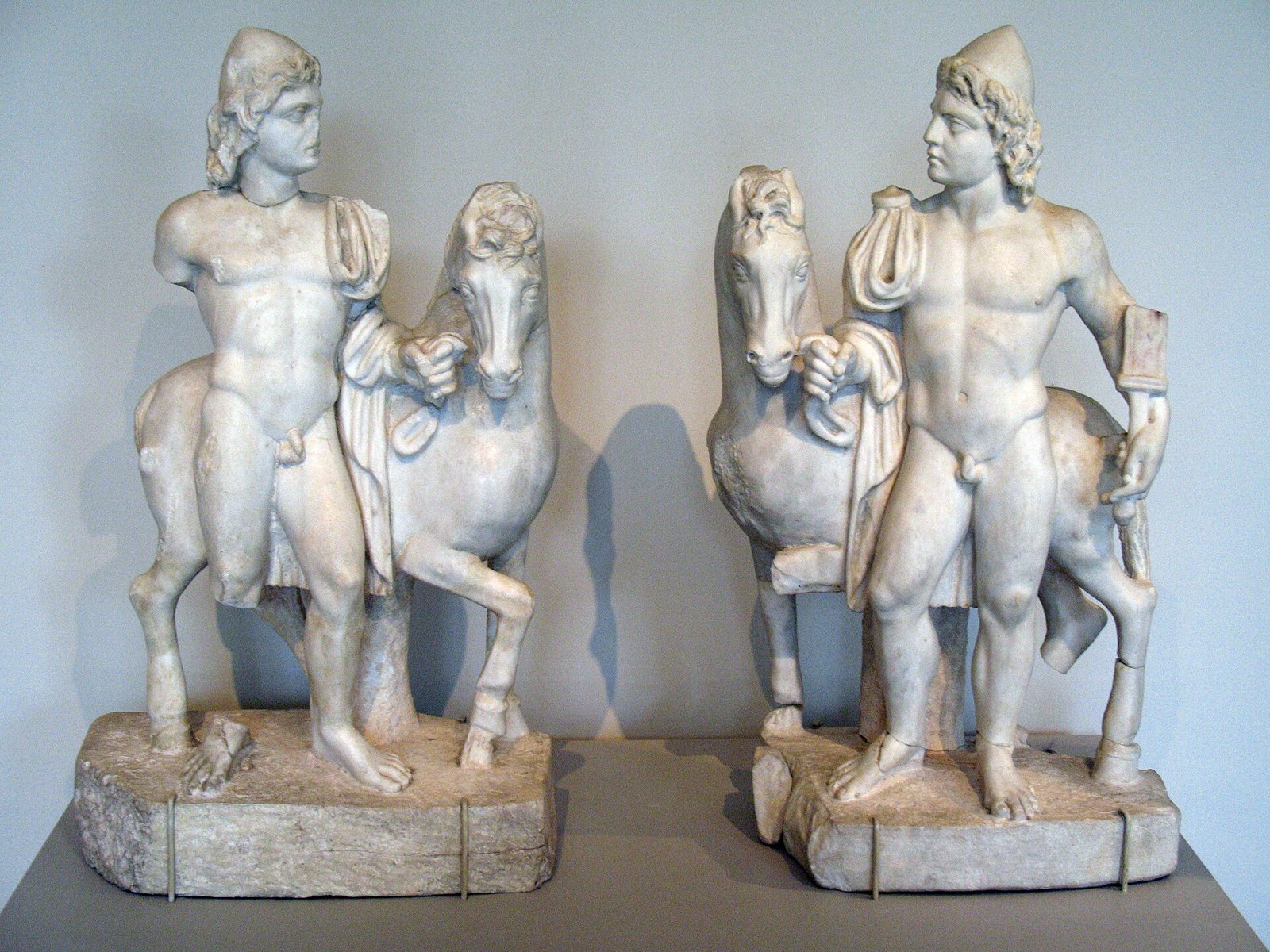
The Dioskouroi, “sons of Zeus”, are Kastor the horse-tamer and Polydeukes the boxer, born to Leda “beneath the peak of the great hill Taygetus” (Homeric Hymn 33.1–5). Homer says the earth holds them alive: they live on alternate days and are dead on alternate days, and have honour like the gods (Odyssey 11.298–304). Sailors in storm call on them, and they come darting through the air on tawny wings to still the winds and waves (Homeric Hymn 33.6–17). They are the twin guardians of Sparta.
Epithets
- Τυνδαρίδαι · Tyndaridai
- sons of Tyndareus
- Ἄνακες · Anakes
- the Lords
- Σωτῆρες · Soteres
- saviours
Domains and symbols
Brotherhood and loyalty; horsemanship and boxing; rescue at sea. Admire: fidelity between brothers and friends. Sacred symbols: the two stars, the felt caps, the horses, the dokana.
Myths
- Their birth. Born to Leda under Taygetos (Homeric Hymns 17 and 33).
- Alternate days. Polydeukes shared his immortality with his brother (Odyssey 11.298–304; Pindar, Nemean 10.55–90).
- Saviours at sea. They appear to sailors in storms (Homeric Hymn 33.6–17).
Cult sites
- Sparta. The Spartans represented them by the dokana, two upright beams joined by cross-beams (Plutarch, On Brotherly Love 478a).
Festivals
- Theoxenia. A feast at which the gods were guests, sung by Pindar for the Dioskouroi (Olympian 3).
Offerings
White lambs vowed by sailors (Homeric Hymn 33.10); a table set for two guests. Today: honour them with a shared meal and a promise kept between friends.
Beneath the Divine Mind
The Dioskouroi are the Divine Mind as union of the mortal and the immortal, personified and deified as twin brothers who share one life. Like every god they stand beneath the One (The One and the Many).
Honouring Dioskouroi today
- Altar. Two lamps side by side.
- Hymn. Recite Homeric Hymn 33.
Hymn
Bright-eyed Muses, tell of the Tyndaridae, the Sons of Zeus, glorious children of neat-ankled Leda, Castor the tamer of horses, and blameless Polydeuces.Homeric Hymn 33, To the Dioscuri, 1–3. Homeric Hymns, tr. H. G. Evelyn-White (1914), public domain.
Sources
Homeric Hymns 17 and 33; Homer, Odyssey 11.298–304; Pindar, Nemean 10, Olympian 3; Plutarch, On Brotherly Love 478a.
Quotations in public-domain translations (Evelyn-White 1914, Butler 1898/1900, Taylor 1792); other authors paraphrased.