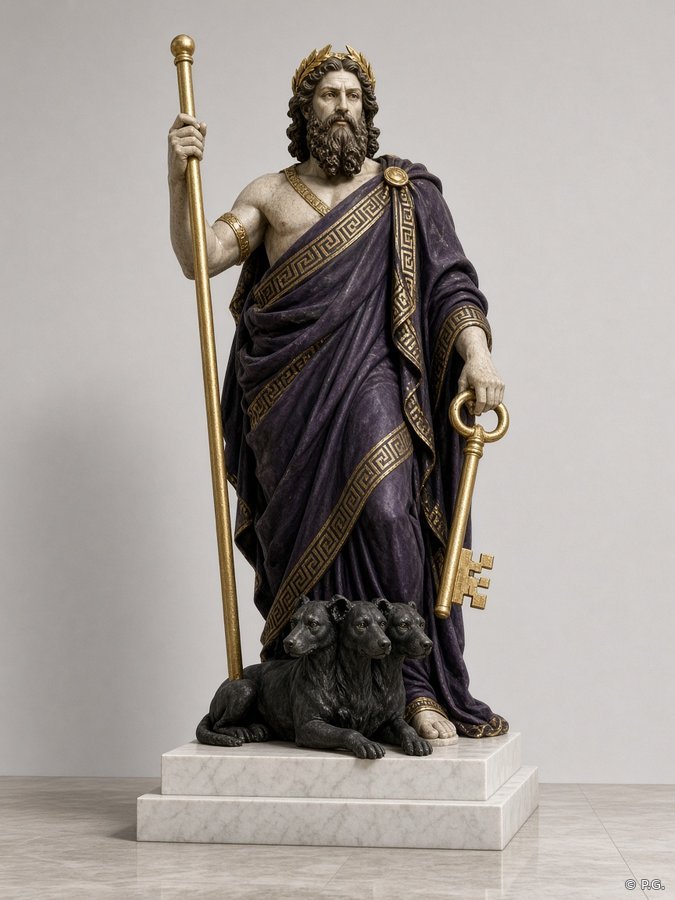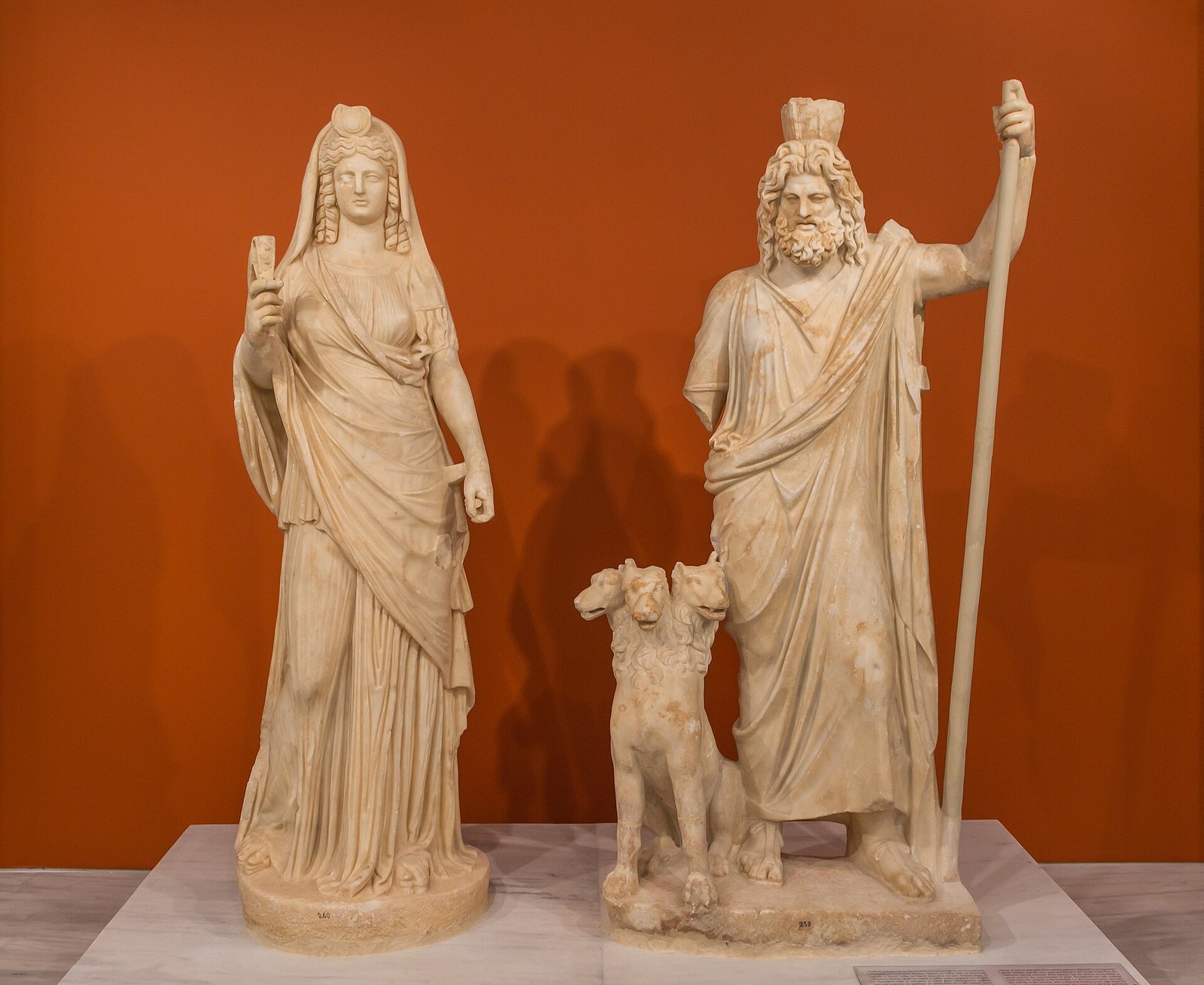
Hades, son of Kronos and Rhea, is lord of the dead (Theogony 453–456). When the sons of Kronos drew lots, Zeus took the sky, Poseidon the sea, and Hades the murky dark, while the earth and Olympus stayed common to all (Iliad 15.187–193). He carried off Persephone to be his queen, and with her he rules the house beneath the earth. The Greeks often avoided his name and called him Plouton, the giver of wealth, for grain and metals come from below.
Epithets
- Πλούτων · Plouton
- giver of wealth (Plato, Cratylus 403a)
- Πολυδέγμων · Polydegmon
- host of many, receiver of all (Homeric Hymn to Demeter 9, 17)
- Ἀϊδωνεύς · Aidoneus
- the unseen (Homeric Hymn to Demeter 2)
- Ζεὺς καταχθόνιος · Zeus Katachthonios
- Zeus beneath the earth (Iliad 9.457)
- Κλύμενος · Klymenos
- the renowned, worshipped at Hermione (Pausanias 2.35.9)
Domains and symbols
The dead and their just keeping; the riches of the earth; the boundary that no living man crosses. Admire: honouring ancestors, accepting mortality, justice that cannot be bribed. Sacred symbols: the sceptre and key, the helm of darkness, the dog Kerberos, the cypress and the narcissus.
Myths
- The lot. The three sons of Kronos divided the world by lot; Hades received the dark beneath the earth (Iliad 15.187–193).
- Persephone. With the consent of Zeus he rose from the earth in his golden chariot and carried off the daughter of Demeter; before she returned he gave her a pomegranate seed to eat, so that she must spend a third of each year with him (Homeric Hymn to Demeter 1–20, 360–374, 398–400).
- The helm of darkness. Athena put on the cap of Hades so that Ares could not see her (Iliad 5.844–845).
- Kerberos. Herakles was sent to bring up the hound of Hades (Iliad 8.366–369; Odyssey 11.623–626).
Cult sites
- Elis. A sanctuary of Hades opened once a year, and even then only the priest might enter (Pausanias 6.25.2–3).
- The Acheron. The oracle of the dead on the river Acheron in Thesprotia, where Periander consulted his dead wife (Herodotus 5.92).
- Eleusis. He was honoured with Persephone in the sanctuary of the Two Goddesses.
Offerings
Black victims and libations poured into a pit, with the face turned away: so Odysseus sacrificed at the edge of the world and prayed to “mighty Hades and dread Persephone” (Odyssey 10.524–534, 11.29–47). Today: a libation of dark wine or water poured on the ground, honey cakes, and the names of the family dead spoken aloud.
Beneath the Divine Mind
Hades is the Divine Mind as the hidden: its keeping of all that has passed out of sight, personified and deified as the king of the unseen. Like every god he stands beneath the One (The One and the Many). He still acts wherever the dead are honoured and a life is weighed justly.
Honouring Hades today
- Altar. A dark cloth, a cypress sprig or a narcissus.
- Offerings. Dark wine, water or honey poured on the earth.
- The dead. Remember the family dead by name, as at the Genesia in Boedromion.
- Hymn. Recite the Orphic hymn below.
Hymn
Hades, magnanimous, whose realms profound are fix’d beneath the firm and solid ground, in the Tartarian plains remote from fight, and wrapt forever in the depths of night; terrestrial Zeus, thy sacred ear incline, and, pleas’d, accept thy mystic’s hymn divine.Orphic Hymn 18, To Plouton, 1–4 (Taylor 17). Tr. Thomas Taylor (1792), public domain; divine names as given on Hemera.
Images
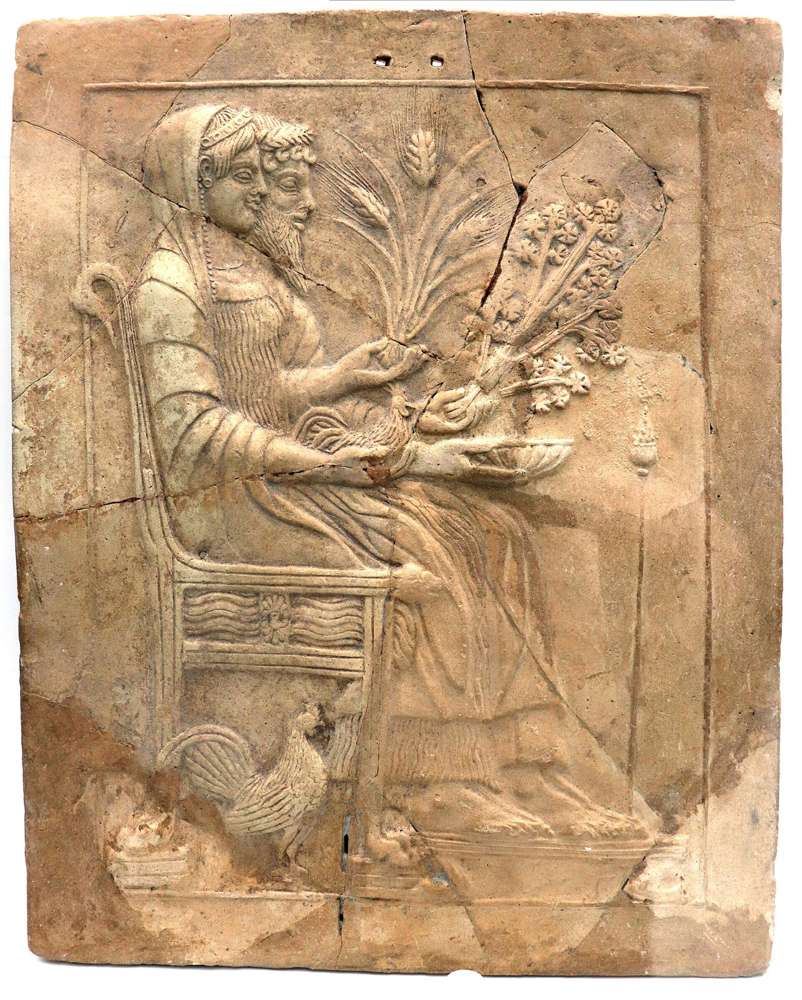
Fabien Bièvre-Perrin, CC BY-SA 4.0, via Wikimedia Commons

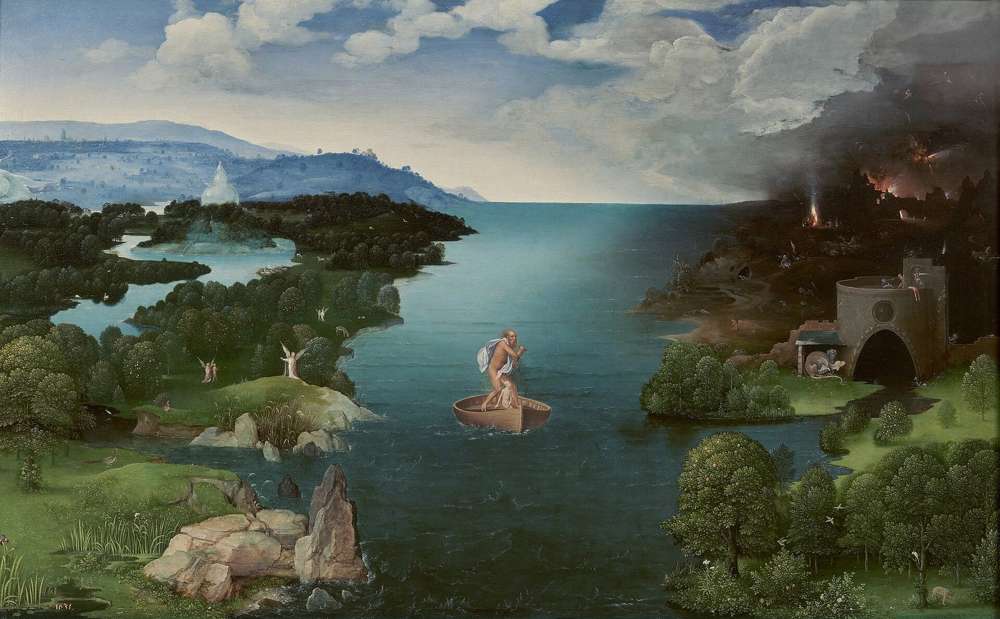
Joachim Patinir, Public domain, via Wikimedia Commons

Sources
Homer, Iliad 5.844–845, 8.366–369, 9.457, 15.187–193; Odyssey 10.524–534, 11.29–47, 11.623–626; Hesiod, Theogony 453–456; Homeric Hymn to Demeter; Orphic Hymn 18; Plato, Cratylus 403a; Herodotus 5.92; Pausanias 2.35.9 and 6.25.2–3.
Quotations in public-domain translations (Evelyn-White 1914, Butler 1898/1900, Taylor 1792); other authors paraphrased.