Apollo, son of Zeus and Leto, is the god of prophecy, music, healing and purification. At Delphi his priestess spoke his oracles; at Sparta the greatest festivals of the year, the Karneia, the Hyakinthia and the Gymnopaidiai, were his. He bears the crimson of Laconia on this site.
Epithets
- Φοῖβος · Phoibos
- the bright
- Πύθιος · Pythios
- of Pytho, Delphi
- Δήλιος · Delios
- of Delos
- Λοξίας · Loxias
- the oblique, for his riddling oracles
- Παιάν · Paian
- the healer
- Ἑκατηβόλος · Hekatebolos
- far-shooter
- Μουσαγέτης · Mousagetes
- leader of the Muses
- Κάρνειος · Karneios
- of the Karneia, the Dorian festival
- Ἀμυκλαῖος · Amyklaios
- of Amyklai near Sparta
- Λύκειος · Lykeios
- honoured at the Lykeion in Athens
Myths
- Birth on Delos. Leto wandered until the island of Delos received her, and there she bore Apollo by the palm tree (Homeric Hymn to Apollo 25–126).
- The serpent of Pytho. Apollo slew the she-dragon at Pytho and founded his oracle; the place was named from the rotting of the serpent (Hymn to Apollo 300–374).
- The Cretan priests. In the form of a dolphin he led a Cretan ship to Krisa and made its crew his priests, as Apollo Delphinios (Hymn to Apollo 388–544).
- Hyakinthos. The Amyklaian youth loved by Apollo was killed by a cast discus; the Hyakinthia mourned and celebrated him (Apollodorus 1.3.3; Pausanias 3.19.4–5).
Cult sites
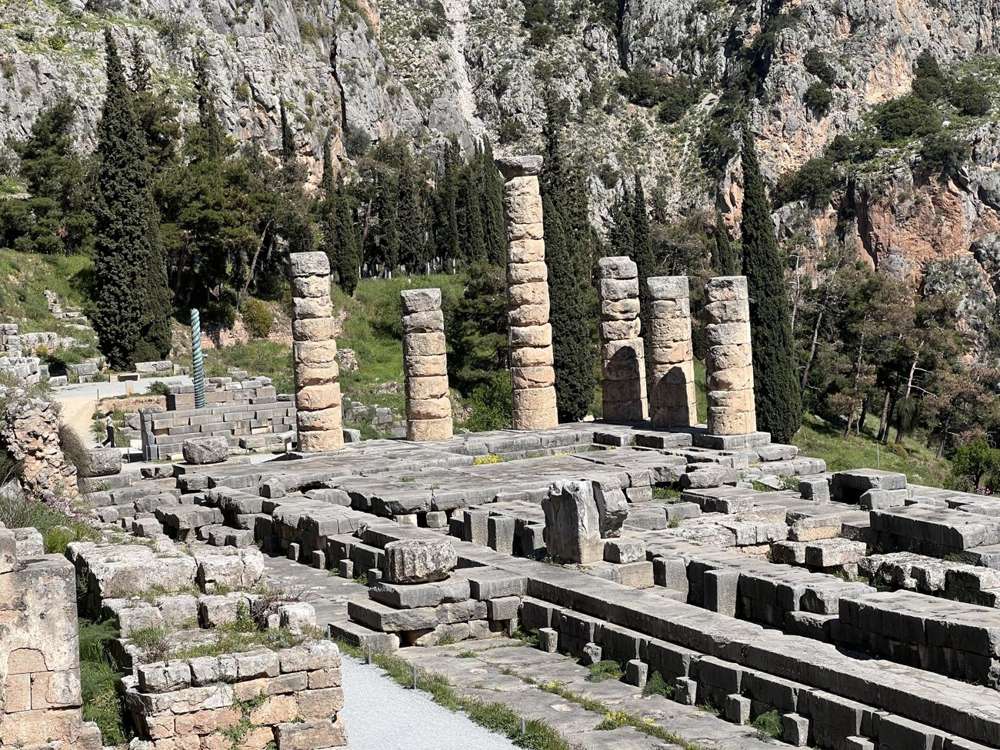
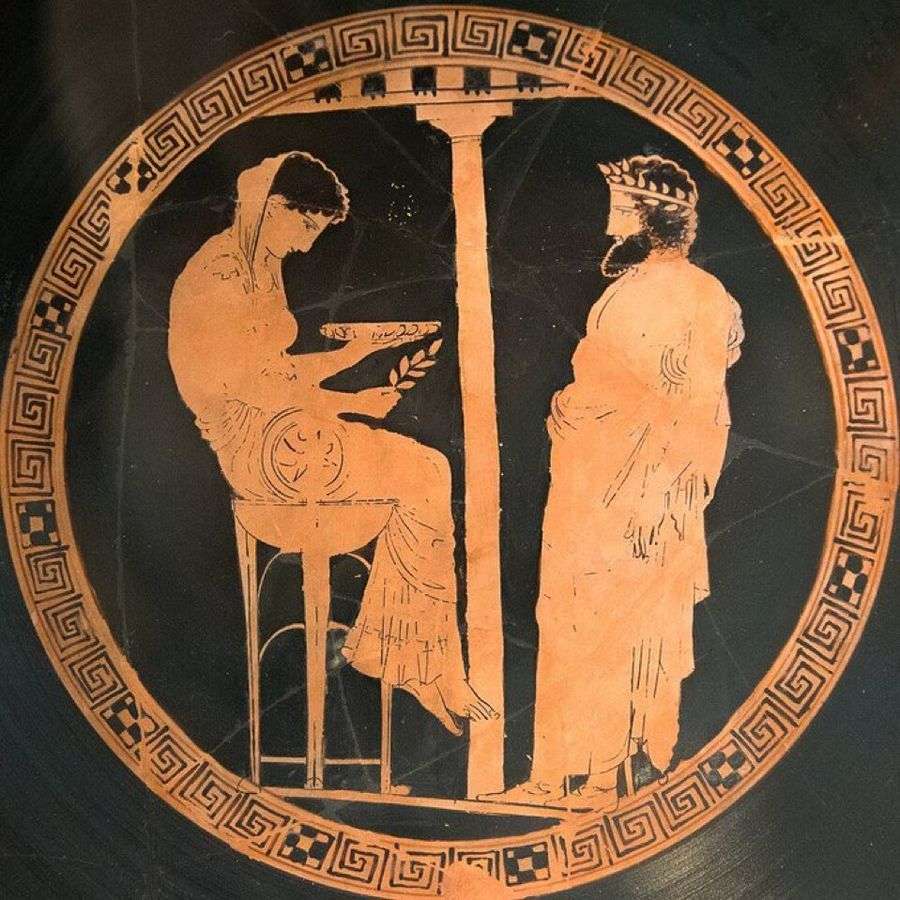
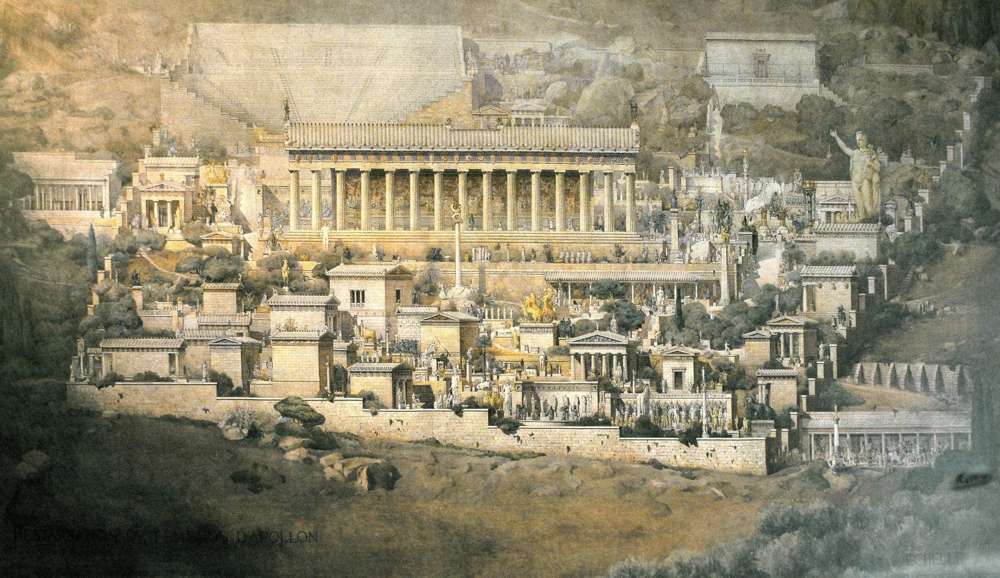
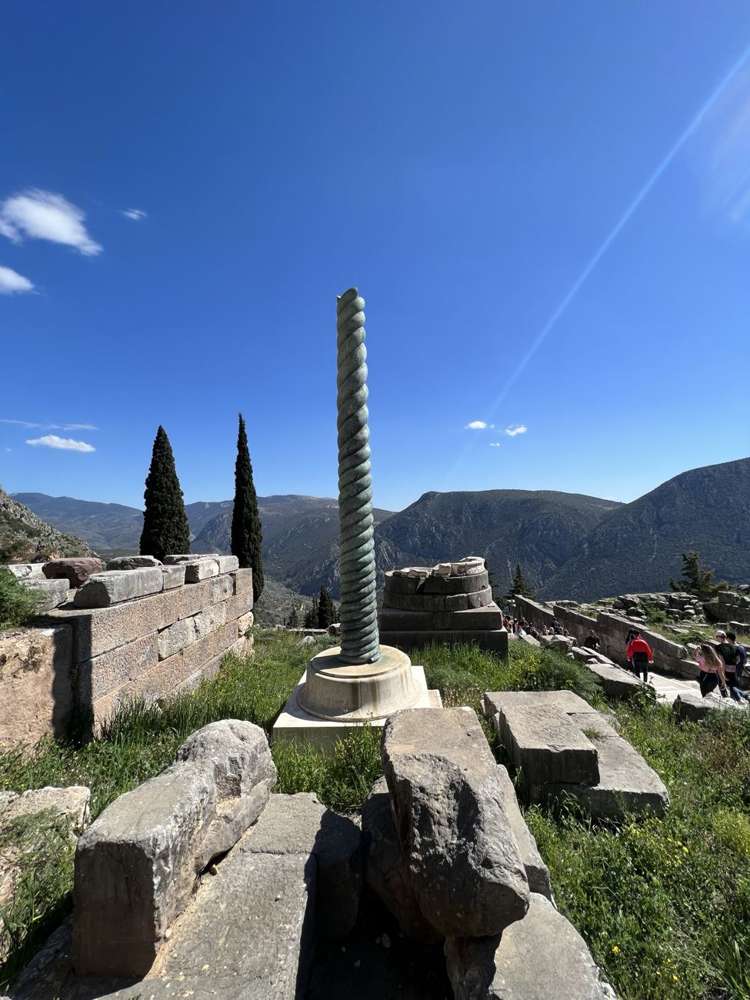
- Delphi. The navel of the earth, where the Pythia prophesied from the tripod; the forecourt of the temple bore the maxims “Know thyself” and “Nothing in excess” (Pausanias 10.24.1).
- Delos. His birthplace and the sacred island of the Ionians (Thucydides 3.104).
- Amyklai. The throne of Apollo built by Bathykles near Sparta (Pausanias 3.18.9–3.19.5).
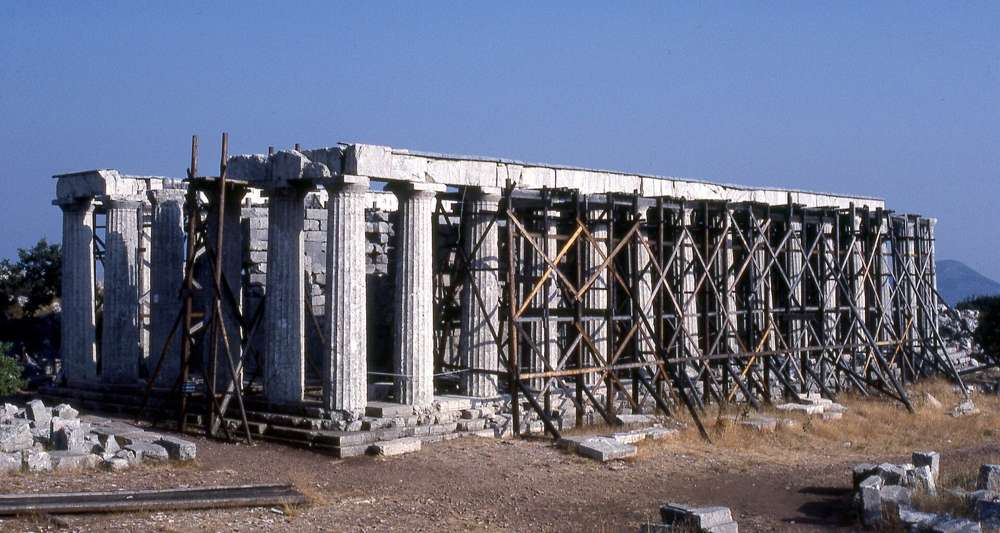
- Bassai. The temple of Apollo Epikourios in Arcadia, by Iktinos (Pausanias 8.41.7–9).
Festivals
- Karneia. The Dorian festival in the month Karneios, during which the Spartans would not march (Herodotus 7.206; Thucydides 5.75).
- Hyakinthia. A three-day Spartan festival at Amyklai, first mourning then joyful (Herodotus 9.7; Xenophon, Hellenica 4.5.11).
- Gymnopaidiai. Choruses of boys and men dancing in the agora of Sparta (Herodotus 6.67; Pausanias 3.11.9).
- Pythian Games. Musical and athletic contests at Delphi every fourth year.
- Thargelia. Athenian festival on 6–7 Thargelion with first fruits and purification.
Offerings
Laurel, sacred to Apollo, crowned his victors at Delphi; first fruits were brought at the Thargelia, and boys carried the eiresione, an olive branch hung with wool and fruits, at the Pyanepsia. Paeans and the music of the lyre are the offerings he loves best.
Further epithets
- Σμινθεύς · Smintheus
- of the mice, invoked by his priest Chryses (Iliad 1.39)
- Πατρῷος · Patroos
- ancestral, father of Ion and of the Ionians, with a temple in the Athenian Agora
- Ἀγυιεύς · Agyieus
- of the streets, whose pillar stood before Athenian doors
- Ἐπικούριος · Epikourios
- the helper, who stayed the plague at Bassai (Pausanias 8.41.7–9)
- Ἀλεξίκακος · Alexikakos
- averter of evil (Pausanias 1.3.4)
Birth and the primary sources
Apollo is the son of Zeus and Leto, twin of Artemis (Theogony 918–920). The Homeric Hymn to Apollo tells his birth on Delos. Leto wandered over every land, and none dared receive her, until barren, rocky Delos agreed when she swore that her son would build his temple there. For nine days and nights she laboured, for Hera kept Eileithyia away; then the goddesses sent Iris with a necklace nine cubits long to bring her. Leto threw her arms around the palm tree and knelt on the soft meadow, and the child leapt into the light while all the goddesses cried out (Hymn 3.25–126). Fed on nectar and ambrosia, he burst his golden bands and declared: "The lyre and the curved bow shall be dear to me, and I will declare to men the unfailing will of Zeus" (131–132). Delos blossomed with gold.
The second half of the Hymn tells how he founded Delphi. He shot the great she-serpent who guarded the spring and let her body rot in the sun, from which the place and the god were called Pytho and Pythios (300–374). Taking the form of a dolphin, he leapt aboard a Cretan ship and brought its crew to Krisa to be his first priests (388–544). The pilgrimage page describes the sanctuary itself, and the Delphic E its riddle.
The Iliad opens with the god's wrath: Agamemnon dishonoured his priest Chryses, and Apollo came down from Olympus "like the night", the arrows rattling on his shoulders, and shot plague into the Achaean camp for nine days (Iliad 1.43–52). Euripides's Alkestis begins with his service as herdsman to King Admetos, a penalty for killing the Cyclopes (Alcestis 1–9). Pindar tells of his love for the nymph Kyrene, whom he saw wrestling a lion (Pythian 9.5–70), and of the birth of Asklepios from Koronis (Pythian 3.8–46). Ovid tells of Daphne turned into the laurel as he pursued her, and of Hyacinthus killed by his discus (Metamorphoses 1.452–567; 10.162–219). Callimachus's Hymn to Apollo celebrates his epiphany at Kyrene and his love of order in poetry (Hymn 2).
Domains and symbols
Apollo is the god of prophecy and the oracle, of music and the lyre, of poetry and the Muses, of healing and of the plague that his arrows send, of purification from bloodshed, of young men coming of age, of colonies, and of the bright measure expressed in the Delphic sayings "Know thyself" and "Nothing in excess". He carries the bow and the lyre, the kithara. The laurel is his, worn by the Pythia and the victors at the Pythian Games; so are the palm of Delos, the swan, the raven, the wolf, the dolphin and the cicada. The tripod is his throne of prophecy. Later authors identify him with Helios, the Sun.
Sanctuaries and cults
Beyond Delphi and Delos, Apollo had oracles at Didyma near Miletos, at Klaros near Kolophon, at Abai in Phokis, and on the Ptoion in Boeotia. His temple at Bassai in Arcadia, built by Iktinos, architect of the Parthenon, stands high in the mountains (Pausanias 8.41.7–9). At Amyklai near Sparta the Hyakinthia mourned and celebrated Hyakinthos each summer, and at Sparta the Karneia honoured Apollo Karneios in the month Karneios.
At Athens the seventh day of every month was his birthday. The festivals of the Attic year included the Thargelia on 6–7 Thargelion, with the first-fruit bread thargelos and the purifying pharmakoi; the Pyanopsia on 7 Pyanopsion, with a dish of boiled beans and the eiresione, an olive branch hung with wool and fruits; the Boedromia in Boedromion; and the Metageitnia in Metageitnion. Every fourth year Athens sent a sacred embassy, the Pythais, to Delphi, and every year the sacred ship went to Delos; no execution could take place while it was away, which is why Socrates lived thirty days after his sentence (Plato, Phaedo 58a–c).
Statues and art
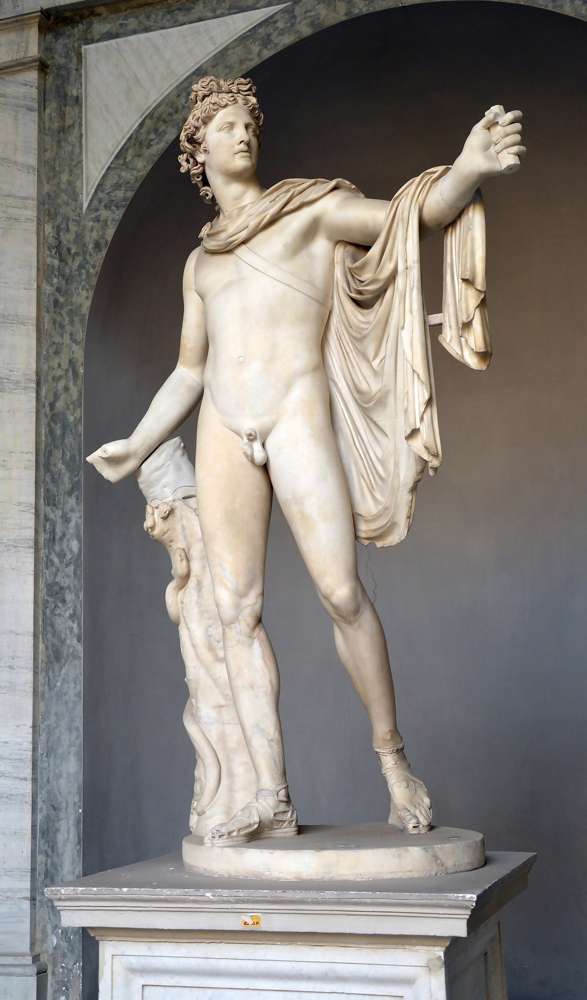
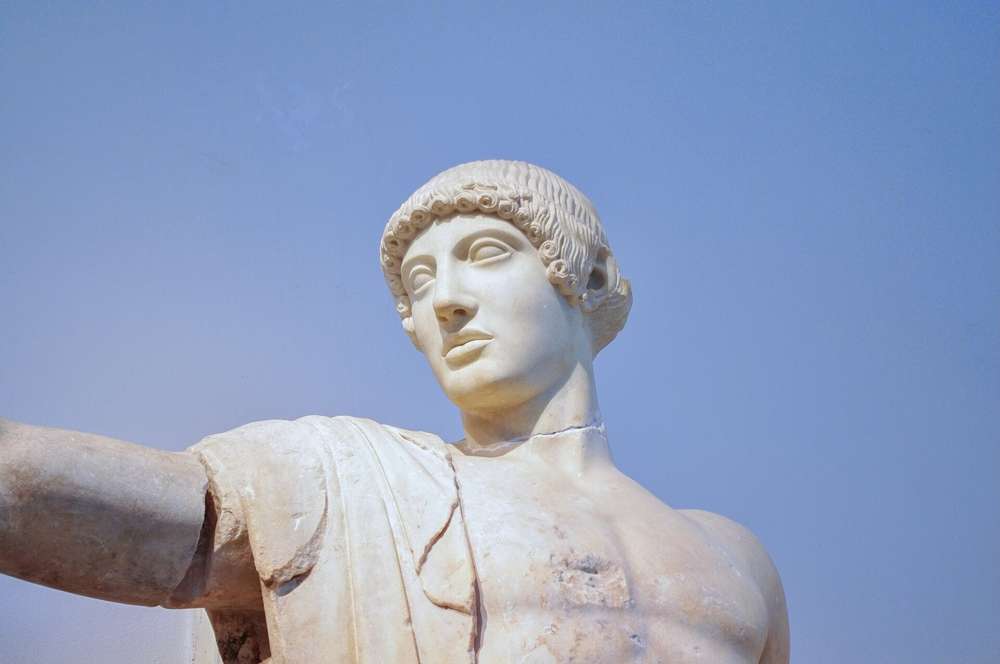
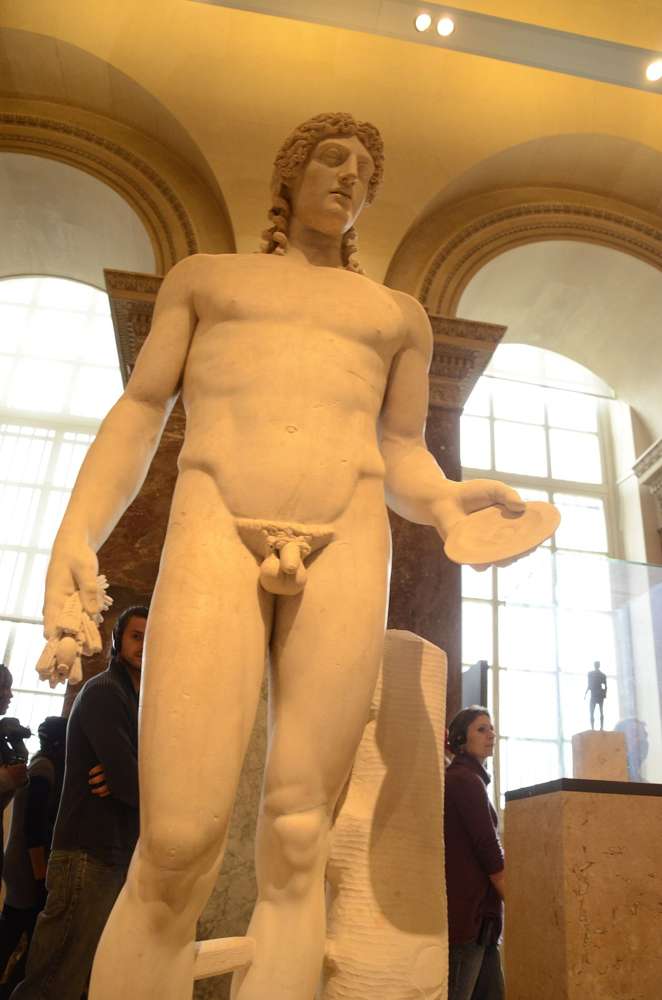
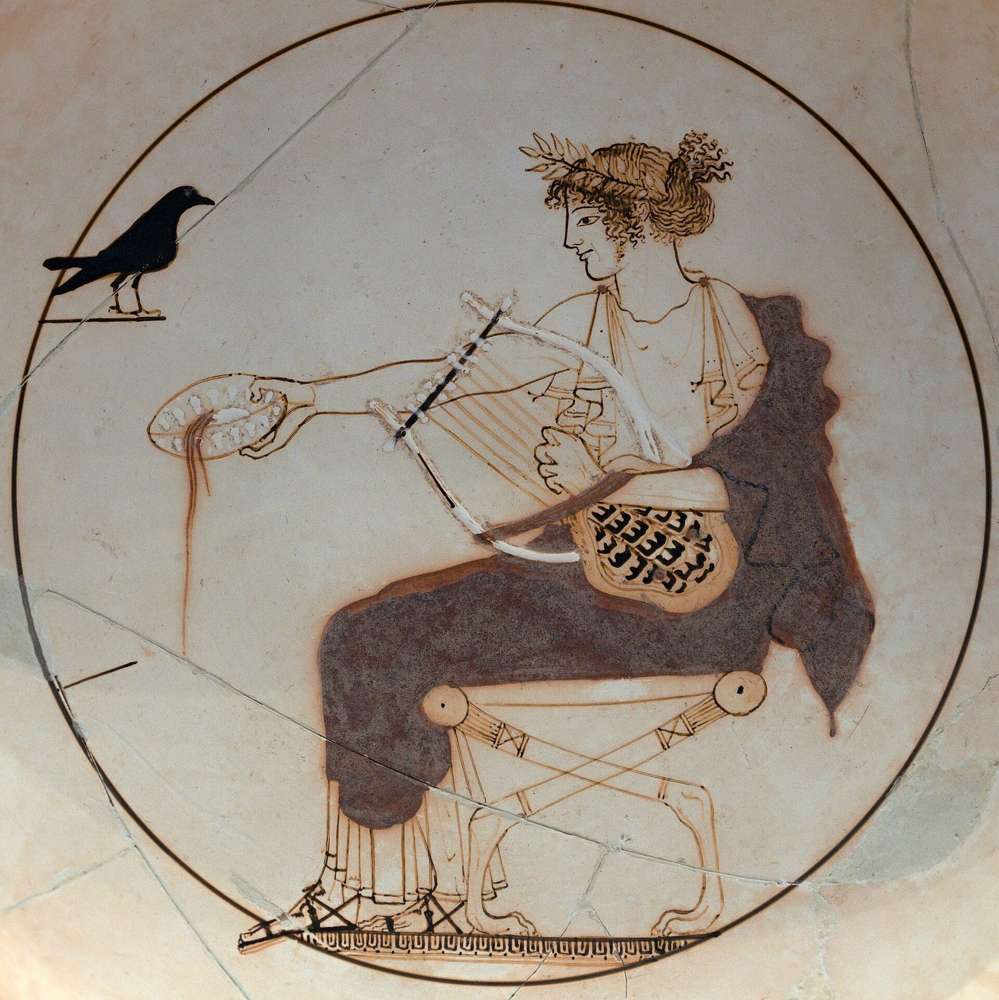
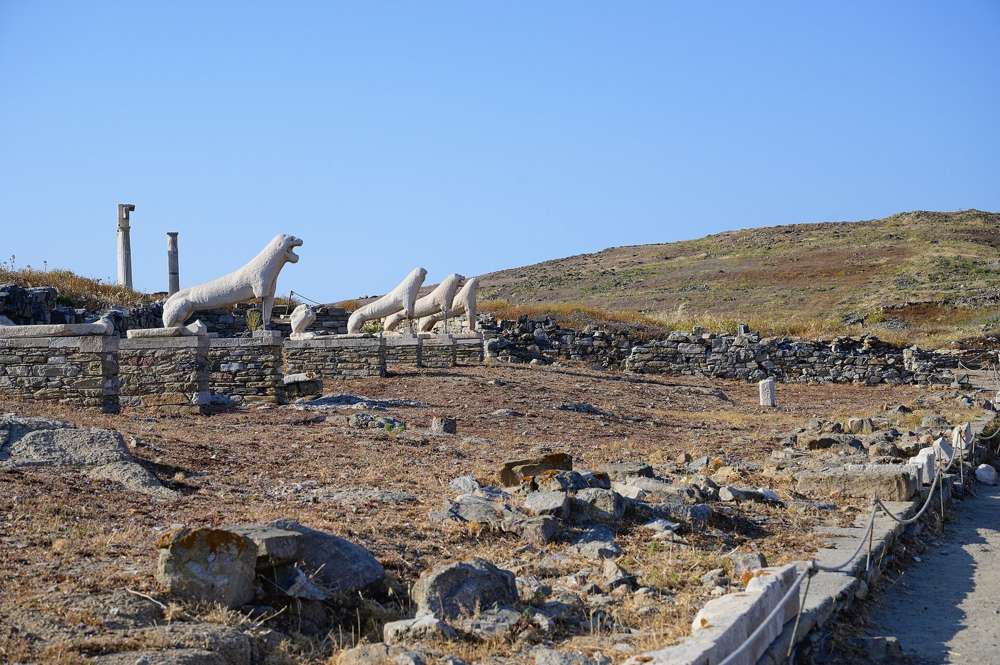
On the west pediment of the temple of Zeus at Olympia, about 460 BC, Apollo stands at the centre with arm outstretched, calm amid the battle of Lapiths and Centaurs. The Kassel Apollo, after a bronze of about 450 BC associated with Pheidias, shows the grave early classical type. The Apollo Belvedere, shown above, is a Roman copy after Leochares. Praxiteles made the Sauroktonos, the young Apollo watching a lizard (Pliny, Natural History 34.70). A white-ground kylix of about 470 BC found at Delphi shows the god himself pouring a libation, laurel-crowned, a raven before him. The colossal Naxian Apollo on Delos and the Terrace of the Lions, guarding the sacred lake where he was born, are the island's archaic monuments.
Beneath the Divine Mind
Apollo is the Divine Mind as light and measure: its clarity, harmony and foreknowledge, fractured off, personified and deified as the god who speaks the will of Zeus. The lyre's tuned intervals and the oracle's word are both Mind's proportion made audible. He stands beneath the One, whom, as Plotinus records, the Pythagoreans called Apollo, "not many" (Enneads 5.5.6); The One and the Many gives the doctrine. He still acts in human affairs wherever music is made well, a sickness is healed, or a person comes to know himself.
Honouring Apollo today
- Offerings. Laurel, frankincense, honey cakes, the first fruits of the season, and music: a song or a piece played for him.
- The seventh day. Keep the seventh of each lunar month as his birthday with a laurel sprig and a hymn, and Sunday, the day of the Sun, for prayer.
- The months. Keep the Thargelia on 6–7 Thargelion and the Pyanopsia on 7 Pyanopsion with a pot of beans and an eiresione hung on the door for the year.
- Purification. Wash with lustral water before prayer, as at the Castalian spring.
- Hymn. Recite the Homeric Hymn above or the opening of Hymn 3, "I will remember and not forget Apollo who shoots afar".
Hymn
Phoebus, of you even the swan sings with clear voice to the beating of his wings, as he alights upon the bank by the eddying river Peneus; and of you the sweet-tongued minstrel, holding his high-pitched lyre, always sings both first and last. And so hail to you, lord! I seek your favour with my song.Homeric Hymn 21, To Apollo. Homeric Hymns, tr. H. G. Evelyn-White (1914), public domain.
Images
Michael Nicht, CC BY-SA 4.0, via Wikimedia Commons

SpirosK photography, Public domain, via Wikimedia Commons

Zde, Public domain, via Wikimedia Commons

Mark Landon, CC0, via Wikimedia Commons

Zde, CC BY-SA 4.0, via Wikimedia Commons

Sources
Homeric Hymn to Apollo (3); Homer, Iliad 1; Hesiod, Theogony; Pindar, Pythian 3 and 9; Aeschylus, Eumenides; Euripides, Alcestis; Callimachus, Hymn 2; Plato, Phaedo; Pliny, Natural History 34; Ovid, Metamorphoses 1 and 10; Pausanias 1.3 and 8.41.
Quotations in public-domain translations (Evelyn-White 1914, Butler 1898/1900, Taylor 1792); other authors paraphrased.