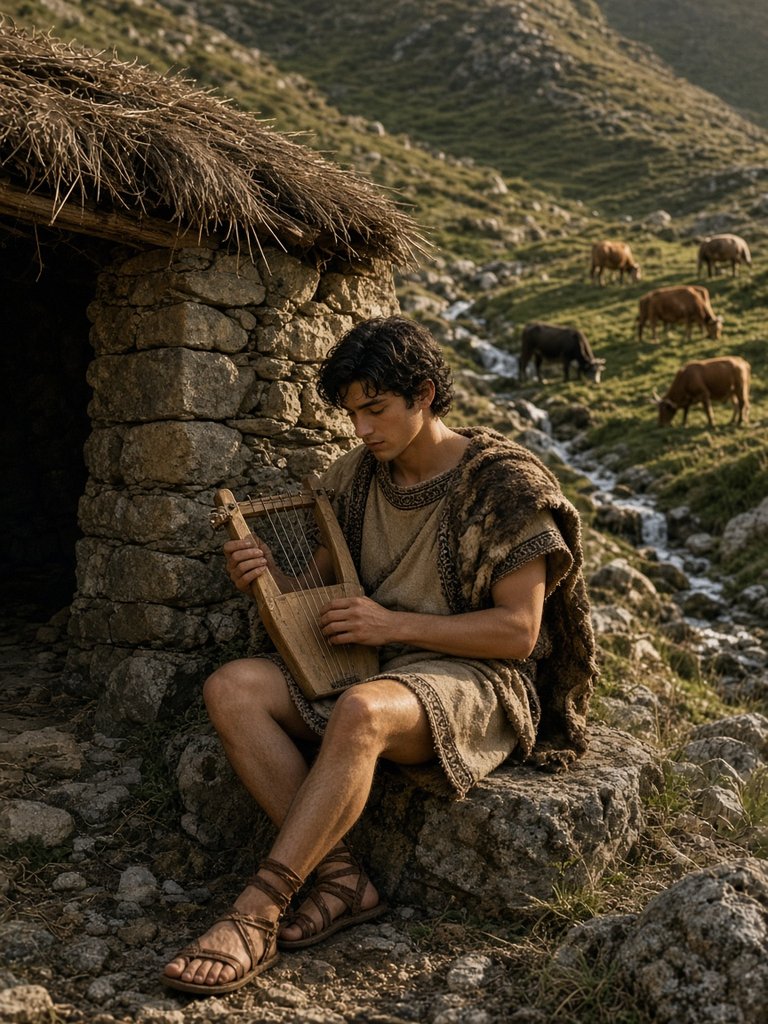
Anchises, son of Kapys, was a prince of the Dardanian line of Troy (Iliad 20.230–240, paraphrased). The Iliad says that the Dardanians were led by “brave Aeneas, whom Venus bore to Anchises, when she, goddess though she was, had lain with him upon the mountain slopes of Ida” (Iliad 2.819–821, tr. Butler).
The Homeric Hymn to Aphrodite tells the story. Zeus put in the goddess desire for “Anchises who was tending cattle at that time among the steep hills of many-fountained Ida, and in shape was like the immortal gods” (Hymn 5.53–55, tr. Evelyn-White). She came to him disguised as a mortal maiden, and only afterwards revealed herself, foretelling the birth of Aineias and warning him never to boast of their union (Hymn 5.81–290, paraphrased).
Later poets said that he did boast, and was lamed or blinded by Zeus’s thunderbolt. When Troy fell, Aineias carried him from the burning city on his shoulders; he died on the voyage west at Drepanon in Sicily, where his son held funeral games for him (Virgil, Aeneid 2.634–729, 3.707–715, 5.42–603, paraphrased). He had bred his horses from the immortal stock of Laomedon (Iliad 5.265–272, paraphrased).
Epithets
- Ἀγχίσης · Anchisēs
- Anchises
Symbols and virtues
Mortal beauty loved by a goddess, and filial piety. Symbols: the herdsman’s lyre, the son carrying his father.
Myths
- Father of Aineias by Aphrodite. Iliad 2.819–821.
- The goddess on Mount Ida. Homeric Hymn to Aphrodite 53–290.
- His horses. Iliad 5.265–272.
- Carried from Troy. Virgil, Aeneid 2.707–729.
- Death in Sicily. Virgil, Aeneid 3.707–715.
Cult and places
- Arkadia. A tomb of Anchises was shown at the foot of Mount Anchisia (Pausanias 8.12.8).
In the poets
“Brave Aeneas, whom Venus bore to Anchises, when she, goddess though she was, had lain with him upon the mountain slopes of Ida.”Homer, Iliad 2.819–821, tr. Samuel Butler (1898), public domain.
Sources
Homer, Iliad 2.819–821, 5.265–272, 20.215–240; Homeric Hymn 5 to Aphrodite; Virgil, Aeneid 2, 3.707–715, 5; Pausanias 8.12.8.
Quotations in public-domain translations (Evelyn-White 1914, Butler 1898/1900, Taylor 1792); other authors paraphrased.