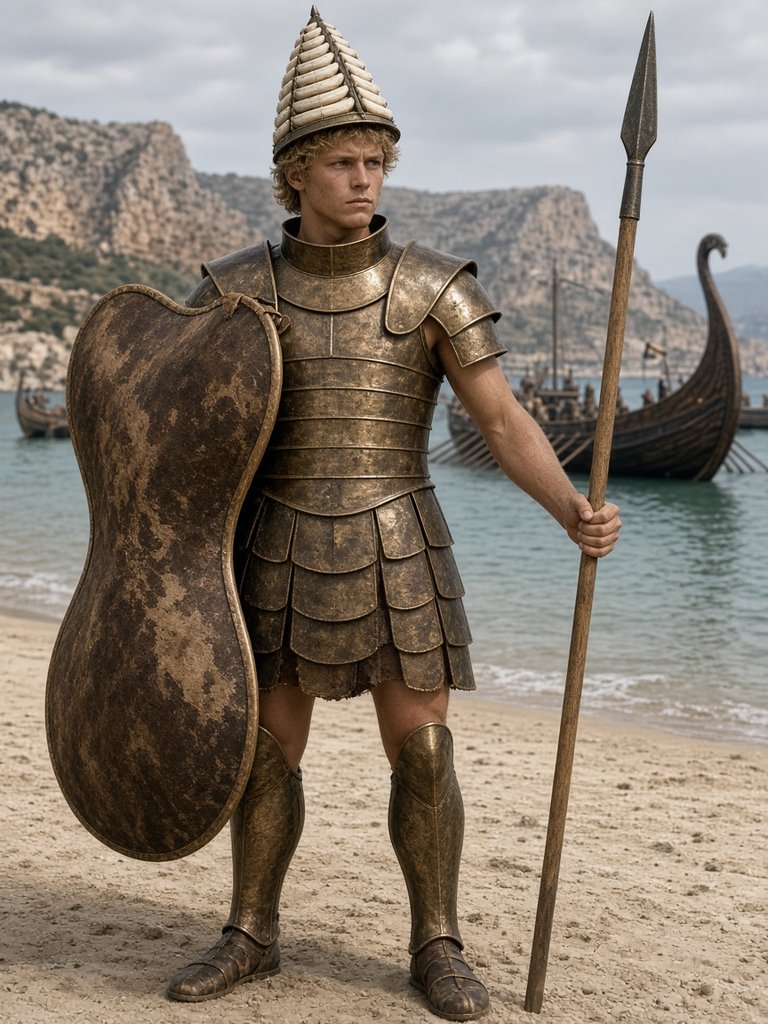
Achilles is the son of the mortal king Peleus and the sea-goddess Thetis; Hesiod ends his Theogony with the goddesses who bore children to men, and tells that “the silver-shod goddess Thetis was subject to Peleus and brought forth lion-hearted Achilles, the destroyer of men” (Theogony 1006–1007, tr. Evelyn-White). The Iliad begins with him: “Sing, O goddess, the anger of Achilles son of Peleus, that brought countless ills upon the Achaeans” (Iliad 1.1–2, tr. Butler).
Achilles knows his choice. He tells the envoys of Agamemnon: “My mother Thetis tells me that there are two ways in which I may meet my end. If I stay here and fight, I shall not return alive but my name will live for ever: whereas if I go home my name will die, but it will be long ere death shall take me” (Iliad 9.410–416, tr. Butler). Dishonoured by Agamemnon, he withdraws from the war; when Hektor kills his friend Patroklos he returns in new armour made by Hephaistos, kills Hektor, and at last gives back the body to old Priam, weeping with him (Iliad 18–24).
He died at Troy by the arrow of Paris and Apollo. In the underworld his shade tells Odysseus: “I would rather be a paid servant in a poor man’s house and be above ground than king of kings among the dead” (Odyssey 11.489–491, tr. Butler). The Aethiopis told that Thetis snatched him from the pyre and carried him to the White Island, Leuke, in the Black Sea (Proclus, Chrestomathy, paraphrased). There, and at Sparta and Elis, he was worshipped as a hero: the Spartan youths sacrificed to him before their ritual fight in the Plane-tree Grove, and the women of Elis mourned him at his cenotaph at sunset (Pausanias 3.19.11–13, 3.20.8, 6.23.3, paraphrased).
Epithets
- ποδάρκης · podarkēs
- swift-footed (Iliad 1.121)
- θυμολέων · thumoleōn
- lion-hearted (Theogony 1007)
- ῥηξήνωρ · rhēxēnōr
- breaker of men (Theogony 1007)
Symbols and virtues
The short life and the deathless name; anger, grief and, at the end, pity. Symbols: the ash spear from Pelion, the shield made by Hephaistos, the horses Xanthos and Balios, the lyre he played in his tent.
Myths
- Son of Thetis. Theogony 1006–1007.
- The anger. Iliad 1.
- The two fates. Iliad 9.410–416.
- The shield. Iliad 18.478–608.
- Hektor and Priam. Iliad 22, 24.
- Leuke, the White Island. Proclus, Chrestomathy (Aethiopis); Pausanias 3.19.11–13.
Cult and places
- Sparta. Sanctuary where the youths sacrificed before fighting at the Plane-tree Grove (Pausanias 3.20.8).
- Elis. Cenotaph where the women mourned him (Pausanias 6.23.3).
- Leuke, Black Sea. Island sacred to him (Pausanias 3.19.11–13).
In the poets
“My mother Thetis tells me that there are two ways in which I may meet my end. If I stay here and fight, I shall not return alive but my name will live for ever”Homer, Iliad 9.410–413, tr. Samuel Butler (1898), public domain.
Sources
Hesiod, Theogony 1006–1007; Homer, Iliad 1, 9.410–416, 18–24; Odyssey 11.467–540, 24.36–94; Proclus, Chrestomathy (Aethiopis); Pausanias 3.19.11–13, 3.20.8, 6.23.3.
Quotations in public-domain translations (Evelyn-White 1914, Butler 1898/1900, Taylor 1792); other authors paraphrased.