Mission · Temple of the Hellenic Pantheon
TEMPLE OF THE HELLENIC PANTHEON
Mission
ΣΚΟΠΟΣ
DEDICATION
This Temple is dedicated to the gods of Hellas, and to a double task: to revive their worship, and to raise a living skeleton on which the flesh of Greek antiquity can hang once more: its rites and festivals, its sanctuaries and priesthoods, its myths, its philosophers and its history.

Why did the West forget this tradition while seeking the same goals in the East? See P.G., The Forgotten Ithaca: Hellenic Polytheism and the Eastward Turn of Western Spirituality since 1950 (2026).
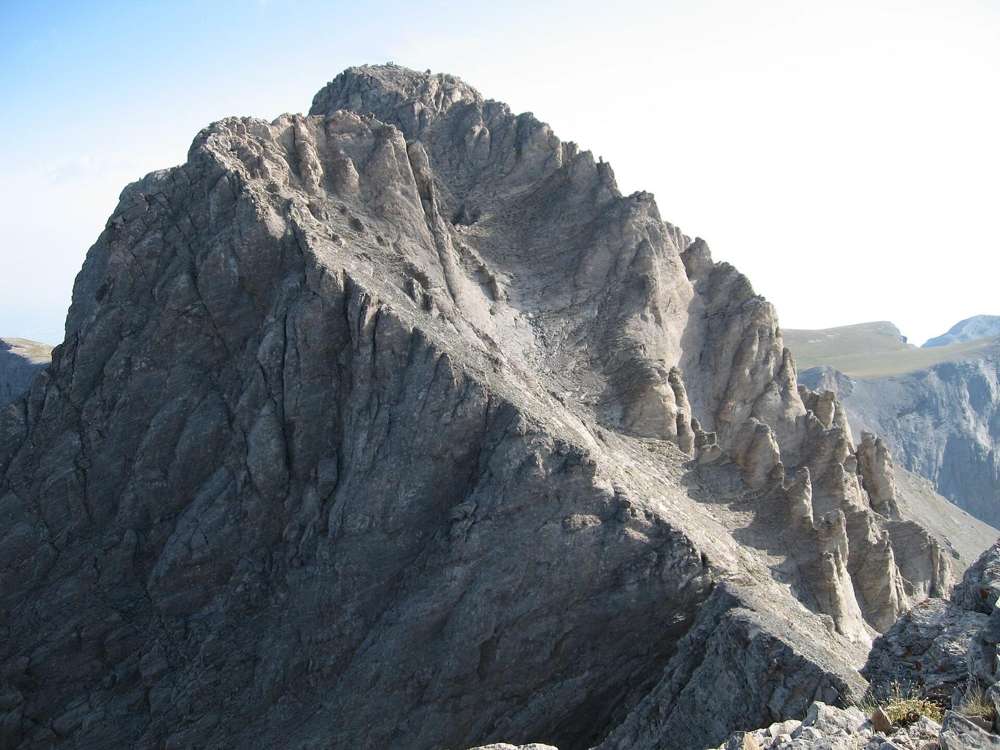
The rocky summit of Mytikas, highest peak of Mount Olympus, seen from the neighbouring Skala summit
MT OLYMPUSHome of the Gods. Mytikas, the highest summit, seen from Skala. Photo: Melkov (derivative by Hike395), CC0, via Wikimedia Commons.

The Temple of the Hellenic Pantheon exists to restore the worship of the gods of Hellas, and with it the understanding that gave Greek and Roman civilization its form. We keep the sacred year, its rites, hymns and offerings. We rebuild, in stone, image and study, the temples, cities and works of art in which that worship lived. And we stand with the communities in Greece, Italy and around the world who have already begun this return.

The Ladder to Divinity (ἀναγωγή, anagōgē)

The ladder to divinity is the soul’s ordered ascent from the life of the body to union with the divine. It is the soul’s natural desire: having fallen from its divine source into birth, it longs to return home (Plotinus, Enneads IV.8, VI.9.9). The Neoplatonists called the ascent anagōgē (ἀναγωγή, “leading upward”). Plato pictures it in the Symposium as a climb “as if by steps” (ἐπαναβασμοῖς, epanabasmois), from beautiful bodies to beautiful souls, to beautiful knowledge, and at last to Beauty itself (211b–c). Its rungs are aretē, which purifies the soul; nous, which the purified soul awakens; and henōsis, union with the One. Theurgy, the work of the rites, is the means by which the gods help the soul climb.
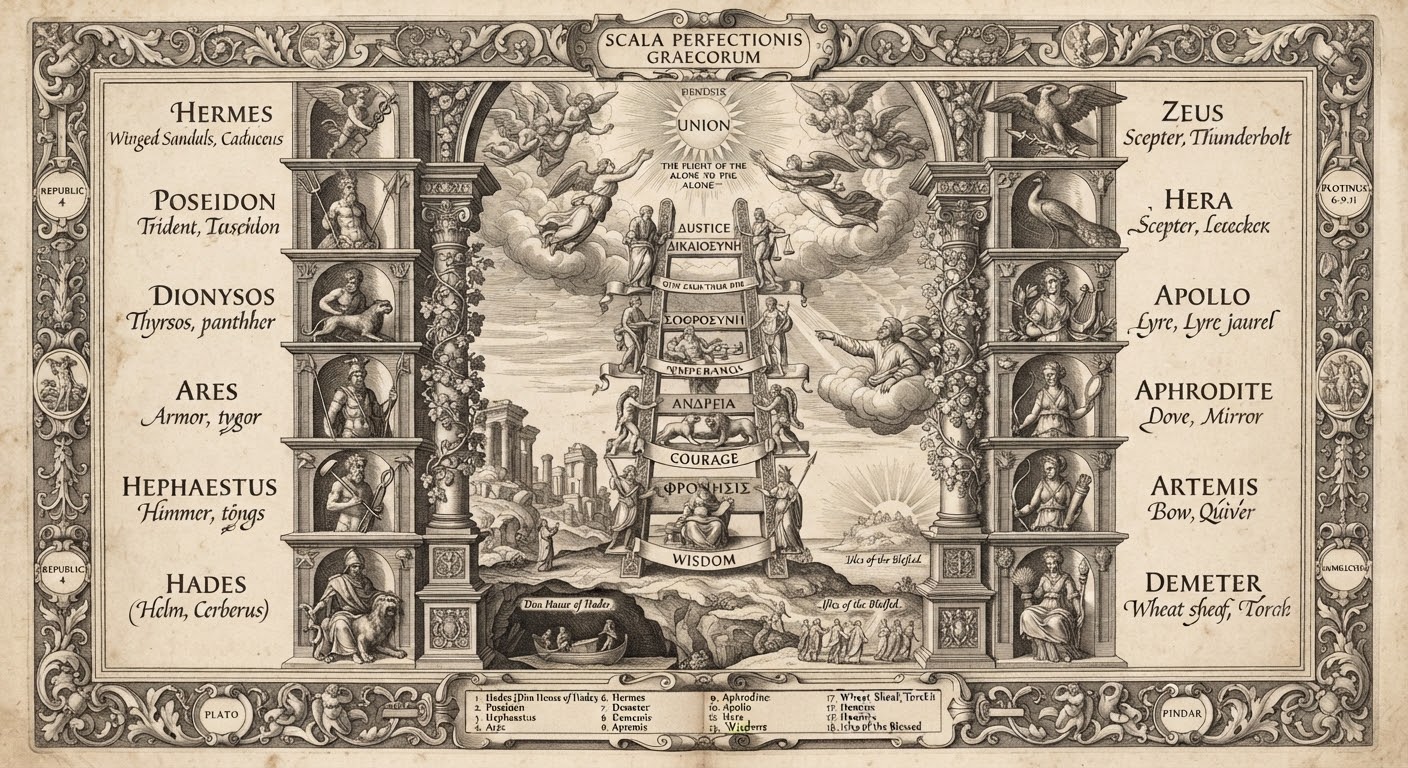
Engraving-style plate titled Scala Perfectionis Graecorum: a ladder of four rungs, wisdom, courage, moderation and justice, rising through clouds to the One, with six gods in niches on each side and the house of Hades and the Isles of the Blessed below
SCALA PERFECTIONIS GRAECORUMThe ladder of the Greeks: wisdom, courage, moderation and justice, rung by rung, up to the One, with the gods on either side.

Theurgy is the work by which the soul, guided by the gods and heroes, rises through a life of aretē to awaken its nous and reach henōsis, union with the divine.

Nous. Nous (νοῦς, “mind” or “intellect”) is the highest power of the soul, the faculty that grasps truth directly rather than by reasoning step by step. Plato places it at the top of the Divided Line, where the soul, through noēsis, rises to first principles themselves (Republic VI, 511b–d), and in the Timaeus he makes it the ordering power of the cosmos, which can dwell in nothing apart from soul (30b). For the Neoplatonists, Nous is the second hypostasis, the divine Intellect that flows from the One and holds within itself the Forms.

Aretē. Aretē is excellence as virtue and virtue as excellence. For Plato, the aretē of anything is what lets it do its proper work well, as sight is the excellence of the eye, and the soul’s aretē is justice, by which it lives well (Republic I, 353b–e). Its parts are wisdom, courage, moderation and justice (Republic IV, 427e). Through aretē the soul is purified and made like the gods (Theaetetus 176b).

Henōsis. Henōsis (ἕνωσις, “union”) is the summit of the ascent: the soul’s union with the One, beyond thought and beyond all attributes. Plotinus ends the Enneads with it, “the flight of the alone to the alone” (VI.9.11), and his pupil Porphyry records that he reached it four times while they were together (Life of Plotinus 23). It is the Hellenic counterpart of the Eastern goals; see Nirvana and Henosis.

In the following section we show the method that links these steps together: a ladder to divinity, from aretē through nous to henōsis, climbed with the help of the gods.
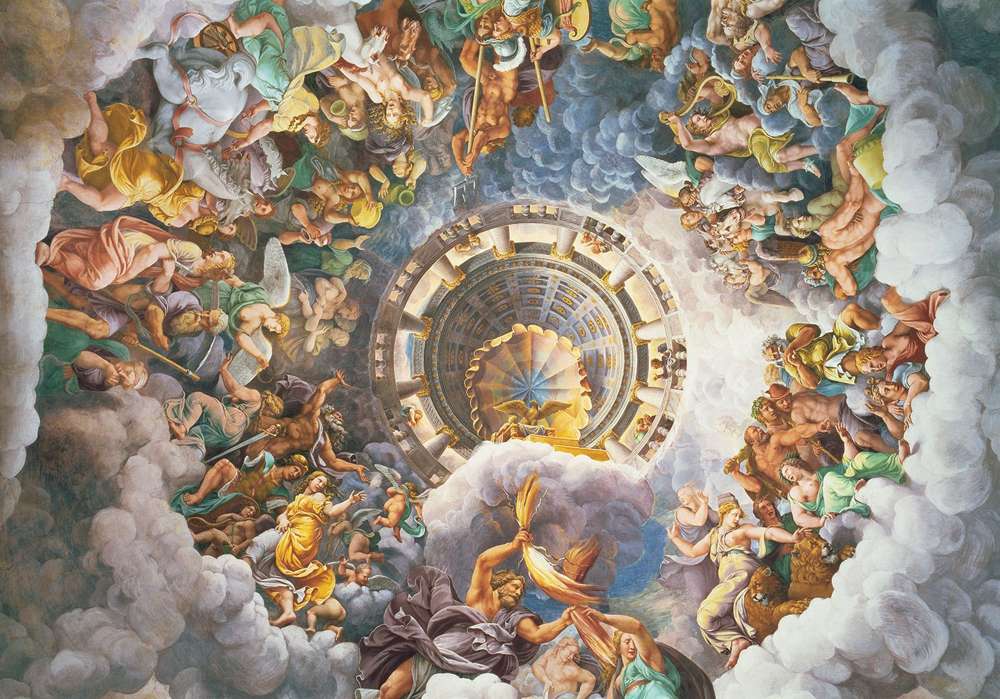
Painted ceiling of the Sala dei Giganti: the Olympian gods on clouds around a domed temple and throne, Zeus below with his thunderbolts
THE ASSEMBLY OF THE GODSThe Olympians on Olympus. Giulio Romano, Sala dei Giganti, Palazzo Te, Mantua, 1532–35.

The inheritance without its root

The modern world lives among the fruits of Greece and Rome and has forgotten the tree they grew on. We govern ourselves by words the Greeks coined: democracy, politics, the republic. Our capitols, courthouses, banks and universities wear the columns and pediments of temples. Our physicians still swear by an oath that once began with Apollo the Healer and Asklepios.

Yet almost none of this was secular in its own day. The Parthenon was a house for Athena. Tragedy was performed in the precinct of Dionysos, at his festival, before his altar. The Olympic Games were held in honour of Zeus, beneath his temple. "Know yourself" was carved at Delphi as Apollo's command, not a self-help motto.

We have kept the forms and discarded their meaning. A column without a god is decoration; a theatre without Dionysos is entertainment; an oath without Apollo is a formality. The beauty, order and measure of the classical world flowed from its theology. To recover the meaning of what we have inherited, we must recover the worship from which it grew.

The Christians, who called the followers of the Olympian gods idolaters and pagans, did not simply outlast the old religion; they replaced it. The Theodosian decrees of 391 and 392 AD banned sacrifice and temple worship. In the years that followed, the temples were closed, stripped of their gold, silver and votive treasures, or taken over outright, and the gods' festivals and symbols were given to saints. The Parthenon itself, the house of Athena Parthenos, became a church of the Virgin Mary, the Theotokos, in late antiquity. It is an irony worth noting that a faith so rich in icons and statues called others idolaters. The Temple aims to restore what was overwritten. For the full account, see P.G., The Roman Crimes Against the Hellenes and the Revival of the Olympian Gods (2026).

Rebuilding the sacred world

A religion of place cannot be revived in words alone. The Hellenes met their gods at the altar before the temple, in the sacred precinct and beside the hearth. Reconstructing the built environment is therefore paramount to this revival:

  • Temples, with the altar outside and the god's image within.
  • Cities, where sanctuary, agora and theatre made civic and sacred life one.
  • Buildings faithful to ancient models, from Villa Kerylos to the Parthenon in Nashville.
  • Art in its true colours, painted and gilded as the ancients saw it.
  • Furniture and offerings: the klismos, the couch, the tripod, the krater.

Every reconstruction teaches. When a visitor stands before a temple restored to its colour, the theology behind the stones begins to speak again.

ΕΚΑΤΗ ΦΩΣΦΟΡΟΣ

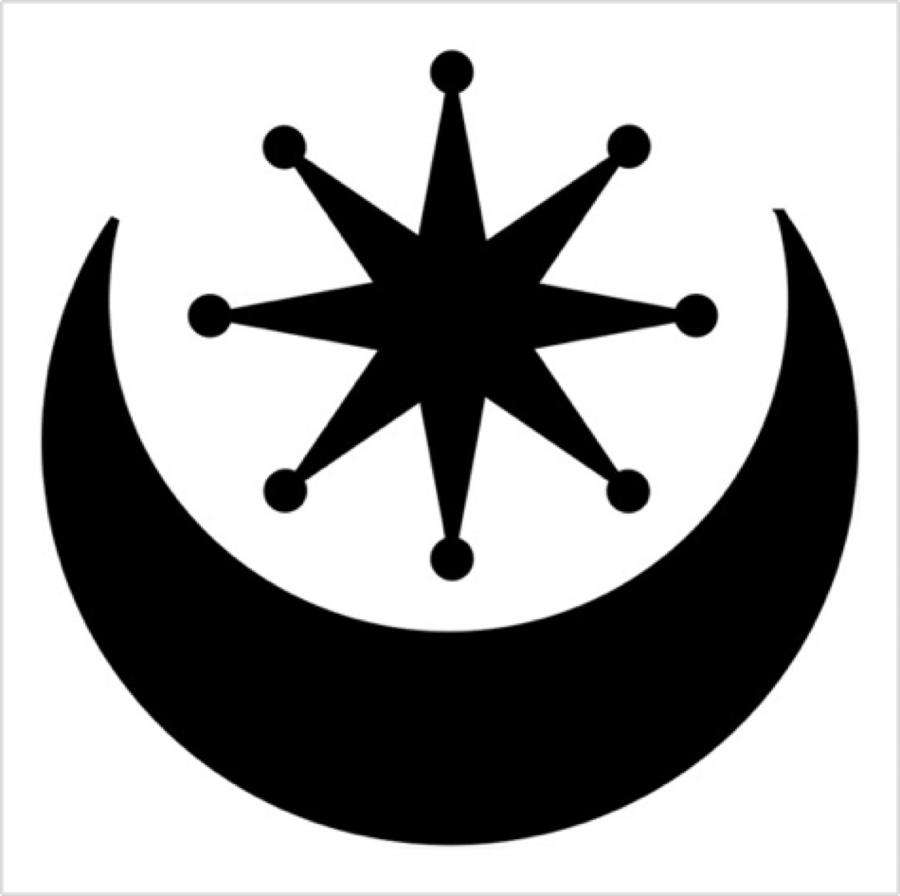
The star and crescent: Hekate's sign, taken for Islam's

An eight-rayed star above a crescent moon, the emblem of Hekate and of ancient Byzantium
THE STAR AND CRESCENTThe eight-rayed star over the crescent: the light of Hekate on the coins of Byzantium, long before it was taken as the sign of Islam.

Here is an irony of history. For centuries a sigil of Hekate, goddess of the moon's light and of magic, guarded a Greek city on the Bosporus. Today the same star and crescent is taken as the sign of a faith whose scripture condemns sorcery (Qur'an 2:102) and prescribes no symbol at all.

Long before it flew over mosques and ministries, the crescent with its star belonged to the gods of Hellas. The crescent moon was the sign of Selene and of Artemis, and of Hekate, the torch-bearing goddess of night, crossroads and thresholds, who had a cult at Byzantium on the Bosporus. Coins of the Greek city of Byzantium from the first century BC show the head of Artemis with bow and quiver and, on the reverse, a crescent with a rayed star, a civic emblem that continued on the city's coins into the Roman era.

The Byzantines told why. In 340 BC Philip II of Macedon besieged the city, and on a dark night attempted a surprise attack on the walls. A sudden light in the sky revealed his men, the defenders were roused, and Byzantium was saved. In thanks the city set up a statue of the goddess as Lampadephoros, the Torch-bearer, named in the sources as Hekate or Artemis. The story reaches us through later writers: Hesychius of Miletus, of the sixth century AD, whose history survives in fragments preserved by Photius and the Suda, and the geographer Stephanus of Byzantium. The ancient accounts speak of a light, not of the moon itself; the link to the crescent on the coins is a later reading, but a natural one for a city whose goddess carried the night's light.

The sign outlived the gods' temples. When Constantine refounded the city as Constantinople in 330, the crescent remained a civic emblem, sometimes joined by a star or a cross. Some later accounts say the city's moon was rededicated to the Virgin Mary, the Christians reading Hekate's crescent as Mary's; this is a tradition rather than a documented act of Constantine, and we give it as such.

After the conquest of 1453, the Ottomans came to use the crescent and star as their own. It is often said they took it from the city they had won, and the Temple holds that Constantinople's Hellenic emblem stands in that lineage. Fairness requires the rest of the record: crescents, and crescents with stars, appear earlier on Sasanian Persian coins and among Turkic peoples, and Turkish banners bore crescents before 1453, so the Ottoman sign may have more than one root. Its state use grew under Mustafa III and his successors; a decree of 1793 ordered it flown on the ships of the Ottoman navy, and the flag reform of 1844 fixed the white crescent and star on red, the flag Turkey keeps today.

Through the prestige of the Ottoman sultan as caliph, the emblem passed in the nineteenth and twentieth centuries to other states with Muslim majorities: Tunisia, Libya, Algeria, Pakistan, Malaysia, Azerbaijan and others. In the twentieth century it came to be read, in the West and in much of the Muslim world, as "the symbol of Islam." Yet the Qur'an and the hadith prescribe no such sign, early Islam had no religious emblem, and many Muslim scholars reject the crescent as a religious symbol at all.

So the night-light of Hekate, set on the coins of a Greek city in gratitude to its goddess, became the badge of an empire and then of a faith that never chose it. The Temple restores it to its first meaning: the torch of Hekate Phosphoros over the Bosporus.

Sources: Hesychius of Miletus, Patria of Constantinople (fragments, via Photius and the Suda); Stephanus of Byzantium, Ethnica, s.v. Βόσπορος; coin evidence summarised by the Numismatic Bibliomania Society, “The star and crescent on ancient coins” (E-Sylum 20.40, 2017); “Star and crescent,” Wikipedia (Ottoman decree of 1793, flag of 1844, later national flags, Muslim commentary); Divinity Atlas, “Star and Crescent” (Sasanian coins; absence from the Qur'an and hadith); Qur'an 2:102 (on sorcery).

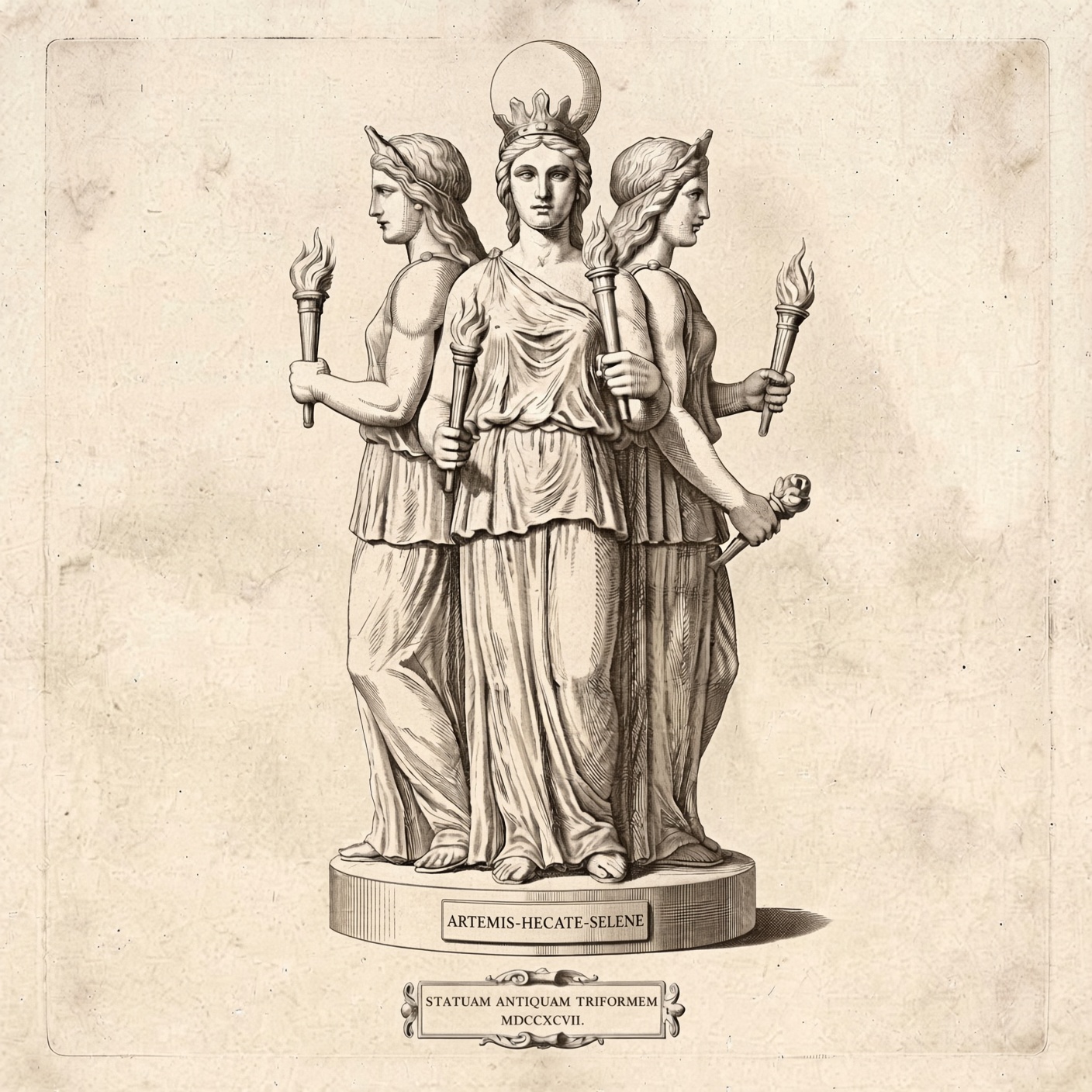
Engraving of a triple-form statue of Hekate: three crowned goddesses back to back on a round base, holding torches
THE HEKATAIONHekate of the three forms, back to back with torches, after the type made by Alkamenes for the entrance to the Athenian Acropolis, drawn by P.G. with the help of Gemini.

A revival already under way

CountryCommunity
GreeceSupreme Council of Ethnic Hellenes (YSEE), whose campaign won the Hellenic religion recognition as a "known religion" in 2017
GreeceLabrys, celebrating the ancient festivals publicly in Athens
ItalyPietas – Comunità Gentile, restoring the Religio Romana, recognised by Italian law in 2020, with temples in Rome, Ardea, Pordenone and Palermo
ItalySocietas Hesperiana Pro Cultu Deorum
United StatesHellenion
EuropeEuropean Congress of Ethnic Religions, founded in Vilnius in 1998

Our commitments

  1. To honour the gods of Hellas by their Greek names, the Attic calendar and the rites of the ancestors, with a place of honour for Sparta's festivals.
  2. To teach the theology behind the classical inheritance.
  3. To reconstruct and, where we can, rebuild the sacred world.
  4. To gather in chapters at classical buildings, beginning at the Parthenon in Nashville.
  5. To travel as pilgrims to Greece and Italy.
  6. To work in friendship with fellow revival communities.
  7. To practise in measure: ΜΗΔΕΝ ΑΓΑΝ, nothing in excess.