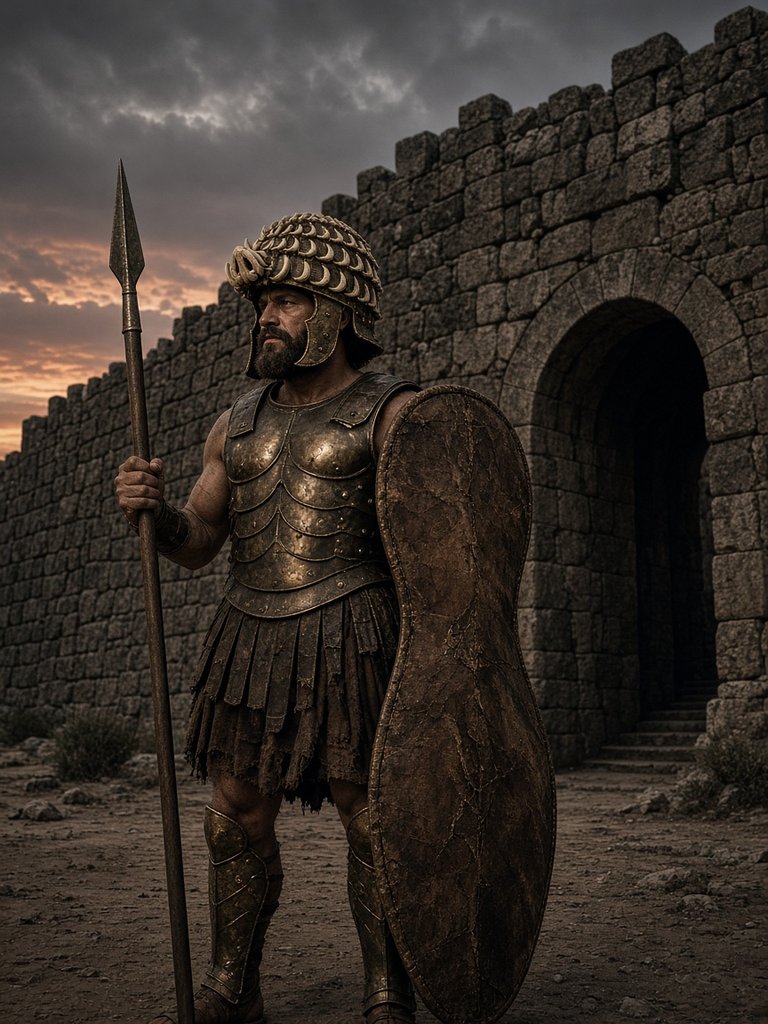
Tydeus, son of Oineus of Kalydon, fled to Argos after a killing and married a daughter of King Adrastos; he is the father of Diomedes. Small of stature but a great fighter, he is held up in the Iliad as the model of courage. Agamemnon taunts his son: “Tydeus did not shrink thus, but was ever ahead of his men when leading them on against the foe—so, at least, say they that saw him in battle, for I never set eyes upon him myself. They say that there was no man like him” (Iliad 4.372–375, tr. Butler).
Sent alone as envoy to Thebes, he challenged the Cadmeans at their feast and beat them all, with Athena at his side; when fifty men ambushed him on the way back he killed all but one (Iliad 4.382–398, 5.800–808, paraphrased).
He was one of the Seven against Thebes (Aeschylus, Seven against Thebes 377–394). Mortally wounded, he was about to be made immortal by Athena, but disgusted her by eating the brains of his enemy Melanippos, and she withdrew the gift (Apollodorus 3.6.8, paraphrased). His tomb was at Thebes (Iliad 14.114).
Epithets
- Οἰνείδης · Oineidēs
- son of Oineus
- μικρὸς δέμας · mikros demas
- small in stature (Iliad 5.801)
Symbols and virtues
Fierce courage and its limits. Symbols: the spear, the boar on his shield (Euripides, Phoenician Women 1120–1122).
Myths
- The embassy to Thebes. Iliad 4.382–398.
- The ambush. Iliad 4.391–398.
- The Seven against Thebes. Aeschylus, Seven against Thebes 377–394.
- Athena’s gift withdrawn. Apollodorus 3.6.8.
Cult and places
- Thebes. His grave (Iliad 14.114).
In the poets
“Tydeus did not shrink thus, but was ever ahead of his men when leading them on against the foe—so, at least, say they that saw him in battle, for I never set eyes upon him myself.”Homer, Iliad 4.372–374, tr. Samuel Butler (1898), public domain.
Sources
Homer, Iliad 4.365–410, 5.800–813, 10.284–291, 14.113–125; Aeschylus, Seven against Thebes 377–394; Apollodorus 1.8.5, 3.6.8.
Quotations in public-domain translations (Evelyn-White 1914, Butler 1898/1900, Taylor 1792); other authors paraphrased.