Sailko, CC BY 3.0, via Wikimedia Commons

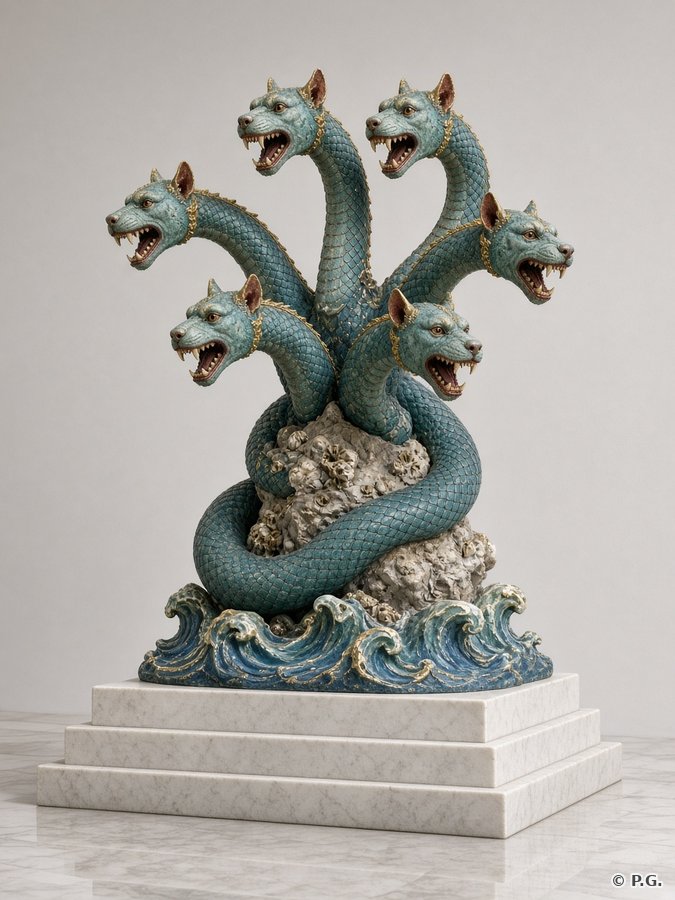
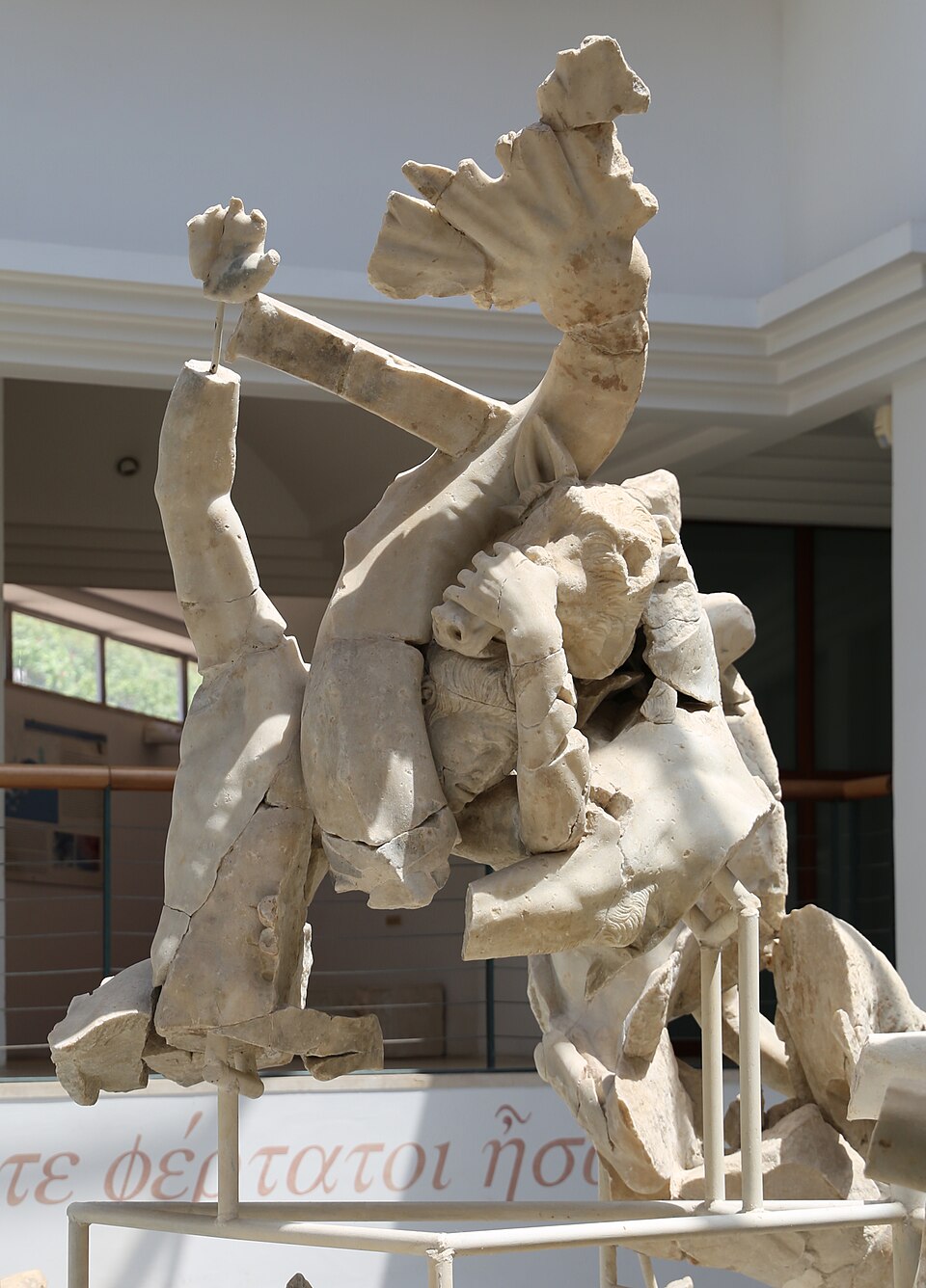
Skylla lives in a cave high in a sheer rock on one side of the strait that Odysseus must pass. Kirki warns him: “Inside it Scylla sits and yelps with a voice that you might take to be that of a young hound, but in truth she is a dreadful monster and no one—not even a god—could face her without being terror-struck. She has twelve mis-shapen feet, and six necks of the most prodigious length; and at the end of each neck she has a frightful head with three rows of teeth in each” (Odyssey 12.85–92, tr. Butler). She fishes from her cave for dolphins and dogfish, and “no ship ever yet got past her without losing some men” (12.98–100).
She cannot be fought: “Scylla is not mortal; moreover she is savage, extreme, rude, cruel and invincible” (12.118–119). Odysseus must call on her mother Krataiis to hold her back (12.124–126). As the ship passes, keeping clear of Charybdis, Skylla snatches six men, and Odysseus calls it the most pitiful sight he saw on all his voyages (12.234–259). Apollonius names her parents as Phorkys and Hekate, called Krataiis (Argonautica 4.828–829); Ovid tells a later story, that she was a nymph changed by Kirki’s poisons out of jealousy for the sea god Glaukos (Metamorphoses 13.900–14.74).
Epithets
- Σκύλλη · Skylla
- often linked with σκύλαξ, puppy, for her yelping voice (Odyssey 12.85–86)
- Ἀθάνατον κακόν · Athanaton kakon
- “an immortal evil” (Odyssey 12.118)
Domains and symbols
The danger that cannot be fought, only passed: necessity and the loss it exacts. Admire: the courage to accept a lesser loss to save the whole. Sacred symbols: the dog heads, the sea-cave, the rock that reaches heaven.
Myths
- Kirki’s warning. Her cave, voice and six heads (Odyssey 12.73–100).
- Not mortal. Odysseus must not fight her but pass quickly (12.112–126).
- Six men taken. She seizes six companions in the strait (12.234–259).
- Odysseus passes again. Zeus keeps her from seeing him when he drifts back on the wreck (12.445–446).
- The Argo. Hera and Thetis bring the Argo past her (Apollonius 4.783–832, 4.922–963).
- Glaukos and Kirki. The later story of her transformation (Ovid, Metamorphoses 13.900–14.74).
Offerings
Skylla received no cult. In the Odyssey the only right response is to call on her mother Krataiis and pass by swiftly.
Beneath the Divine Mind
Skylla is the Divine Mind seen as necessity: some losses cannot be avoided, and wisdom is choosing the lesser one, as Kirki teaches Odysseus. Like every god she stands beneath the One (The One and the Many).
Honouring Skylla today
- Accept. When a loss cannot be prevented, accept it and save what can be saved.
- Courage. Pass through what you fear without stopping.
- Story. Read Odyssey book 12.
Krataiis Κράταιις
the mother of Skylla, who can hold her back · Roman: Crataeis
Krataiis, “the mighty one”, is named once in Homer, by Kirki. As Odysseus rows past Skylla’s cave he must not stop to fight but row hard and call on Krataiis, the mother of Skylla, who bore her as a bane to mortals; she will stop her from darting out a second time (Odyssey 12.124–126).
Nothing more is told of her in the epic. She is the power that can restrain the monster she bore: the one to call on when danger cannot be fought.
Epithets: Κράταιις · Krataiis (the mighty one); Μήτηρ Σκύλλης · Meter Skylles (mother of Skylla (Odyssey 12.124–125))
Domains and symbols: Restraint of a danger that cannot be fought. Admire: in danger, call for the power that can hold it back. Sacred symbols: the sea cliff, the restraining hand.
Myths:
- Kirki’s counsel. Call on Krataiis while rowing past Skylla (Odyssey 12.124–126).
Sources: Homer, Odyssey 12.73–126. Ancient sources are cited by book and line or section in the standard numbering. Quotations from Hesiod and the Homeric Hymns are in the translation of H. G. Evelyn-White (1914), from the Orphic Hymns in that of Thomas Taylor (1792), both public domain. Hemera gives each day's god in brief; this page is the temple's fuller account.
Sources
Homer, Odyssey 12.73–126, 12.234–259, 12.426–446, 23.327–328; Apollonius, Argonautica 4.783–832, 4.922–963; Ovid, Metamorphoses 13.900–14.74. Quotations from Homer are in the prose translation of Samuel Butler (Odyssey 1900), public domain, which gives the gods their Latin names (Jove, Neptune).
Quotations in public-domain translations (Evelyn-White 1914, Butler 1898/1900, Taylor 1792); other authors paraphrased.