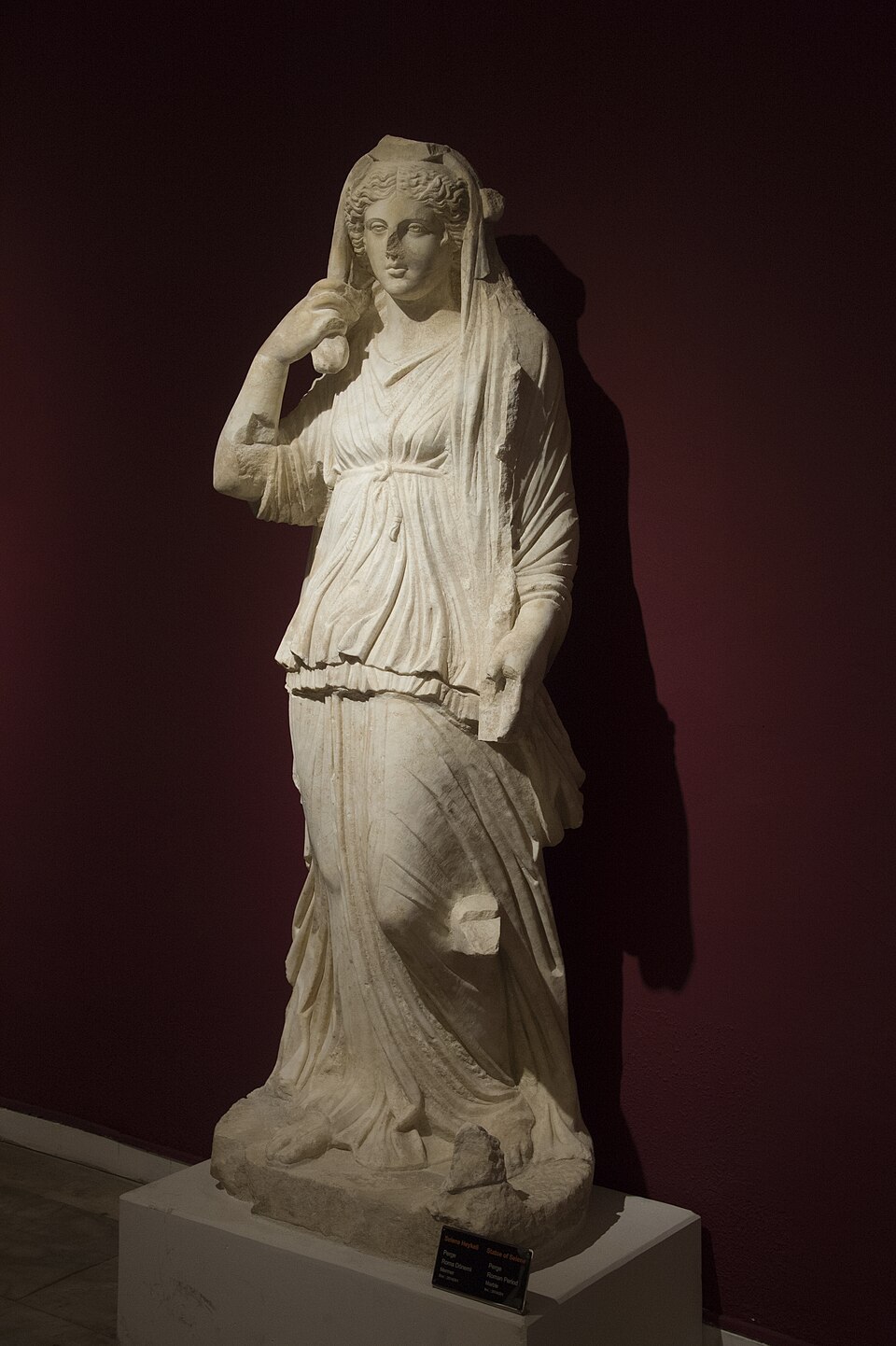
Dosseman, CC BY-SA 4.0, via Wikimedia Commons

Selene, the Moon, daughter of Hyperion and Theia and sister of Helios and Eos (Theogony 371–374), drives her long-maned horses across the night sky. At mid-month, “then her great orbit is full and then her beams shine brightest as she increases. So she is a sure token and a sign to mortal men” (Homeric Hymn 32.11–13). She loved the sleeping Endymion. The Temple keeps three lunar goddesses distinct: Hekate at the dark and new moon, Selene at the full, and Artemis in the days between (see the Calendar).
Epithets
- Μήνη · Mene
- the Moon, whose name gives the month
- Χρυσοστέφανος · Chrysostephanos
- golden-crowned (Homeric Hymn 32.6)
- Λευκώλενος · Leukolenos
- white-armed (Homeric Hymn 32.17)
Domains and symbols
The full moon and the measured month; night made bright; sleep and dreams. Admire: calm, constancy through change. Sacred symbols: the crescent and the full disc, the chariot drawn by horses or oxen, the veil billowing above her head.
Myths
- Endymion. She loved the shepherd Endymion, who sleeps for ever, deathless and ageless (Apollodorus, Library 1.7.5); the Eleans said she bore him fifty daughters (Pausanias 5.1.4).
- Pandia. By Zeus she bore Pandia, “exceeding lovely amongst the deathless gods” (Homeric Hymn 32.14–16).
- Pan’s gift. Pan won her with the gift of a snow-white fleece (Virgil, Georgics 3.391–393).
Cult sites
- Elis. Images of Helios and Selene stood in the market-place, rays on his head, horns on hers (Pausanias 6.24.6).
- Thalamai, Laconia. An oracle of Pasiphae, whom some identified with Selene (Pausanias 3.26.1).
Festivals
- The full moon. The Temple honours Selene each month at the full moon.
Offerings
Round white cakes, milk, honey and incense under the full moon. Today: keep the full moon with a lamp and a hymn.
Beneath the Divine Mind
Selene is the Divine Mind as reflected light: she shines with a light received and gives it again to the night, as the soul shines with the light of Mind. Like every god she stands beneath the One (The One and the Many).
Honouring Selene today
- The full moon. Light a lamp at moonrise.
- Offerings. Milk, honey, round white cakes.
- Distinction. Keep the dark moon for Hekate and the days between for Artemis.
- Hymn. Recite Homeric Hymn 32.
Hymn
And next, sweet voiced Muses, daughters of Zeus, well-skilled in song, tell of the long-winged Moon. From her immortal head a radiance is shown from heaven and embraces earth; and great is the beauty that ariseth from her shining light.Homeric Hymn 32, To Selene, 1–4. Homeric Hymns, tr. H. G. Evelyn-White (1914), public domain.
Images
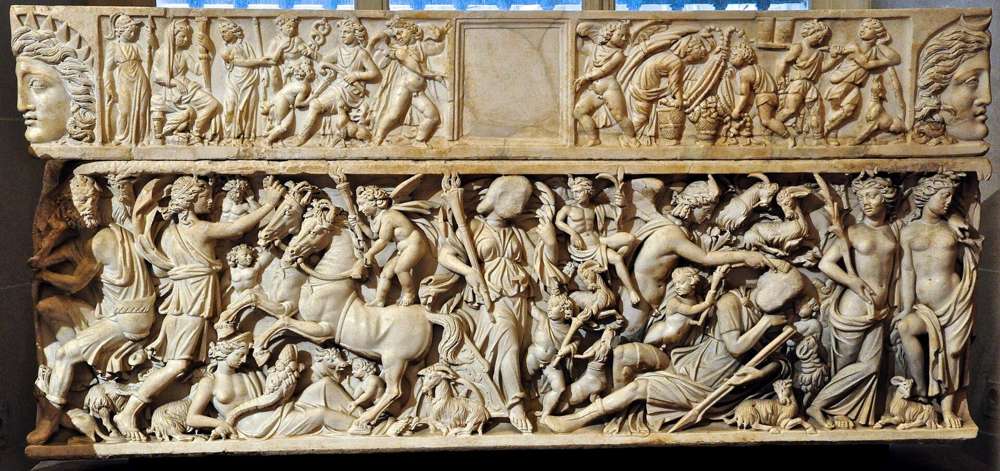
Typhon2222, CC BY-SA 4.0, via Wikimedia Commons

Sources
Hesiod, Theogony 371–374; Homeric Hymn 32; Orphic Hymn 9; Apollodorus, Library 1.7.5; Virgil, Georgics 3.391–393; Pausanias 3.26.1, 5.1.4 and 6.24.6.
Quotations in public-domain translations (Evelyn-White 1914, Butler 1898/1900, Taylor 1792); other authors paraphrased.