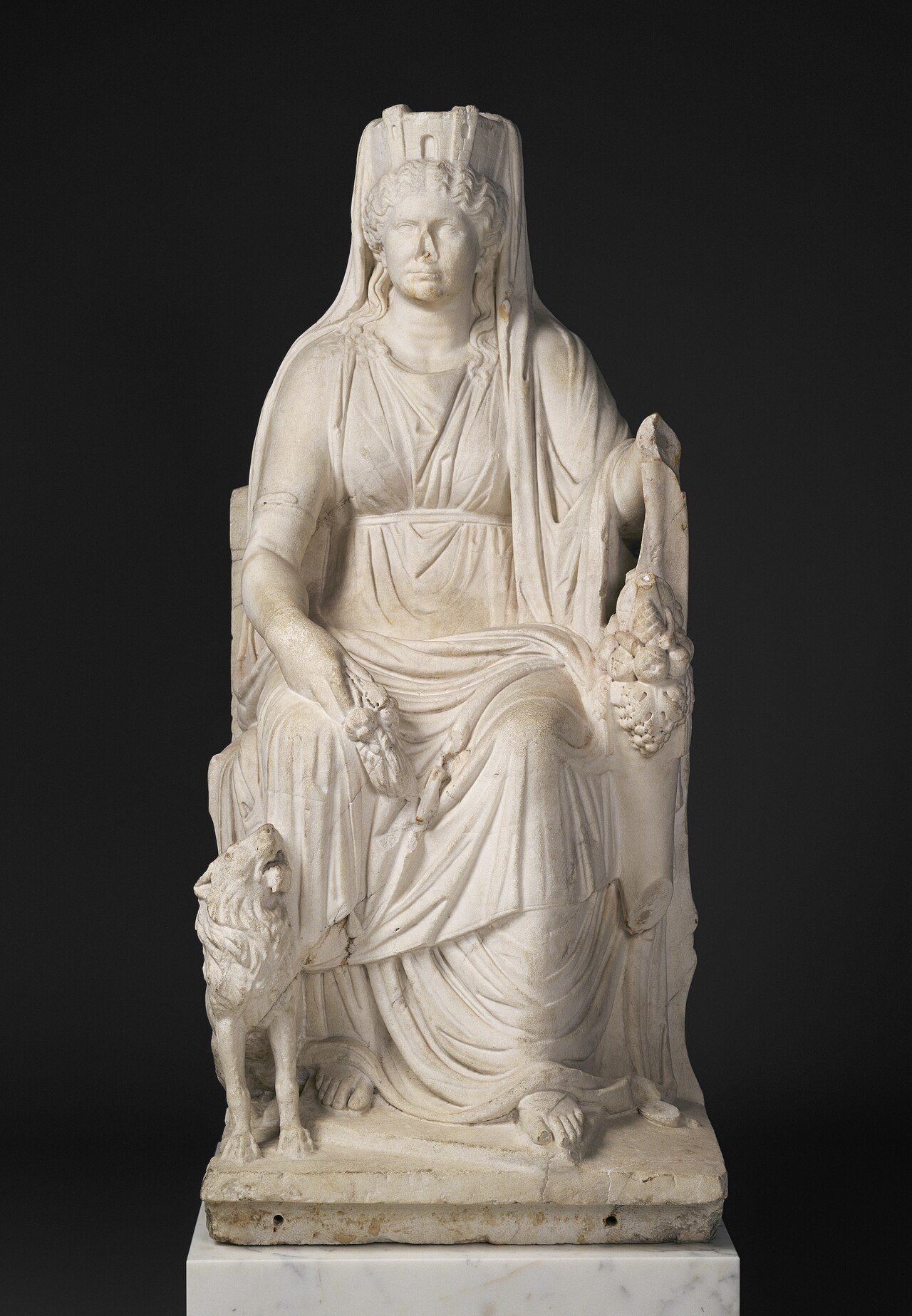
J. Paul Getty Museum, Open Content (no restrictions), via Wikimedia Commons

Rhea, Titaness, daughter of Ouranos and Gaia and wife of Kronos, bore Hestia, Demeter, Hera, Hades, Poseidon and Zeus (Theogony 135, 453–458). Grieving for the children Kronos swallowed, she took counsel with her parents, bore Zeus by night in Crete and gave her husband a stone in his place (Theogony 467–491). The Greeks joined her with the Mother of the Gods of the mountains, who delights in drums and the roar of lions (Homeric Hymn 14; Euripides, Bacchae 58–59, 120–134).
Epithets
- Μήτηρ θεῶν · Meter Theon
- Mother of the Gods
- Ῥείη · Rheie
- the Ionic form of her name in Hesiod and Homer
Domains and symbols
Motherhood that protects; the mountains and their wild beasts; the drum and the dance. Admire: the courage to save what one loves. Sacred symbols: the lion, the drum (tympanon), the turreted crown, the swaddled stone.
Myths
- The birth of Zeus. She bore him in Crete and hid him in a deep cave of Mount Aigaion; Kronos swallowed the stone instead (Theogony 468–491).
- The stone in Arcadia. The Arcadians showed Mount Thaumasion, where Rhea, pregnant with Zeus, came and deceived Kronos with the stone (Pausanias 8.36.2).
- Petrachos. At Chaeronea they said Rhea gave Kronos the stone on the crag of Petrachos (Pausanias 9.41.6).
Cult sites
- Athens. A temple of Kronos and Rhea in the precinct of Olympian Zeus (Pausanias 1.18.7), and the Metroon in the Agora, the shrine of the Mother.
- Crete. The caves where her son was born and hidden.
Offerings
Honey, grain, wine; music of drum and pipe. Today: honour her with Zeus on the days of his birth and with the Mother at the full moon of spring.
Beneath the Divine Mind
Rhea is the Divine Mind as flowing life (her name was read as “flow”, Plato, Cratylus 402b): the stream from which the gods are born, personified and deified as their mother. Like every god she stands beneath the One (The One and the Many).
Honouring Rhea today
- Altar. A drum, a stone, a figure of a lion.
- Offerings. Honey, grain and wine.
- Hymn. Recite Homeric Hymn 14 or the Orphic hymn below.
Hymn
Daughter of great Protogonus, divine, illustrious Rhea, to my pray’r incline, who driv’st thy holy car with speed along, drawn by fierce lions, terrible and strong.Orphic Hymn 14, To Rhea, 1–4. Tr. Thomas Taylor (1792), public domain; divine names as given on Hemera.
Images
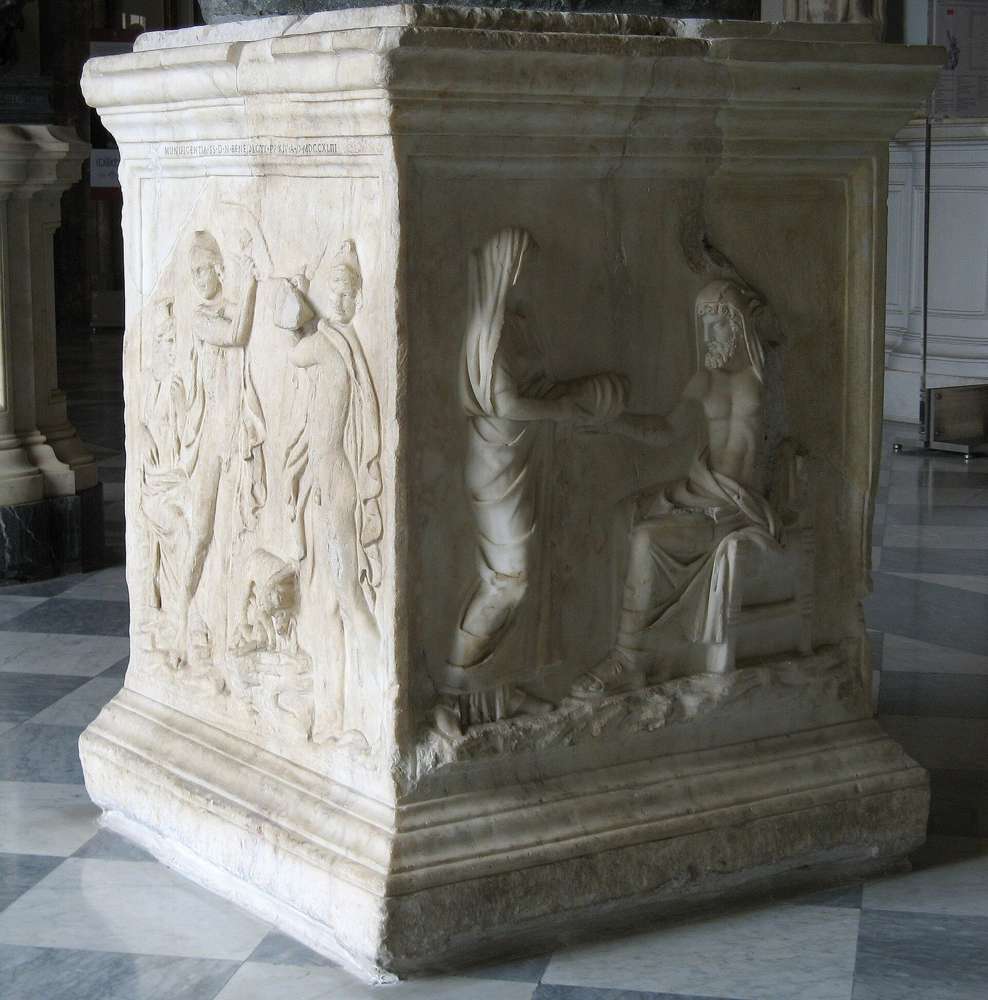
Mark Landon, CC BY 4.0, via Wikimedia Commons

Sources
Hesiod, Theogony 135, 453–506; Homeric Hymn 14; Orphic Hymn 14; Euripides, Bacchae 58–59, 120–134; Plato, Cratylus 402b; Pausanias 1.18.7, 8.36.2 and 9.41.6.
Quotations in public-domain translations (Evelyn-White 1914, Butler 1898/1900, Taylor 1792); other authors paraphrased.