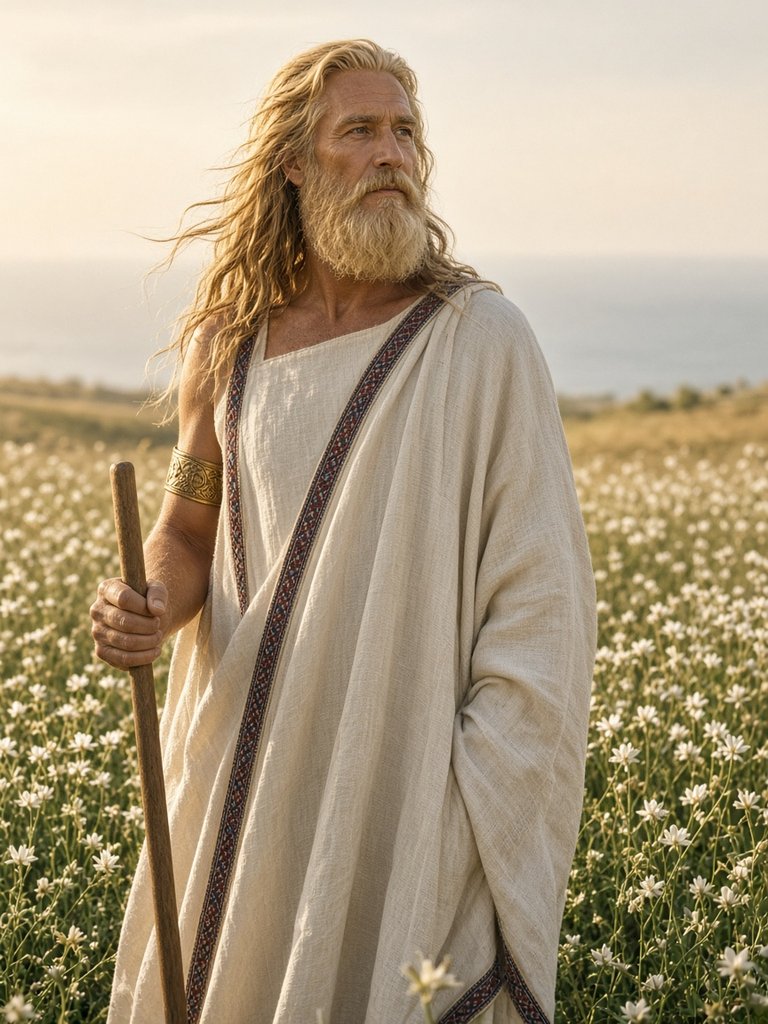
Rhadamanthys is a son of Zeus and Europa, brother of Minos (Iliad 14.321–322). In the Odyssey, Proteus tells Menelaos that he will not die but go to the Elysian plain at the ends of the earth: “There fair-haired Rhadamanthus reigns, and men lead an easier life than any where else in the world, for in Elysium there falls not rain, nor hail, nor snow” (Odyssey 4.564–566, tr. Butler).
The Phaeacians once carried him in their ships to Euboea to see Tityos, son of Gaia, and back in a single day (Odyssey 7.321–326, paraphrased). Later writers made him a lawgiver of Crete so just that he became one of the judges of the dead, with Minos and Aiakos (Plato, Gorgias 523e–524a; Pindar, Olympian 2.75–77, paraphrased).
Apollodorus says that after the death of Amphitryon he married Alkmene (2.4.11, paraphrased).
Epithets
- ξανθός · xanthos
- fair-haired (Odyssey 4.564)
Symbols and virtues
Justice after death and the blessed life. Symbols: the asphodel meadow, the judge’s staff.
Myths
- Son of Zeus and Europa. Iliad 14.321–322.
- Lord of Elysium. Odyssey 4.561–569.
- Voyage to Tityos. Odyssey 7.321–326.
- Judge of the dead. Plato, Gorgias 523e–524a.
In the poets
“There fair-haired Rhadamanthus reigns, and men lead an easier life than any where else in the world.”Homer, Odyssey 4.564–565, tr. Samuel Butler (1900), public domain.
Sources
Homer, Iliad 14.321–322; Odyssey 4.561–569, 7.321–326; Pindar, Olympian 2.75–77; Plato, Gorgias 523e–524a; Apollodorus 2.4.11, 3.1.1–2.
Quotations in public-domain translations (Evelyn-White 1914, Butler 1898/1900, Taylor 1792); other authors paraphrased.