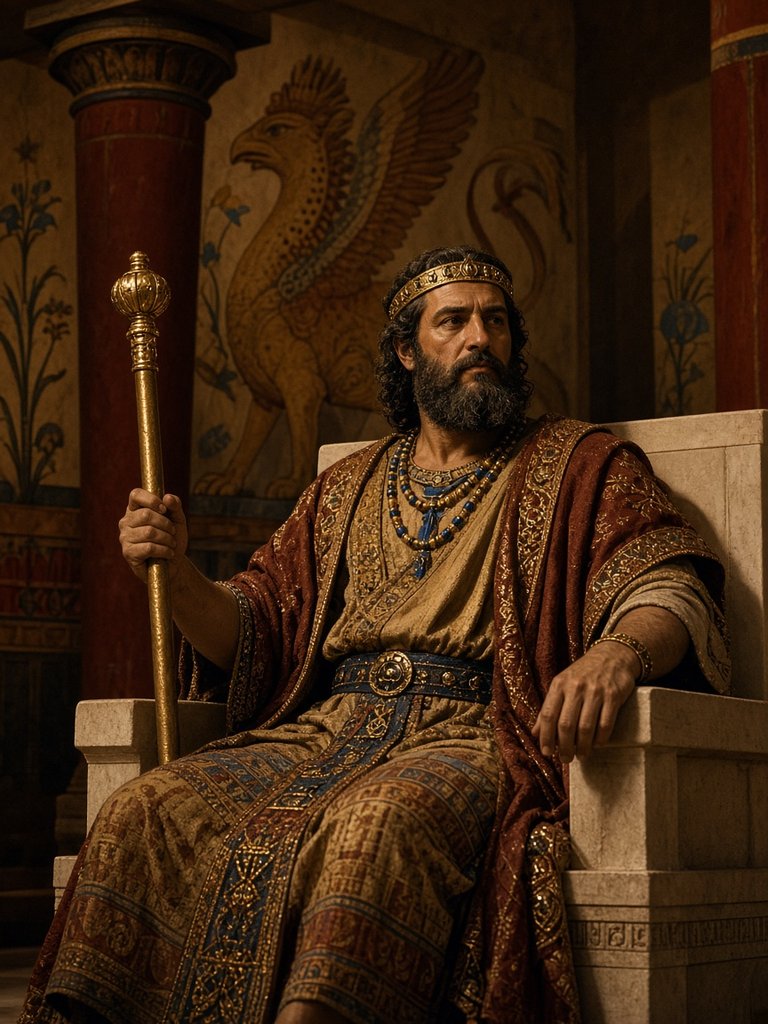
Minos is the son of Zeus and the daughter of Phoinix, brother of Rhadamanthys (Iliad 14.321–322, paraphrased), and king of Crete. In the Odyssey the disguised Odysseus says: “There is a great town there, Cnossus, where Minos reigned who every nine years had a conference with Jove himself” (Odyssey 19.178–179, tr. Butler).
He is the father of Ariadne, whom Dionysos made his wife (Theogony 947–949, paraphrased). Later writers tell of the bull from the sea, the Minotaur and the Labyrinth built by Daidalos, and the tribute of Athenian youths ended by Theseus (Apollodorus 3.1.3–4, 3.15.8, paraphrased). Thucydides calls him the first who had a navy and ruled the sea (1.4, paraphrased).
After death he judges among the dead: “Then I saw Minos son of Jove with his golden sceptre in his hand sitting in judgement on the dead” (Odyssey 11.568–569, tr. Butler). The great Bronze Age palace at Knossos, excavated by Arthur Evans from 1900, gave its name, Minoan, to the whole civilization.
Epithets
- Διὸς υἱός · Dios huios
- son of Zeus
- Διὸς μεγάλου ὀαριστής · Dios megalou oaristēs
- companion of great Zeus (Odyssey 19.179)
Symbols and virtues
Kingship, law and judgment. Symbols: the golden sceptre, the double axe, the Labyrinth.
Myths
- Son of Zeus and Europa. Iliad 14.321–322.
- King at Knossos. Odyssey 19.178–179.
- The Minotaur and the Labyrinth. Apollodorus 3.1.3–4, 3.15.8.
- Judge of the dead. Odyssey 11.568–571.
Cult and places
- Knossos. His city (Odyssey 19.178).
In the poets
“Then I saw Minos son of Jove with his golden sceptre in his hand sitting in judgement on the dead.”Homer, Odyssey 11.568–569, tr. Samuel Butler (1900), public domain.
Sources
Homer, Iliad 13.449–453, 14.321–322; Odyssey 11.568–571, 19.172–180; Hesiod, Theogony 947–949; Thucydides 1.4; Apollodorus 3.1.
Quotations in public-domain translations (Evelyn-White 1914, Butler 1898/1900, Taylor 1792); other authors paraphrased.