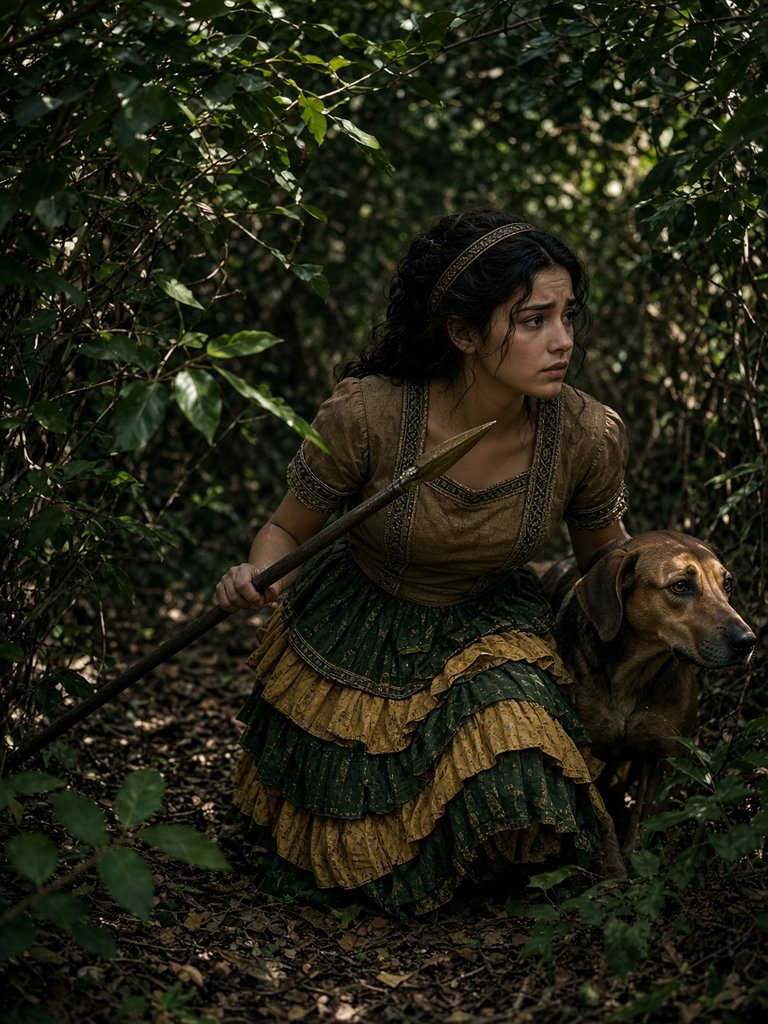
Prokris was a daughter of Erechtheus, king of Athens, and wife of Kephalos. Odysseus sees her among the shades of famous women: “Then I saw Phaedra, and Procris, and fair Ariadne” (Odyssey 11.321, tr. Butler).
Apollodorus tells that she was bribed with a golden crown by one Pteleon and, discovered by her husband, fled to Minos in Crete. She cured Minos of a curse laid on him by Pasiphae and received from him the hound that always caught its prey and the javelin that never missed; then she returned and was reconciled with Kephalos (Apollodorus 3.15.1, paraphrased). Ovid makes the gifts come from Artemis (Metamorphoses 7.753–756).
Suspecting that her husband loved another, she followed him into the woods and hid in a thicket to watch. Kephalos heard the leaves stir, thought it was a beast and threw the javelin, and she died in his arms (Apollodorus 3.15.1; Ovid, Metamorphoses 7.796–862, paraphrased). Polygnotos painted her among the dead in the Lesche at Delphi (Pausanias 10.29.6).
Epithets
- Ἐρεχθηΐς · Erechthēïs
- daughter of Erechtheus
Symbols and virtues
Love and jealousy, and the gift that kills. Symbols: the javelin, the hound, the thicket.
Myths
- Among the shades. Odyssey 11.321.
- Flight to Minos. Apollodorus 3.15.1.
- The hound and the javelin. Apollodorus 3.15.1; Ovid, Metamorphoses 7.753–756.
- Death in the thicket. Ovid, Metamorphoses 7.796–862.
In the poets
“Then I saw Phaedra, and Procris, and fair Ariadne.”Homer, Odyssey 11.321, tr. Samuel Butler (1900), public domain.
Sources
Homer, Odyssey 11.321; Apollodorus 3.15.1; Pausanias 1.37.6, 10.29.6; Ovid, Metamorphoses 7.661–865.
Quotations in public-domain translations (Evelyn-White 1914, Butler 1898/1900, Taylor 1792); other authors paraphrased.