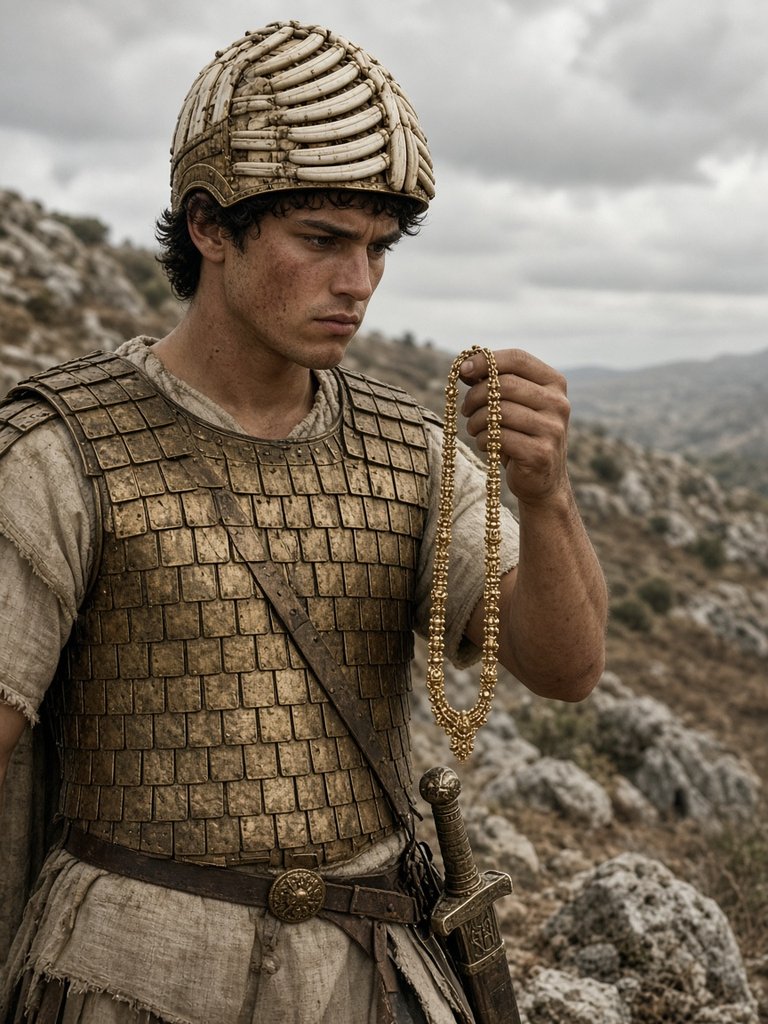
Polyneikes, whose name means much strife, is a son of Oidipous. He and his brother Eteokles agreed to rule Thebes in turn, but Eteokles would not give up the throne, and Polyneikes went to Argos and married Argeia, daughter of King Adrastos (Apollodorus 3.6.1, paraphrased).
The Iliad remembers him raising an army with Tydeus: “He came once to Mycenae, not as an enemy but as a guest, in company with Polynices to recruit his forces, for they were levying war against the strong city of Thebes” (Iliad 4.376–378, tr. Butler). He bribed Eriphyle with the necklace of Harmonia to send her husband Amphiaraos to the war (Apollodorus 3.6.2, paraphrased).
At the seventh gate of Thebes he met Eteokles in single combat and the brothers killed each other, fulfilling their father’s curse (Aeschylus, Seven against Thebes 631–676, 805–819, paraphrased). Kreon forbade his burial, and his sister Antigone buried him at the cost of her life (Sophocles, Antigone).
Epithets
- θεοειδής · theoeidēs
- godlike (Iliad 4.377)
- πολυνεικής · poluneikēs
- of much strife
Symbols and virtues
The brother’s quarrel and the curse fulfilled. Symbols: the necklace of Harmonia, the seventh gate.
Myths
- Exile to Argos. Apollodorus 3.6.1.
- Raising the army. Iliad 4.376–381.
- The necklace. Apollodorus 3.6.2.
- Death at the seventh gate. Aeschylus, Seven against Thebes.
- Burial by Antigone. Sophocles, Antigone.
In the poets
“He came once to Mycenae, not as an enemy but as a guest, in company with Polynices to recruit his forces.”Homer, Iliad 4.376–377, tr. Samuel Butler (1898), public domain.
Sources
Homer, Iliad 4.376–381; Aeschylus, Seven against Thebes; Sophocles, Antigone and Oedipus at Colonus; Euripides, Phoenician Women; Apollodorus 3.5.9–3.7.1.
Quotations in public-domain translations (Evelyn-White 1914, Butler 1898/1900, Taylor 1792); other authors paraphrased.