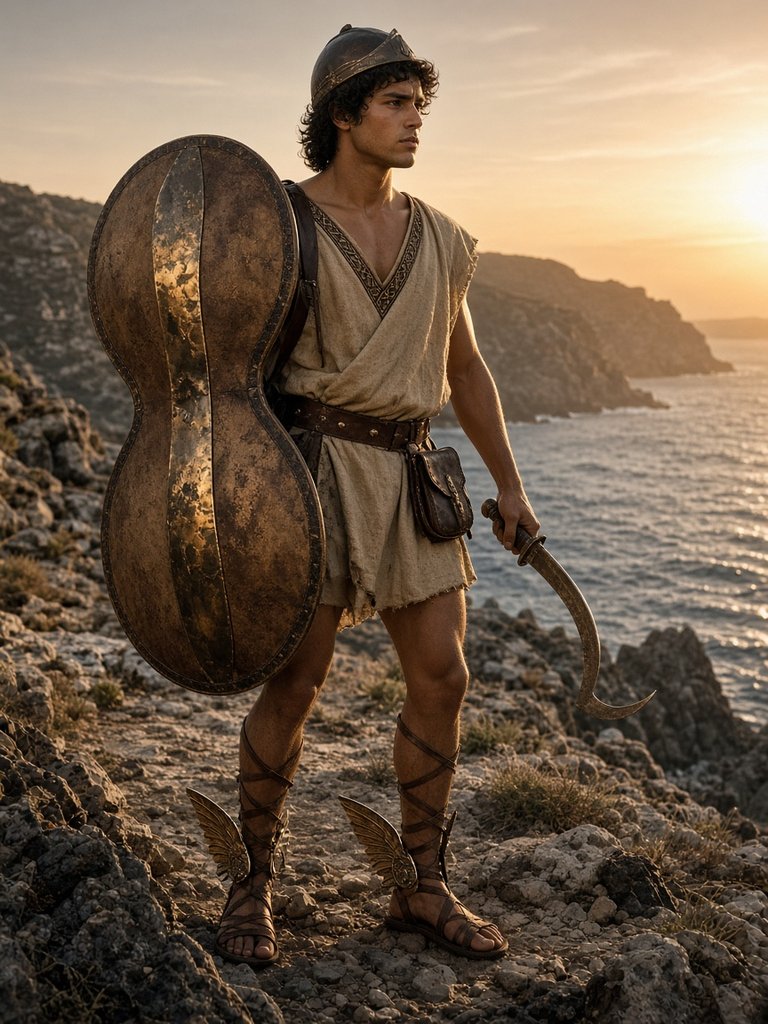
Perseus is the son of Zeus and Danaë, daughter of Akrisios king of Argos. In the Iliad Zeus himself recalls “Danae the daintily-ancled daughter of Acrisius, who bore me the famed hero Perseus” (Iliad 14.319–320, tr. Butler). Warned that a grandson would kill him, Akrisios shut Danaë in a bronze chamber; Zeus came to her as a shower of gold, and the king set mother and child adrift in a chest, which washed up on Seriphos (Apollodorus 2.4.1, paraphrased).
On Seriphos king Polydektes sent the youth to fetch the head of the Gorgon. With the help of Athena and Hermes, and with winged sandals, a cap of invisibility and a wallet from the nymphs, he found the Gorgons by the stream of Okeanos and beheaded Medusa while she slept; Hesiod tells that “when Perseus cut off her head, there sprang forth great Chrysaor and the horse Pegasus” (Theogony 280–281, tr. Evelyn-White). On the way home he freed Andromeda from the sea-monster, turned Polydektes to stone with the head, and gave it to Athena, who set it on her aegis. At games in Larissa a discus he threw struck Akrisios and killed him, as the oracle had said; ashamed to rule Argos, he exchanged it for Tiryns and fortified Mycenae (Apollodorus 2.4.2–5; Pausanias 2.16.3, paraphrased).
Pindar sends him to feast among the Hyperboreans (Pythian 10.31–48, paraphrased) and tells how Athena made the music of the pipes from the Gorgons’ wailing (Pythian 12.6–26, paraphrased). Perseus was honoured as a hero: Pausanias saw his hero-shrine on the road from Mycenae to Argos (2.18.1, paraphrased), and Herodotus describes a temple of Perseus at Chemmis in Egypt, where the people held games in his honour (2.91, paraphrased). Through his son Perses he was held to be ancestor of the Persian kings (Herodotus 7.61, paraphrased), and Herakles was his great-grandson.
Epithets
- πάντων ἀριδείκετος ἀνδρῶν · pantōn arideiketos andrōn
- famed above all men (Iliad 14.320)
- Δανάης υἱός · Danaēs huios
- son of Danaë
Symbols and virtues
Courage under the gods’ guidance, and the cunning that does not look the monster in the face. Symbols: the winged sandals, the cap of Hades, the curved sickle-sword (harpē), the polished shield, the Gorgon’s head.
Myths
- The shower of gold. Zeus comes to Danaë in her bronze chamber (Apollodorus 2.4.1).
- The Gorgon’s head. Theogony 274–281; Apollodorus 2.4.2–3.
- Andromeda. He frees her from the sea-monster in Aithiopia (Apollodorus 2.4.3).
- The discus at Larissa. Akrisios killed by chance (Apollodorus 2.4.4; Pausanias 2.16.2–3).
- Founder of Mycenae. Pausanias 2.16.3.
Cult and places
- Argos and Mycenae. Hero-shrine on the road between them (Pausanias 2.18.1).
- Chemmis, Egypt. Temple of Perseus with games (Herodotus 2.91).
In the poets
“Danae the daintily-ancled daughter of Acrisius, who bore me the famed hero Perseus”Homer, Iliad 14.319–320, tr. Samuel Butler (1898), public domain.
Sources
Hesiod, Theogony 270–281; Homer, Iliad 14.319–320; Pindar, Pythian 10.31–48, 12.6–26; Herodotus 2.91, 7.61; Apollodorus, Library 2.4.1–5; Pausanias 2.16.2–3, 2.18.1.
Quotations in public-domain translations (Evelyn-White 1914, Butler 1898/1900, Taylor 1792); other authors paraphrased.