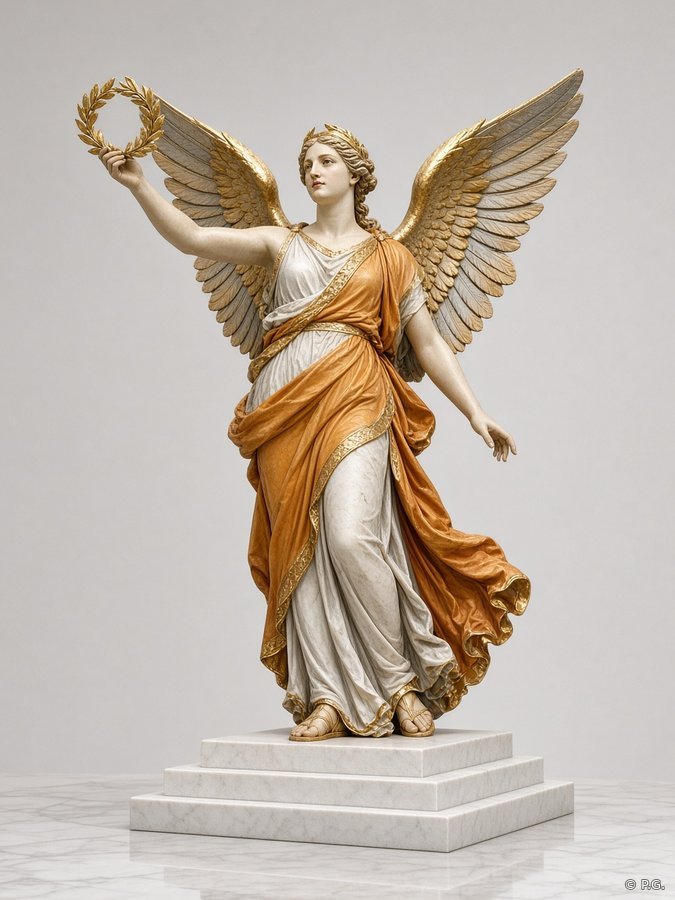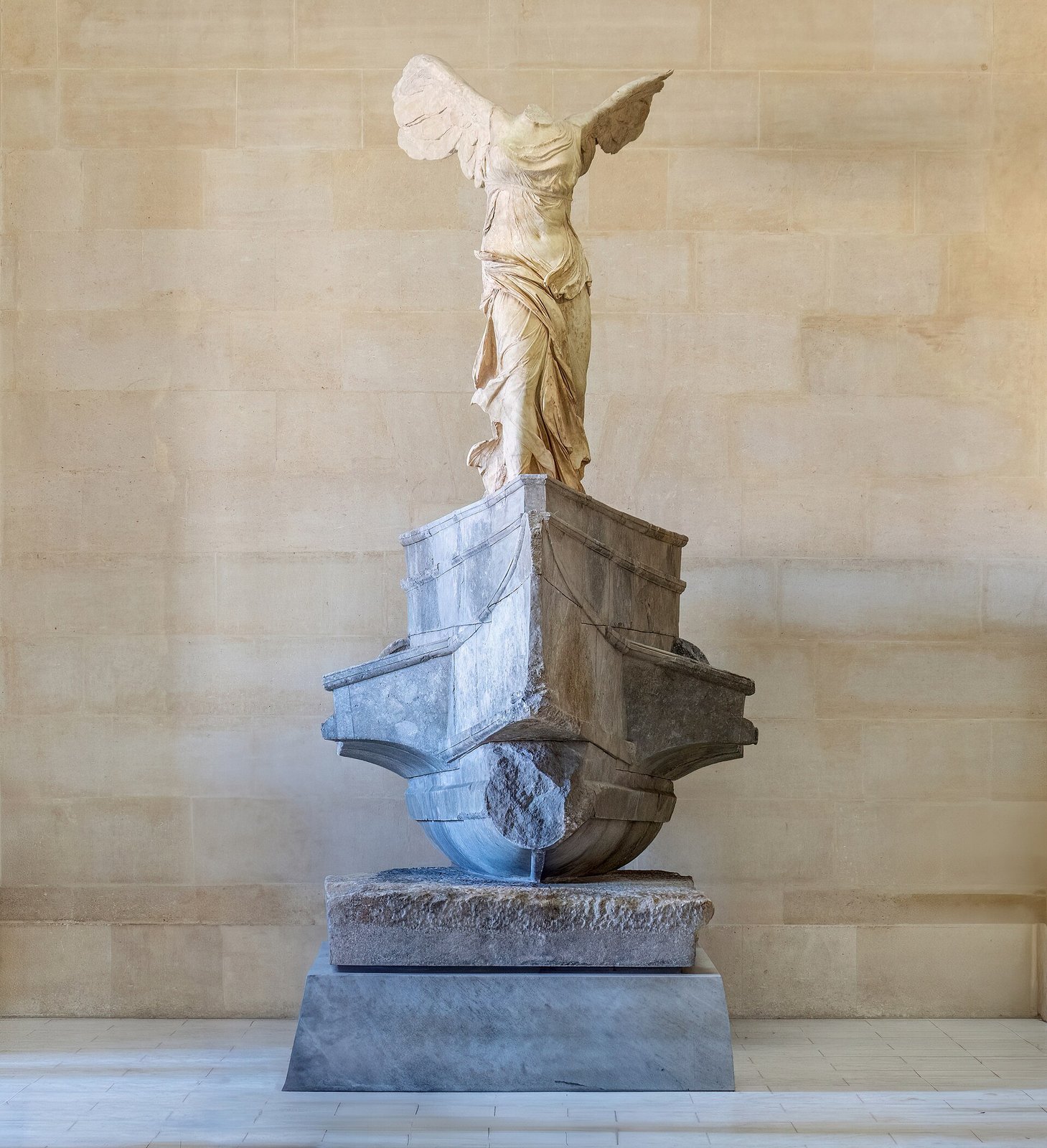
Nike, Victory, is the daughter of the Titan Pallas and of Styx, sister of Zelos, Kratos and Bia: Rivalry, Strength and Force. When Zeus called the gods to fight the Titans, Styx came first with her children, and Zeus made them live with him for ever (Theogony 383–403). Pheidias set Nike in the right hand of his gold-and-ivory Zeus at Olympia and of his Athena Parthenos at Athens (Pausanias 5.11.1, 1.24.7).
Epithets
- Καλλίσφυρος · Kallisphyros
- neat-ankled (Theogony 384)
- Ἄπτερος · Apteros
- wingless, as the Athenians made her so that she could never fly away (Pausanias 3.15.7)
Domains and symbols
Victory in war, in games and in contests of skill; the crown of the winner. Admire: excellence won by effort. Sacred symbols: wings, the wreath, the palm branch.
Myths
- With Zeus. She and her siblings have no home apart from Zeus, but always sit beside him (Theogony 386–388).
- The Nike of Paionios. The Messenians and Naupaktians set up a marble Nike at Olympia by Paionios of Mende (Pausanias 5.26.1).
Cult sites
- The Acropolis. The small Ionic temple of Athena Nike on the bastion by the Propylaia.
- Olympia. Her statues among the dedications for victories.
Offerings
Wreaths, palm fronds, a share of the prize. Today: give thanks after any success, and keep a wreath for her.
Beneath the Divine Mind
Nike is the Divine Mind as completion: the moment when an aim is reached, personified and deified as Victory. Like every god she stands beneath the One (The One and the Many).
Honouring Nike today
- Thanksgiving. Offer a wreath after any success.
- Hymn. Recite the Orphic hymn below.
Hymn
O Powerful Nike, by men desir’d, with adverse breasts to dreadful fury fir’d, thee I invoke, whose might alone can quell contending rage, and molestation fell.Orphic Hymn 33, To Nike, 1–3. Tr. Thomas Taylor (1792), public domain; divine names as given on Hemera.
Zelos Ζῆλος
Emulation and zeal, son of Styx, who stands beside Zeus · Roman: Zelus
Zelos, Emulation or Zeal, is a son of the Titan Pallas and Styx, brother of Nike, Kratos and Bia. “And Styx the daughter of Ocean was joined to Pallas and bare Zelus (Emulation) and trim-ankled Nike (Victory) in the house. Also she brought forth Cratos (Strength) and Bia (Force), wonderful children. These have no house apart from Zeus, nor any dwelling nor path except that wherein God leads them, but they dwell always with Zeus the loud-thunderer” (Theogony 383–388).
His name means the eager striving to equal or surpass another, which may be noble emulation or envy. In the Works and Days Hesiod foretells that in the race of iron envy, harsh-voiced and delighting in evil, will go with all wretched men (Works and Days 195–196, paraphrased); this is the dark face of zeal.
Epithets: Ζῆλος · Zelos (emulation, zeal (Theogony 384))
Domains and symbols: Emulation, eagerness, the will to rival what is excellent. Admire: zeal for the good, honest ambition. Sacred symbol: the throne of Zeus, beside which he stands.
Myths:
- Children of Pallas and Styx. With Zelos, Nike, Kratos and Bia (Theogony 383–385).
- First to Zeus. Styx brings her children to Olympos before the war with the Titans, and Zeus makes them dwell with him for ever (Theogony 386–403).
- The dark face. Envy in the age of iron (Works and Days 195–196).
“These have no house apart from Zeus, nor any dwelling nor path except that wherein God leads them, but they dwell always with Zeus the loud-thunderer.”Hesiod, Theogony 386–388, tr. H. G. Evelyn-White (1914), public domain. There is no Homeric or Orphic hymn to Zelos.
Sources: Hesiod, Theogony 383–403; Works and Days 195–196. Ancient sources are cited by book and line or section in the standard numbering. Quotations from Hesiod and the Homeric Hymns are in the translation of H. G. Evelyn-White (1914), from Homer in the prose of Samuel Butler (Iliad 1898, Odyssey 1900), from the Orphic Hymns in that of Thomas Taylor (1792), all public domain; other ancient authors are paraphrased. Hemera gives each day's god in brief; this page is the temple's fuller account.
Sources
Hesiod, Theogony 383–403; Orphic Hymn 33; Pausanias 1.24.7, 3.15.7, 5.11.1 and 5.26.1.
Quotations in public-domain translations (Evelyn-White 1914, Butler 1898/1900, Taylor 1792); other authors paraphrased.