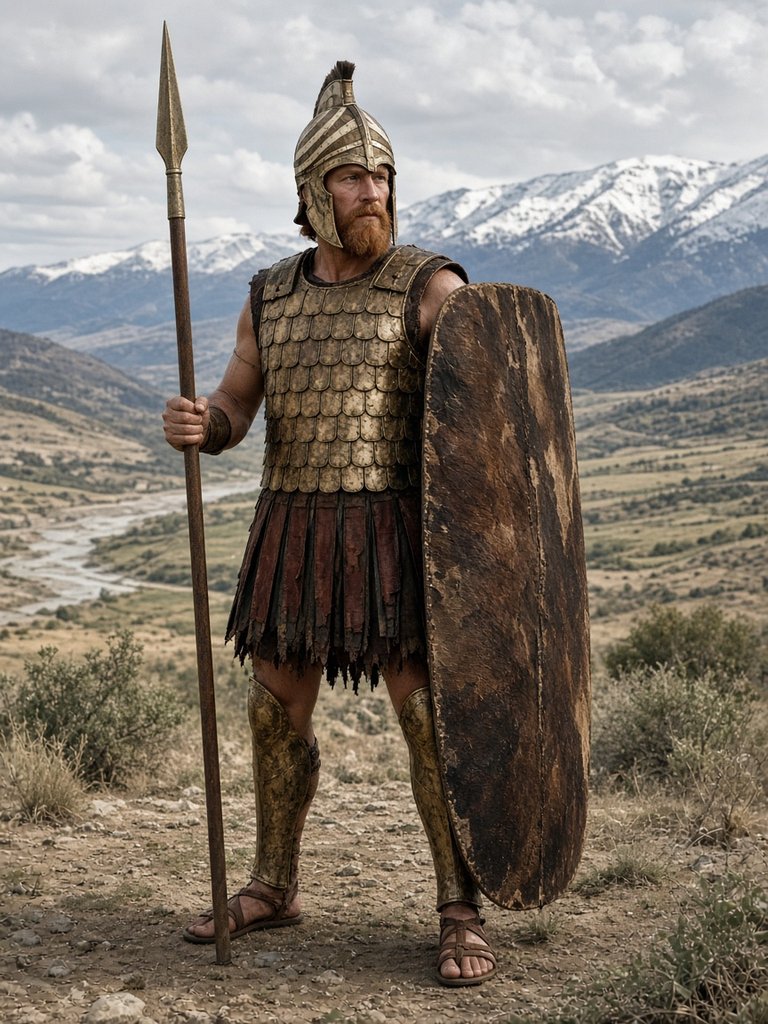
Menelaos, son of Atreus and brother of Agamemnon, is king of Sparta and husband of Helen. In the Catalogue of Ships the men of Lakedaimon, Sparta and Amyklai “were led by Menelaus of the loud battle-cry, brother to Agamemnon, and of them there were sixty ships” (Iliad 2.586–587, tr. Butler). When Paris carried Helen to Troy, it was for him that the Greeks went to war.
In the Iliad he fights Paris in single combat and would have killed him if Aphrodite had not snatched him away (Iliad 3), and he stands over the body of Patroklos (Iliad 17). On his way home he was driven to Egypt, and on the island of Pharos he held fast the shape-changing Proteus until the old god told him his road home (Odyssey 4.351–570). Telemachos finds him back in Sparta with Helen, feasting in a palace bright as the sun and moon (Odyssey 4.1–75).
Proteus foretells for him no common death: “you shall not die in Argos, but the gods will take you to the Elysian plain, which is at the ends of the world. There fair-haired Rhadamanthus reigns” (Odyssey 4.561–564, tr. Butler), because he is Zeus’ son-in-law through Helen. At Therapne, above the Eurotas, the Spartans honoured Helen and Menelaos together, not as heroes but as gods, Isocrates says, at the shrine archaeologists call the Menelaion (Isocrates, Helen 63; Pausanias 3.19.9, paraphrased).
Epithets
- ξανθός · xanthos
- fair-haired
- βοὴν ἀγαθός · boēn agathos
- of the loud battle-cry (Iliad 2.586)
- Ἀτρεΐδης · Atreïdēs
- son of Atreus
Symbols and virtues
Loyalty, hospitality and the long road home. Symbols: the spear, the palace of Sparta, the Elysian plain.
Myths
- Sixty ships from Lakedaimon. Iliad 2.581–590.
- Duel with Paris. Iliad 3.
- Over the body of Patroklos. Iliad 17.
- Proteus on Pharos. Odyssey 4.351–570.
- Elysium. Odyssey 4.561–569.
Cult and places
- Therapne, Sparta. The Menelaion, with Helen (Isocrates, Helen 63; Pausanias 3.19.9).
In the poets
“As for your own end, Menelaus, you shall not die in Argos, but the gods will take you to the Elysian plain, which is at the ends of the world.”Homer, Odyssey 4.561–563, tr. Samuel Butler (1900), public domain.
Sources
Homer, Iliad 2.581–590, 3, 17; Odyssey 3.276–312, 4; Isocrates, Helen 62–63; Pausanias 3.19.9.
Quotations in public-domain translations (Evelyn-White 1914, Butler 1898/1900, Taylor 1792); other authors paraphrased.