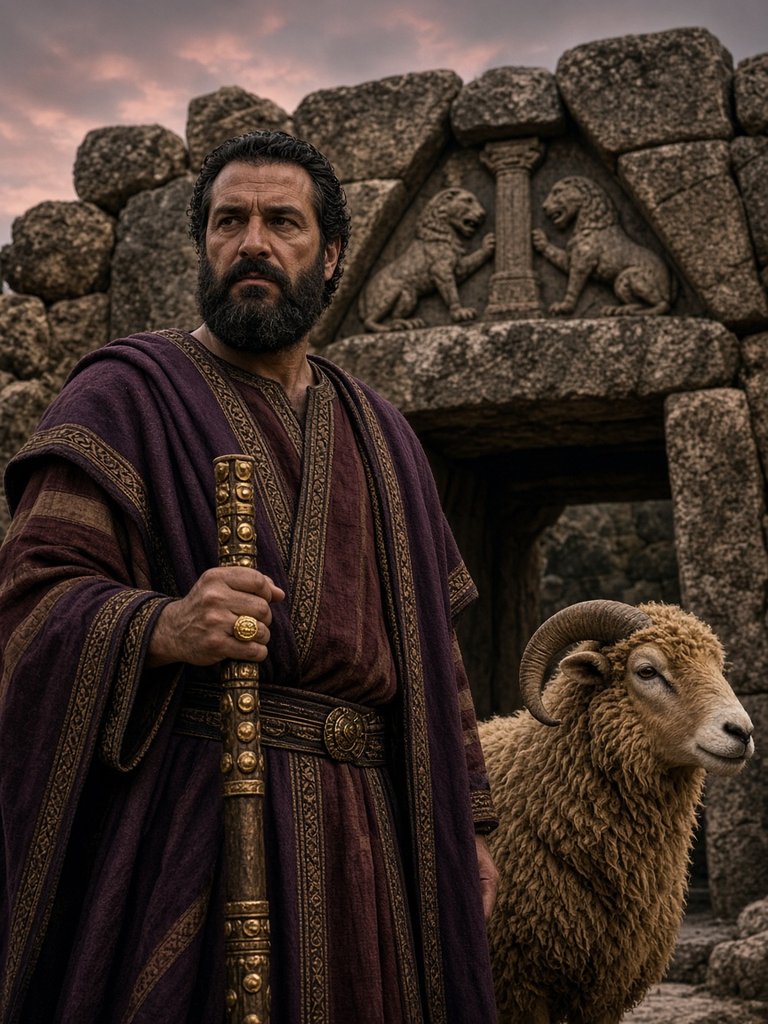
Atreus, son of Pelops and Hippodameia, is the father of Agamemnon and Menelaos, the two “sons of Atreus” of the Iliad. Homer traces the royal sceptre of Mycenae through his hands: “King Mercury gave it to Pelops, the mighty charioteer, and Pelops to Atreus, shepherd of his people. Atreus, when he died, left it to Thyestes, rich in flocks, and Thyestes in his turn left it to be borne by Agamemnon” (Iliad 2.104–107, tr. Butler).
Later writers tell of his feud with his brother Thyestes. Atreus had vowed the finest of his flock to Artemis, but when a lamb with a golden fleece was born he hid it away. His wife Aerope, Thyestes’ lover, gave the lamb to Thyestes, who claimed the kingship with it, until Zeus turned the sun back in its course to show that Atreus was the rightful king (Apollodorus, Epitome 2.10–12; Euripides, Electra 699–736, paraphrased).
In revenge Atreus killed Thyestes’ sons and served them to their father at a feast, the crime that haunts his house in Aeschylus’ Agamemnon (1590–1602, paraphrased). He was killed in turn by Thyestes’ son Aigisthos (Apollodorus, Epitome 2.14, paraphrased).
Epithets
- ποιμὴν λαῶν · poimēn laōn
- shepherd of the people (Iliad 2.105)
- Ἀτρεΐδαι · Atreïdai
- his sons, the Atreidai
Symbols and virtues
Kingship won by guile and stained by kin-murder. Symbols: the sceptre, the golden lamb.
Myths
- The sceptre of Mycenae. Iliad 2.100–108.
- The golden lamb. Apollodorus, Epitome 2.10–12.
- The feast of Thyestes. Aeschylus, Agamemnon 1590–1602.
- Death by Aigisthos. Apollodorus, Epitome 2.14.
Cult and places
- Mycenae. Pausanias was shown the underground treasuries and tomb of Atreus there (2.16.6).
In the poets
“Pelops to Atreus, shepherd of his people. Atreus, when he died, left it to Thyestes, rich in flocks.”Homer, Iliad 2.105–106, tr. Samuel Butler (1898), public domain.
Sources
Homer, Iliad 2.100–108; Aeschylus, Agamemnon 1583–1611; Euripides, Electra 699–736; Apollodorus, Epitome 2.10–14; Pausanias 2.16.6.
Quotations in public-domain translations (Evelyn-White 1914, Butler 1898/1900, Taylor 1792); other authors paraphrased.