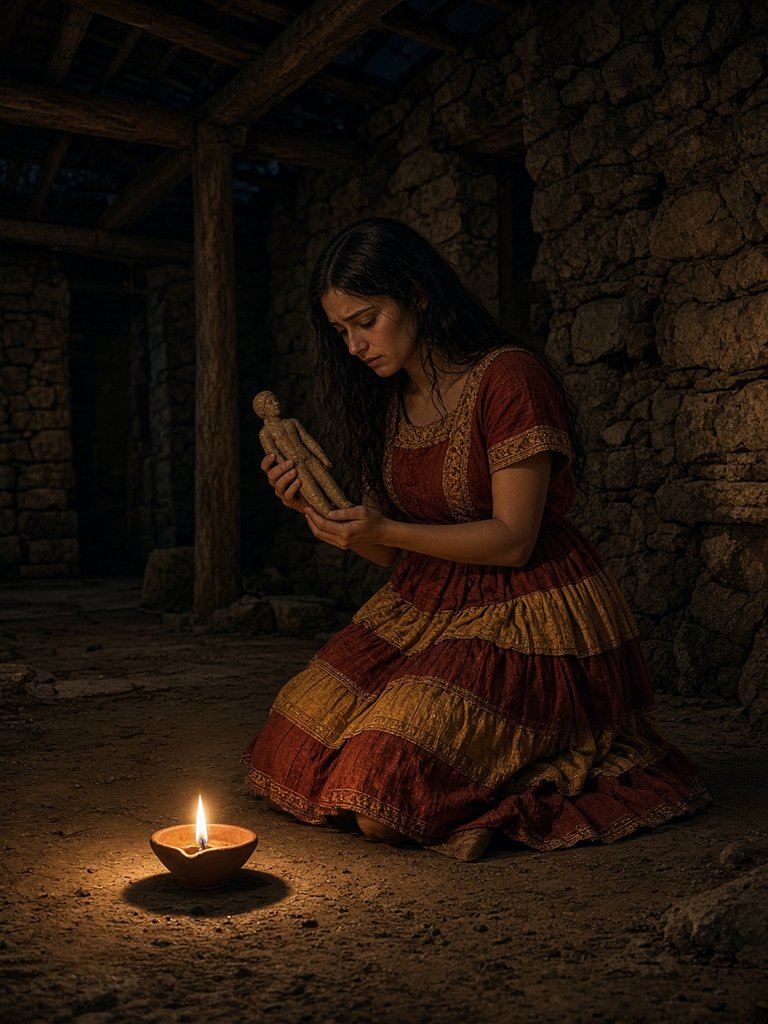
Laodameia, daughter of Akastos, was the wife of Protesilaos, the first of the Achaeans to leap ashore at Troy and the first to die (Apollodorus, Epitome 3.30, paraphrased). The Iliad says of him: “He had left a wife behind him in Phylace to tear her cheeks in sorrow, and his house was only half finished” (Iliad 2.700–701, tr. Butler).
So great was her grief that the gods allowed Protesilaos to return from the dead for a few hours, brought back by Hermes; when he was taken away again, she killed herself (Apollodorus, Epitome 3.30, paraphrased).
In another version she made a likeness of her husband and secretly embraced it as if it were he; when her father found it and had it burned, she threw herself into the fire (Hyginus, Fabulae 103–104, paraphrased). Ovid gives her a letter to Protesilaos before his death, full of foreboding (Heroides 13, paraphrased).
Epithets
- Ἀκαστίς · Akastis
- daughter of Akastos
Symbols and virtues
Love that will not accept death. Symbols: the half-finished house, the likeness of the husband, the lamp.
Myths
- The widow in Phylake. Iliad 2.698–702.
- Protesilaos returned for a day. Apollodorus, Epitome 3.30.
- The likeness and the fire. Hyginus, Fabulae 103–104.
- Letter to Protesilaos. Ovid, Heroides 13.
In the poets
“He had left a wife behind him in Phylace to tear her cheeks in sorrow, and his house was only half finished.”Homer, Iliad 2.700–701, tr. Samuel Butler (1898), public domain.
Sources
Homer, Iliad 2.695–702; Apollodorus, Epitome 3.30; Ovid, Heroides 13; Hyginus, Fabulae 103–104; Catullus 68.73–86.
Quotations in public-domain translations (Evelyn-White 1914, Butler 1898/1900, Taylor 1792); other authors paraphrased.