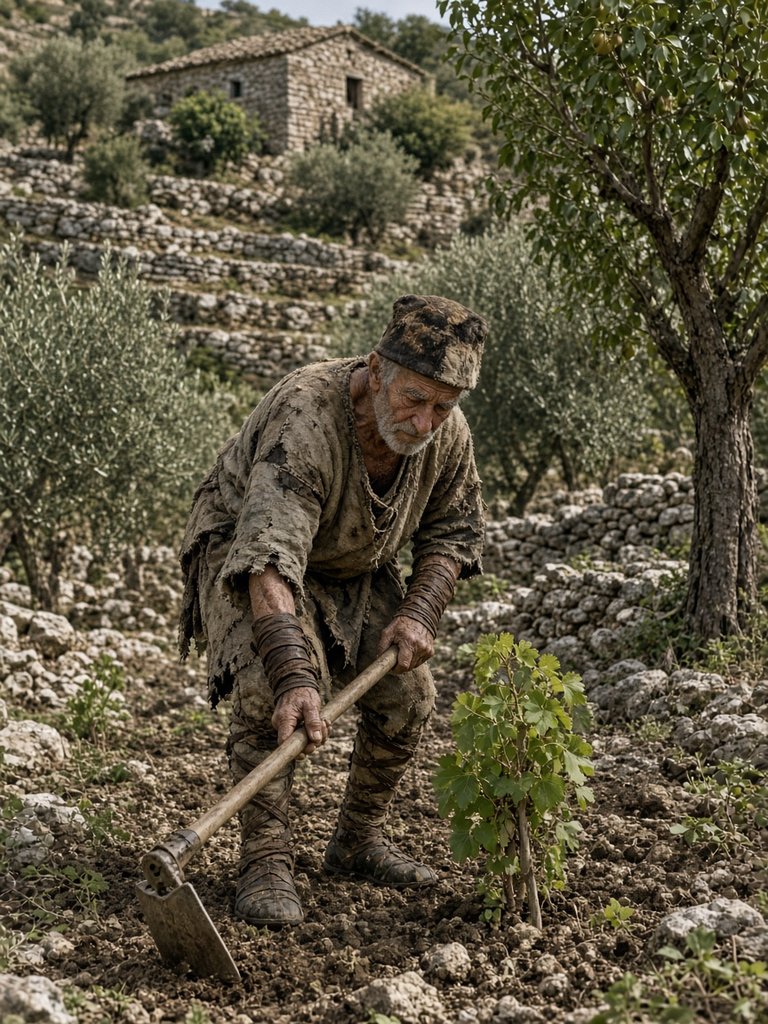
Laertes, son of Arkeisios, is the father of Odysseus and former king of Ithaka. While his son is away he lives on his farm, grieving. Athena, disguised as Mentes, says that “he never comes to town now, and lives by himself in the country, faring hardly, with an old woman to look after him and get his dinner for him, when he comes in tired from pottering about his vineyard” (Odyssey 1.189–193, tr. Butler).
Penelope keeps the suitors waiting by weaving his shroud and unpicking it by night (Odyssey 2.93–110, paraphrased). After the killing of the suitors Odysseus finds him in his orchard, “alone, hoeing a vine. He had on a dirty old shirt, patched and very shabby” (Odyssey 24.226–228, tr. Butler). Odysseus proves who he is by his scar and by naming the trees his father once gave him as a boy (Odyssey 24.331–344, paraphrased).
Bathed and made taller and stronger by Athena, the old man fights beside his son and grandson against the suitors’ kin and kills Eupeithes with a spear, before Athena makes peace (Odyssey 24.365–548, paraphrased).
Epithets
- Ἀρκεισιάδης · Arkeisiadēs
- son of Arkeisios
- γέρων ἥρως · gerōn hērōs
- the old hero
Symbols and virtues
Old age, grief and the joy of a son’s return. Symbols: the hoe, the vineyard, the pear, apple and fig trees.
Myths
- In the country. Odyssey 1.189–193, 11.187–196.
- The shroud. Odyssey 2.93–110.
- The recognition in the orchard. Odyssey 24.205–360.
- The last fight. Odyssey 24.365–548.
In the poets
“He never comes to town now, and lives by himself in the country, faring hardly, with an old woman to look after him and get his dinner for him, when he comes in tired from pottering about his vineyard.”Homer, Odyssey 1.189–193, tr. Samuel Butler (1900), public domain.
Sources
Homer, Odyssey 1.187–193, 2.93–110, 11.187–196, 24.205–548.
Quotations in public-domain translations (Evelyn-White 1914, Butler 1898/1900, Taylor 1792); other authors paraphrased.