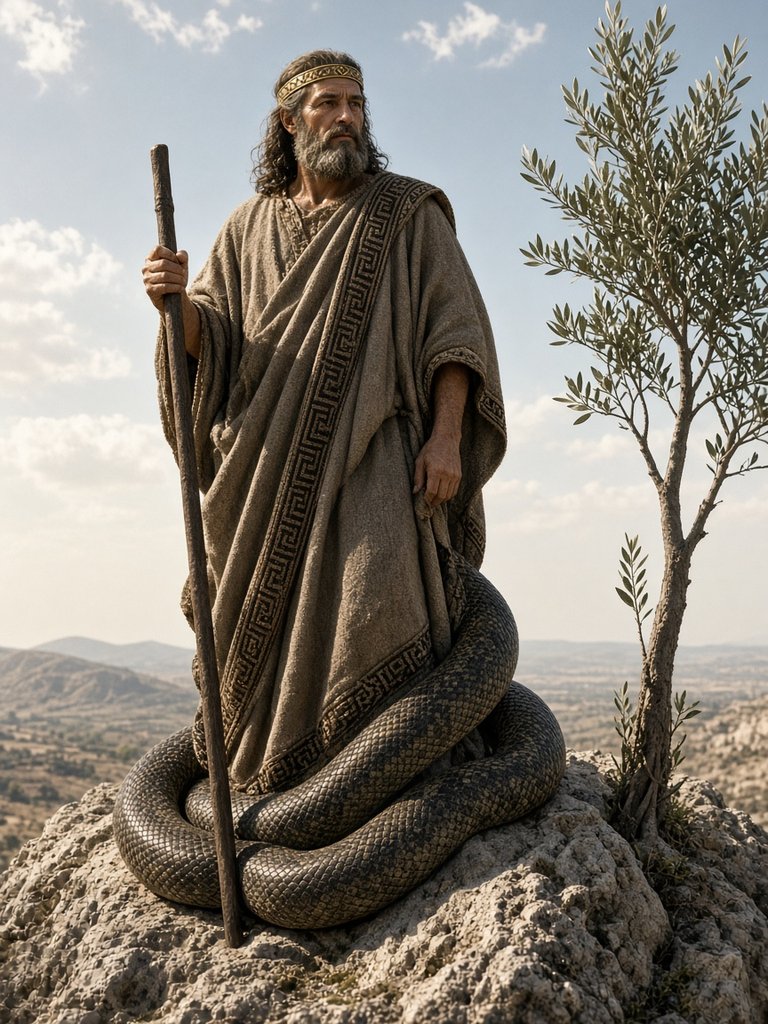
Kekrops was born from the earth of Attica and was its first king; his body was that of a man joined to a serpent’s, and the land was called Kekropia after him (Apollodorus 3.14.1, paraphrased). Herodotus says the Athenians were called Kekropidai under his rule (8.44, paraphrased).
In his reign Athena and Poseidon contested the land. Poseidon struck the Acropolis with his trident and brought forth a sea, Athena planted the olive with Kekrops as witness, and the gods, or Kekrops himself, judged in her favour (Apollodorus 3.14.1, paraphrased). Herodotus saw the olive and the salt spring in the temple of Erechtheus on the Acropolis (8.55, paraphrased).
He was said to have been the first to call Zeus the Highest and to refuse to sacrifice any living thing, offering only cakes (Pausanias 8.2.3, paraphrased). His daughters Aglauros, Herse and Pandrosos were given the chest holding the infant Erichthonios and told not to open it (Apollodorus 3.14.6; Pausanias 1.18.2, paraphrased).
Epithets
- διφυής · diphyēs
- of double form (Diodorus 1.28.7)
Symbols and virtues
The first ordering of a city, earth-born kingship. Symbols: the serpent body, the olive of Athena.
Myths
- Born from the earth, half serpent. Apollodorus 3.14.1.
- Witness of the contest of Athena and Poseidon. Apollodorus 3.14.1; Herodotus 8.55.
- Zeus the Highest and bloodless offerings. Pausanias 8.2.3.
- His daughters and Erichthonios. Apollodorus 3.14.6; Pausanias 1.18.2.
Cult and places
- Athens. The Kekropion, his tomb-shrine, lay on the Acropolis beside the temple of Erechtheus, under the porch of the Maidens (Erechtheion building accounts, IG I³ 474, paraphrased).
Sources
Herodotus 8.44, 8.55; Apollodorus 3.14.1–2, 3.14.6; Pausanias 1.2.6, 1.18.2, 8.2.3; Strabo 9.1.20.
Quotations in public-domain translations (Evelyn-White 1914, Butler 1898/1900, Taylor 1792); other authors paraphrased.