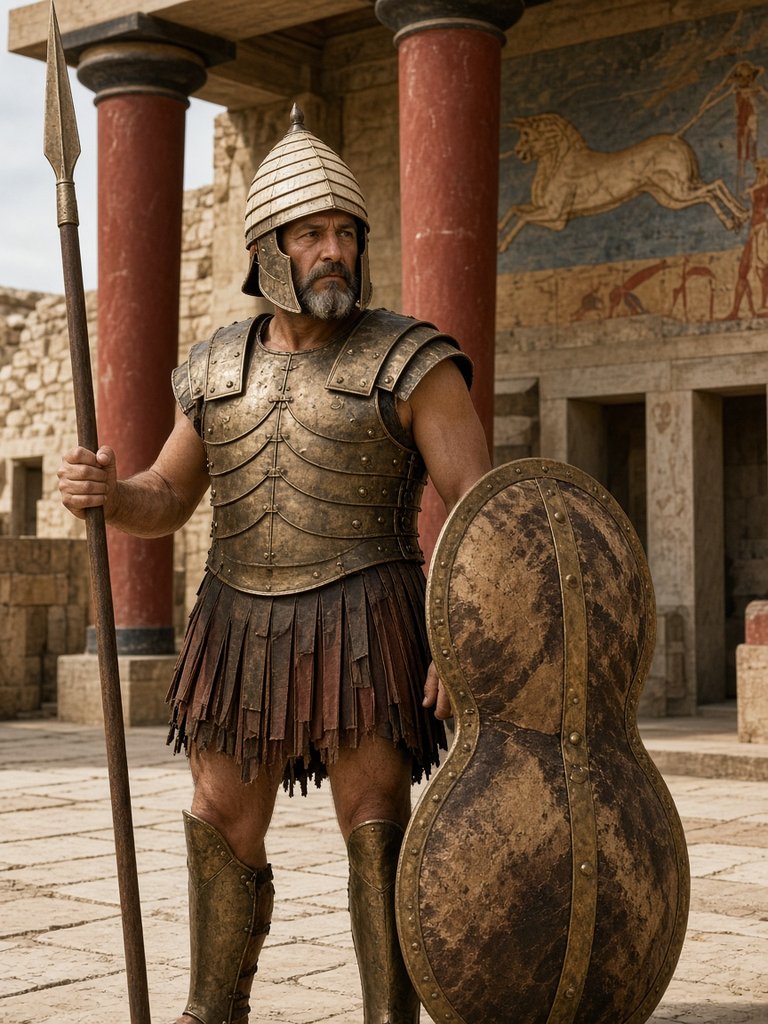
Idomeneus, son of Deukalion and grandson of Minos, leads the Cretans to Troy. The Catalogue of Ships says: “The famous spearsman Idomeneus led the Cretans, who held Cnossus, and the well-walled city of Gortys” (Iliad 2.645–646, tr. Butler), with eighty ships (Iliad 2.652). Though no longer young, he is one of the leading Achaean fighters, and the thirteenth book of the Iliad is his day of glory, when he holds the line at the ships (Iliad 13.240–539, paraphrased).
From the walls of Troy Helen points him out, “looking like a god, and with the captains of the Cretans round him,” and recalls that Menelaos often welcomed him as a guest (Iliad 3.230–233, tr. Butler). In the Odyssey Nestor reports that he brought all his men safe home to Crete (Odyssey 3.191–192, paraphrased).
A later story, told by Servius on Virgil, says that in a storm on the way home he vowed to sacrifice the first thing he met, met his own son, and was driven out of Crete, settling in Italy (Servius on Aeneid 3.121, paraphrased; compare Aeneid 3.121–122).
Epithets
- δουρικλυτός · dourikleitos
- famed for the spear (Iliad 2.645)
- Κρητῶν ἀγός · Krētōn agos
- leader of the Cretans
Symbols and virtues
Steadfast courage in age; the royal line of Minos. Symbols: the spear, the double axe of Knossos.
Myths
- Leader of the Cretans. Iliad 2.645–652.
- His day of glory. Iliad 13.240–539.
- Safe return. Odyssey 3.191–192.
- The vow and exile. Servius on Aeneid 3.121.
Cult and places
- Knossos. The Cretans showed his tomb with that of Meriones (Diodorus 5.79.4, paraphrased).
In the poets
“The famous spearsman Idomeneus led the Cretans, who held Cnossus, and the well-walled city of Gortys.”Homer, Iliad 2.645–646, tr. Samuel Butler (1898), public domain.
Sources
Homer, Iliad 2.645–652, 3.230–233, 13.240–539; Odyssey 3.191–192, 19.181–184; Virgil, Aeneid 3.121–122; Diodorus 5.79.4.
Quotations in public-domain translations (Evelyn-White 1914, Butler 1898/1900, Taylor 1792); other authors paraphrased.