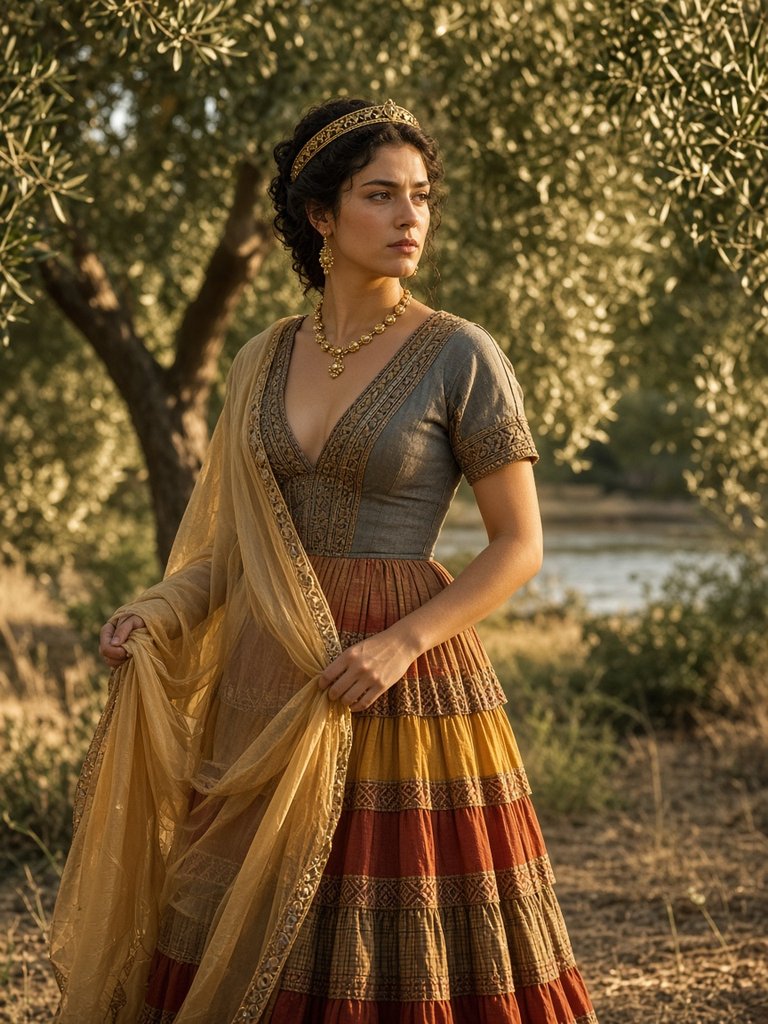
Hippodameia was the daughter of Oinomaos, king of Pisa in Elis. Because an oracle warned that he would die at the hands of his son-in-law, or because he loved her himself, Oinomaos made every suitor race him in a chariot from Pisa toward the Isthmos; he overtook and speared them, and nailed their heads to his house (Apollodorus, Epitome 2.4–5; Pindar, Olympian 1.67–89, paraphrased).
Pelops came with winged horses given by Poseidon. In the usual story Hippodameia, in love with him, or Pelops himself, bribed the king’s charioteer Myrtilos to replace the linchpins of the royal chariot with wax; the chariot broke and Oinomaos was killed. Pelops later threw Myrtilos into the sea, and his dying curse fell on the house (Apollodorus, Epitome 2.6–9; Pausanias 8.14.10–12, paraphrased).
She bore Pelops many sons, among them Atreus and Thyestes. In gratitude for her marriage she founded the Heraia, the footrace of unmarried girls at Olympia held in honour of Hera (Pausanias 5.16.2–4, paraphrased). The race of Pelops and Oinomaos was carved on the east pediment of the temple of Zeus at Olympia, with Hippodameia standing beside the gods (Pausanias 5.10.6–7).
Epithets
- Ἱπποδάμεια · Hippodameia
- tamer of horses
Symbols and virtues
The bride won by a deadly race, and a curse on a royal house. Symbols: the bridal veil, the wax linchpin.
Myths
- The suitors’ race. Apollodorus, Epitome 2.4–5; Pindar, Olympian 1.67–89.
- Myrtilos and the wax linchpins. Apollodorus, Epitome 2.7; Pausanias 8.14.11.
- Mother of Atreus and Thyestes. Apollodorus, Epitome 2.10.
- Founder of the Heraia. Pausanias 5.16.4.
Cult and places
- Olympia. A precinct, the Hippodameion, within the Altis, entered by women once a year for sacrifice (Pausanias 6.20.7).
Sources
Pindar, Olympian 1.67–89; Apollodorus, Epitome 2.3–10; Pausanias 5.10.6–7, 5.16.2–4, 6.20.7, 6.21.7–11, 8.14.10–12; Diodorus 4.73.
Quotations in public-domain translations (Evelyn-White 1914, Butler 1898/1900, Taylor 1792); other authors paraphrased.