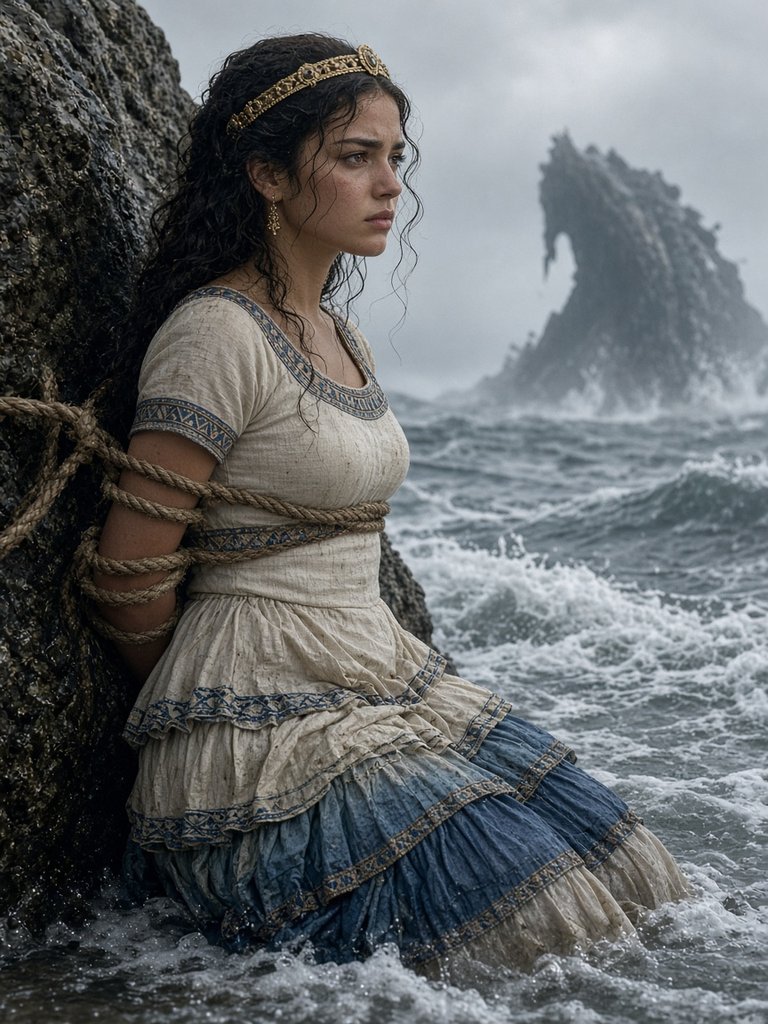
Hesione was a daughter of Laomedon, king of Troy. When Laomedon cheated Apollo and Poseidon of their wages for building the walls, Poseidon sent a sea monster, and an oracle declared that it would leave only if the king exposed his daughter to it; Hesione was bound to the rocks by the sea (Apollodorus 2.5.9, paraphrased).
Herakles offered to save her in return for Laomedon’s famous horses. The Iliad recalls the high wall that Athena and the Trojans built for Herakles as a refuge from the monster (Iliad 20.144–148, paraphrased). He killed it, but Laomedon refused the reward, and Herakles later returned and sacked Troy (Iliad 5.638–651; Apollodorus 2.6.4, paraphrased).
He gave Hesione as a prize to Telamon, to whom she bore Teukros. Allowed to take one captive with her, she chose her brother Podarkes and ransomed him with her veil; from then on he was called Priam, the bought one (Apollodorus 2.6.4, 3.12.3, 3.12.7, paraphrased).
Epithets
- Λαομεδοντίς · Laomedontis
- daughter of Laomedon
Symbols and virtues
Sacrifice for a father’s broken promise, and rescue. Symbols: the rock by the sea, the veil.
Myths
- Exposed to the sea monster. Apollodorus 2.5.9.
- Rescued by Herakles. Iliad 20.144–148; Apollodorus 2.5.9.
- The sack of Troy. Iliad 5.638–651; Apollodorus 2.6.4.
- Wife of Telamon, mother of Teukros. Apollodorus 3.12.7.
- Ransoming Priam. Apollodorus 2.6.4.
Sources
Homer, Iliad 5.638–651, 20.144–148; Diodorus 4.42, 4.49; Apollodorus 2.5.9, 2.6.4, 3.12.3, 3.12.7; Ovid, Metamorphoses 11.211–217.
Quotations in public-domain translations (Evelyn-White 1914, Butler 1898/1900, Taylor 1792); other authors paraphrased.