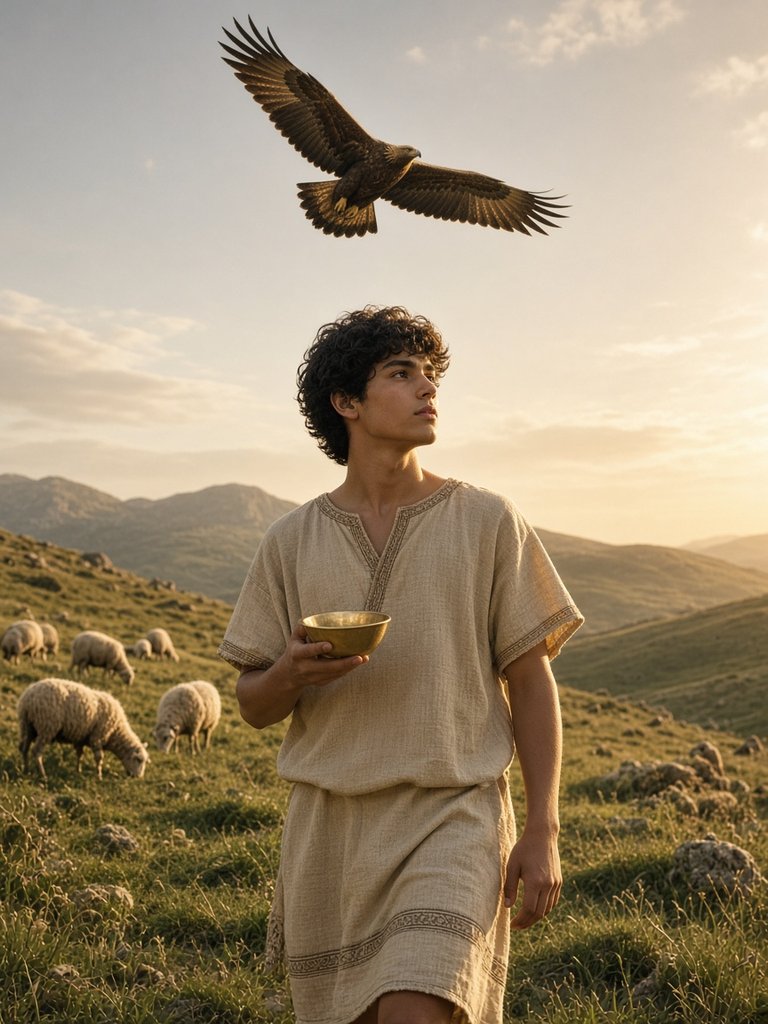
Ganymedes is a son of Tros, the king who gave Troy and the Trojans their name. Aineias recites his family’s lineage: “Tros had three noble sons, Ilus, Assaracus, and Ganymede who was comeliest of mortal men; wherefore the gods carried him off to be Jove’s cup-bearer, for his beauty’s sake, that he might dwell among the immortals” (Iliad 20.231–235, tr. Butler).
Zeus paid his father for him with the finest horses under the sun, from whose blood the horses of Aineias were bred (Iliad 5.265–267, paraphrased). The Homeric Hymn to Aphrodite adds that Tros grieved for his son until Hermes told him the boy would be deathless and unageing (Hymn to Aphrodite 202–217, paraphrased).
Later writers said Zeus sent his eagle, or took the form of an eagle himself, to carry the boy up from Mount Ida (Ovid, Metamorphoses 10.155–161, paraphrased). In the halls of the gods he pours the nectar in place of Hebe.
Epithets
- ἀντίθεος · antitheos
- godlike (Iliad 20.232)
- κάλλιστος θνητῶν ἀνθρώπων · kallistos thnētōn anthrōpōn
- most beautiful of mortal men
Symbols and virtues
Beauty raised to the gods. Symbols: the cup, the eagle, the horses of Tros.
Myths
- Carried off by the gods. Iliad 20.231–235.
- The horses of Tros. Iliad 5.265–267; Hymn to Aphrodite 210–217.
- The eagle. Ovid, Metamorphoses 10.155–161.
In the poets
“Ganymede who was comeliest of mortal men; wherefore the gods carried him off to be Jove’s cup-bearer, for his beauty’s sake.”Homer, Iliad 20.232–234, tr. Samuel Butler (1898), public domain.
Sources
Homer, Iliad 5.265–267, 20.231–235; Homeric Hymn to Aphrodite 202–217; Ovid, Metamorphoses 10.155–161; Apollodorus 3.12.2.
Quotations in public-domain translations (Evelyn-White 1914, Butler 1898/1900, Taylor 1792); other authors paraphrased.