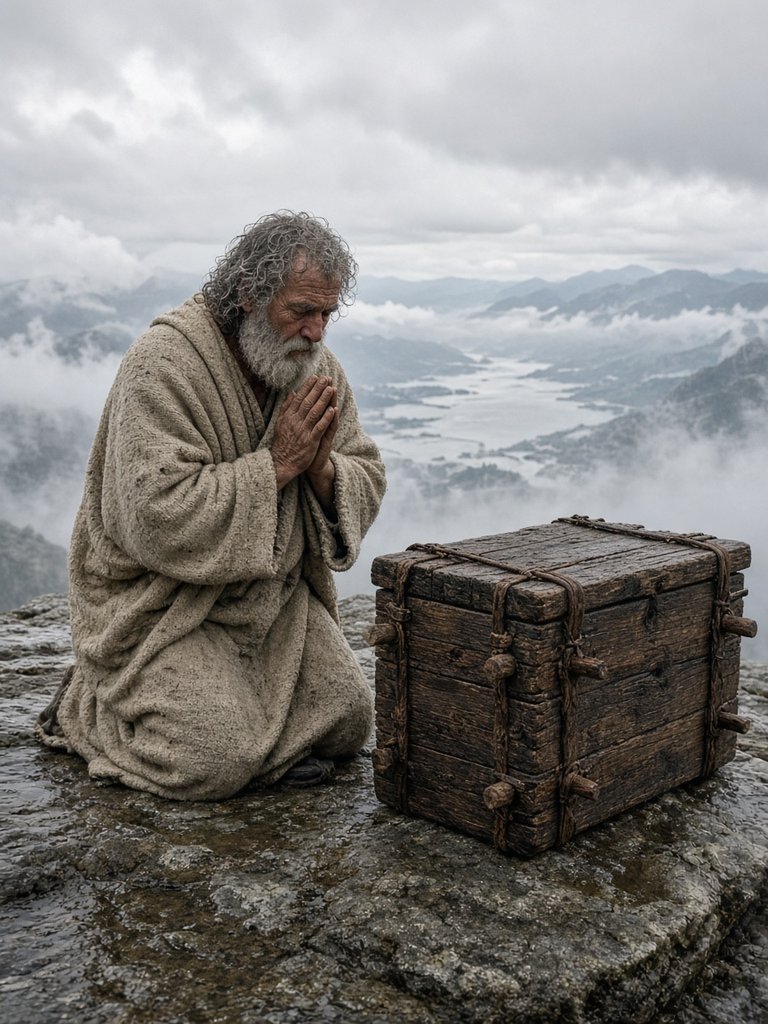
Deukalion, son of Prometheus, ruled in Phthia and married Pyrrha, daughter of Epimetheus and Pandora. When Zeus resolved to destroy the men of the bronze age with a flood, Prometheus told his son to build a chest. Deukalion and Pyrrha floated in it for nine days and nights and came to rest on Mount Parnassos (Apollodorus 1.7.2, paraphrased).
When the rain stopped he sacrificed to Zeus the god of escape, and Zeus let him choose a wish. He asked for people, and at Zeus’ bidding he and Pyrrha threw stones over their heads: his stones became men and hers became women (Apollodorus 1.7.2; Pindar, Olympian 9.42–53, paraphrased). In Ovid the oracle of Themis tells them to throw the bones of their great mother, meaning the stones of the earth (Metamorphoses 1.367–415).
Their son Hellen was the ancestor of all the Hellenes (Apollodorus 1.7.2–3). The Athenians said Deukalion founded the old sanctuary of Olympian Zeus and showed his grave nearby (Pausanias 1.18.8). He is not the Homeric Deukalion, son of Minos and father of Idomeneus.
Epithets
- Προμηθέος υἱός · Promētheos huios
- son of Prometheus
Symbols and virtues
Survival and the renewal of mankind. Symbols: the chest on the waters, the stones.
Myths
- The flood and the chest. Apollodorus 1.7.2; Ovid, Metamorphoses 1.253–347.
- The stones. Pindar, Olympian 9.42–53; Ovid, Metamorphoses 1.367–415.
- Father of Hellen. Apollodorus 1.7.2–3.
Cult and places
- Athens. Grave near the Olympieion (Pausanias 1.18.8).
Sources
Pindar, Olympian 9.42–53; Apollodorus 1.7.2–3; Ovid, Metamorphoses 1.253–415; Pausanias 1.18.8, 10.6.2.
Quotations in public-domain translations (Evelyn-White 1914, Butler 1898/1900, Taylor 1792); other authors paraphrased.