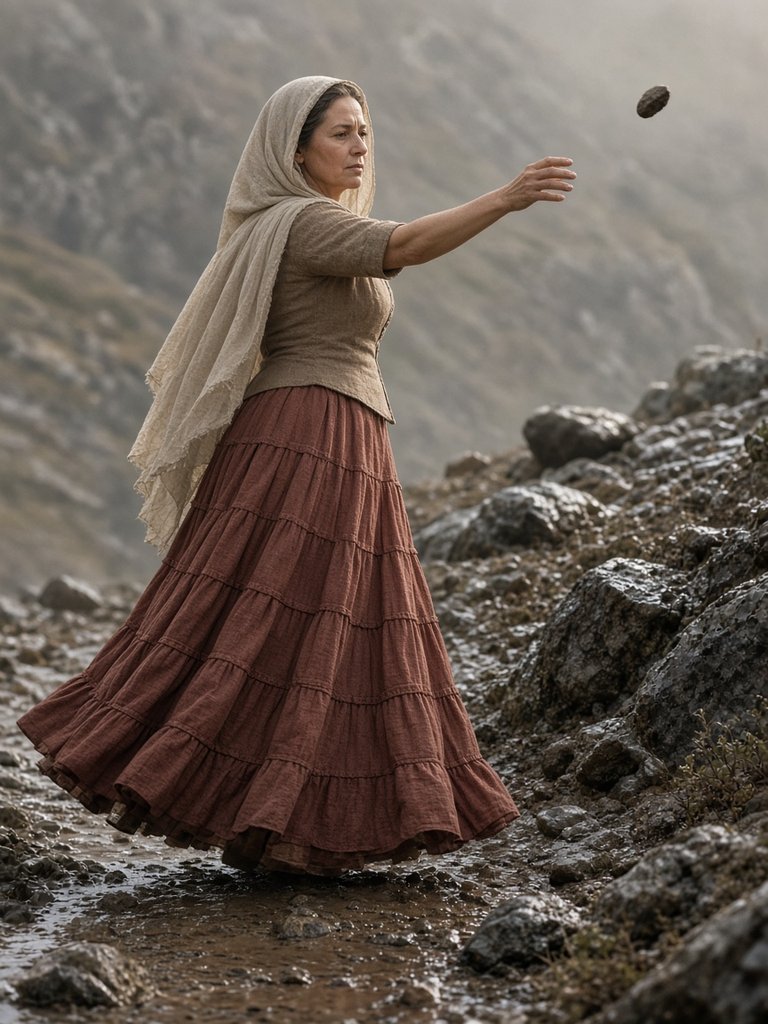
Pyrrha, daughter of Epimetheus and Pandora, the first woman, was the wife of Deukalion. With him she survived the great flood of Zeus in a chest that came to rest on Mount Parnassos (Apollodorus 1.7.2, paraphrased).
After the flood the two were told to throw stones over their heads. The stones Deukalion threw became men and those Pyrrha threw became women (Apollodorus 1.7.2, paraphrased). Pindar says they came down from Parnassos and made a people of stone, a pun on the Greek words for people (laos) and stone (laas) (Olympian 9.42–46).
In Ovid, Pyrrha at first fears to obey the oracle of Themis, which bids them throw their mother’s bones, until Deukalion sees that the great mother is the earth and her bones are stones (Metamorphoses 1.381–394, paraphrased). She was the mother of Hellen, ancestor of the Greeks. Her name means red or fiery.
Epithets
- Πύρρα · Purrha
- red, fiery, the meaning of her name
Symbols and virtues
Faith after disaster and the mothering of a new people. Symbols: the stones, the veil.
Myths
- The flood. Apollodorus 1.7.2.
- The stones become women. Apollodorus 1.7.2; Pindar, Olympian 9.42–46.
- The oracle of Themis. Ovid, Metamorphoses 1.367–415.
Sources
Pindar, Olympian 9.42–53; Apollodorus 1.7.2; Ovid, Metamorphoses 1.313–415.
Quotations in public-domain translations (Evelyn-White 1914, Butler 1898/1900, Taylor 1792); other authors paraphrased.