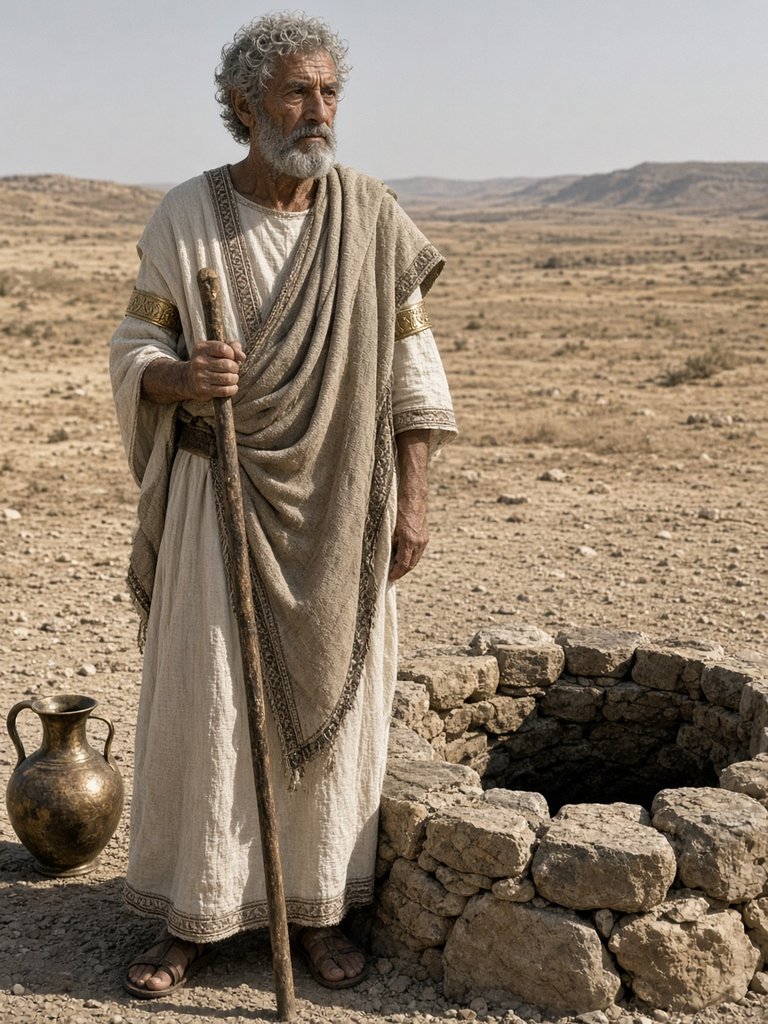
Danaos was a son of Belos, king of Egypt, and descendant of Io. He had fifty daughters, and his twin brother Aigyptos fifty sons. Fearing his brother, he built a ship on the advice of Athena and fled with his daughters to Argos, the land of their ancestress (Apollodorus 2.1.4, paraphrased). In Aeschylus’ Suppliant Women the daughters beg the Argive king for protection (Suppliant Women 1–523, paraphrased).
He became king of Argos. Pausanias tells that when he and the old king Gelanor disputed the throne, the Argives saw a wolf attack and kill the leading bull of a herd, and took it as a sign for the stranger; Danaos founded the sanctuary of Apollo Lykios in thanks (Pausanias 2.19.3–4, paraphrased). He was said to have found water for dry Argos by digging wells (Strabo 8.6.8, paraphrased).
When the sons of Aigyptos came to claim his daughters in marriage, he gave each daughter a dagger, and on the wedding night all but Hypermnestra killed their husbands (Apollodorus 2.1.5, paraphrased). Euripides and others said that the Greeks were once called Danaans after him, the name Homer uses for the Achaeans (Strabo 5.2.4; Apollodorus 2.1.4, paraphrased).
Epithets
- Δαναός · Danaos
- ancestor of the Danaans
Symbols and virtues
Exile, kingship won by omen, and a terrible wedding. Symbols: the well, the wolf and the bull, the daggers.
Myths
- Flight from Egypt. Apollodorus 2.1.4; Aeschylus, Suppliant Women.
- The omen of the wolf. Pausanias 2.19.3–4.
- The wells of Argos. Strabo 8.6.8.
- The wedding night. Apollodorus 2.1.5.
- Ancestor of the Danaans. Strabo 5.2.4.
Cult and places
- Argos. His tomb, called the Palinthos, stood in the middle of the agora of Argos (Strabo 8.6.9).
Sources
Aeschylus, Suppliant Women; Strabo 5.2.4, 8.6.8–9; Apollodorus 2.1.4–5; Pausanias 2.19.3–4.
Quotations in public-domain translations (Evelyn-White 1914, Butler 1898/1900, Taylor 1792); other authors paraphrased.