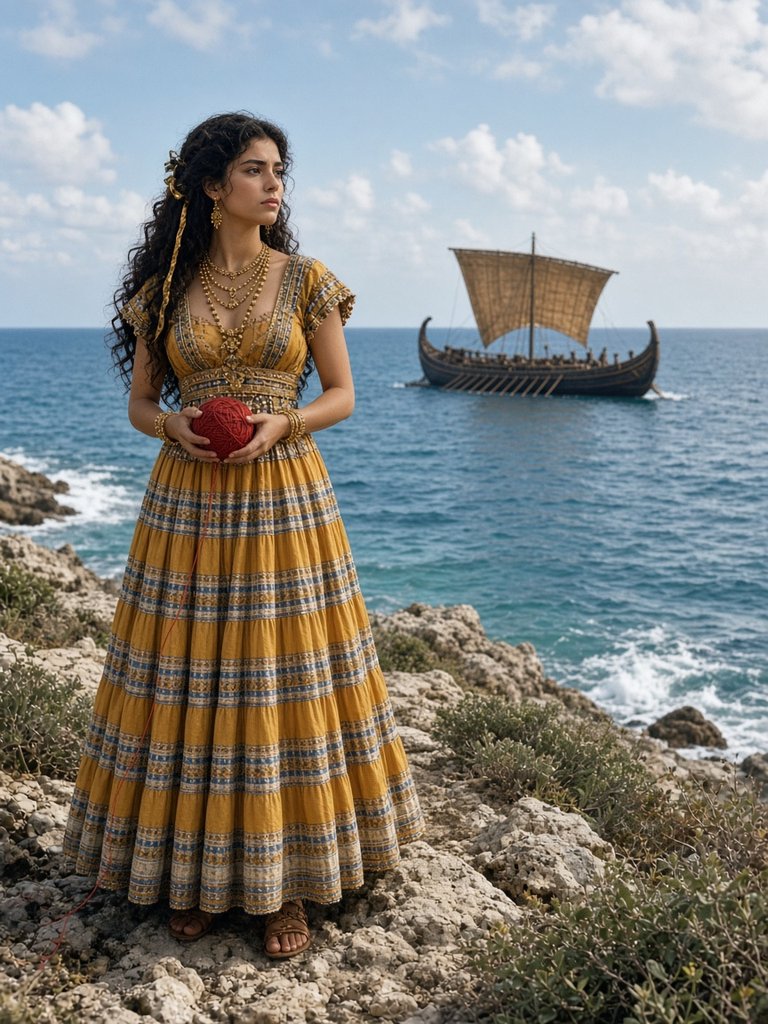
Ariadne is the daughter of Minos king of Crete and Pasiphaë, daughter of Helios. On the shield of Achilles Hephaistos made “a green, like that which Daedalus once made in Cnossus for lovely Ariadne. Hereon there danced youths and maidens” (Iliad 18.590–593, tr. Butler).
When Theseus came from Athens with the youths owed to the Minotaur, she fell in love with him and gave him the thread that led him out of the Labyrinth (Plutarch, Theseus 19, paraphrased). In the Odyssey Odysseus sees among the dead “fair Ariadne daughter of the magician Minos, whom Theseus was carrying off from Crete to Athens, but he did not enjoy her, for before he could do so Diana killed her in the island of Dia on account of what Bacchus had said against her” (Odyssey 11.321–325, tr. Butler).
More often she was left sleeping on Naxos and found there by Dionysos, who made her his wife: Hesiod says that “golden-haired Dionysus made brown-haired Ariadne, the daughter of Minos, his buxom wife: and the son of Cronos made her deathless and unageing for him” (Theogony 947–949, tr. Evelyn-White). Her bridal crown became a constellation, the Corona (Eratosthenes, Catasterismi 5, paraphrased). Plutarch reports a Cyprian cult of Ariadne Aphrodite at Amathous and two festivals on Naxos, one joyful, one of mourning (Theseus 20, paraphrased).
Epithets
- καλλιπλόκαμος · kalliplokamos
- lovely-haired (Iliad 18.592)
- ξανθή · xanthē
- fair (Theogony 947, “brown-haired” in Evelyn-White)
Symbols and virtues
Love that guides through the maze, abandonment and divine marriage. Symbols: the thread, the dancing-floor of Knossos, the bridal crown in the stars.
Myths
- The dancing-floor. Iliad 18.590–593.
- The thread. Plutarch, Theseus 19.
- Death on Dia. Odyssey 11.321–325.
- Bride of Dionysos. Theogony 947–949; Catullus 64.
- The Crown. Eratosthenes, Catasterismi 5.
Cult and places
- Naxos. Two festivals (Plutarch, Theseus 20).
- Amathous, Cyprus. Grove of Ariadne Aphrodite (Plutarch, Theseus 20).
In the poets
“Golden-haired Dionysus made brown-haired Ariadne, the daughter of Minos, his buxom wife: and the son of Cronos made her deathless and unageing for him.”Hesiod, Theogony 947–949, tr. H. G. Evelyn-White (1914), public domain.
Sources
Homer, Iliad 18.590–593; Odyssey 11.321–325; Hesiod, Theogony 947–949; Catullus 64; Plutarch, Theseus 19–20; Eratosthenes, Catasterismi 5; Pausanias 1.20.3, 2.23.7–8.
Quotations in public-domain translations (Evelyn-White 1914, Butler 1898/1900, Taylor 1792); other authors paraphrased.