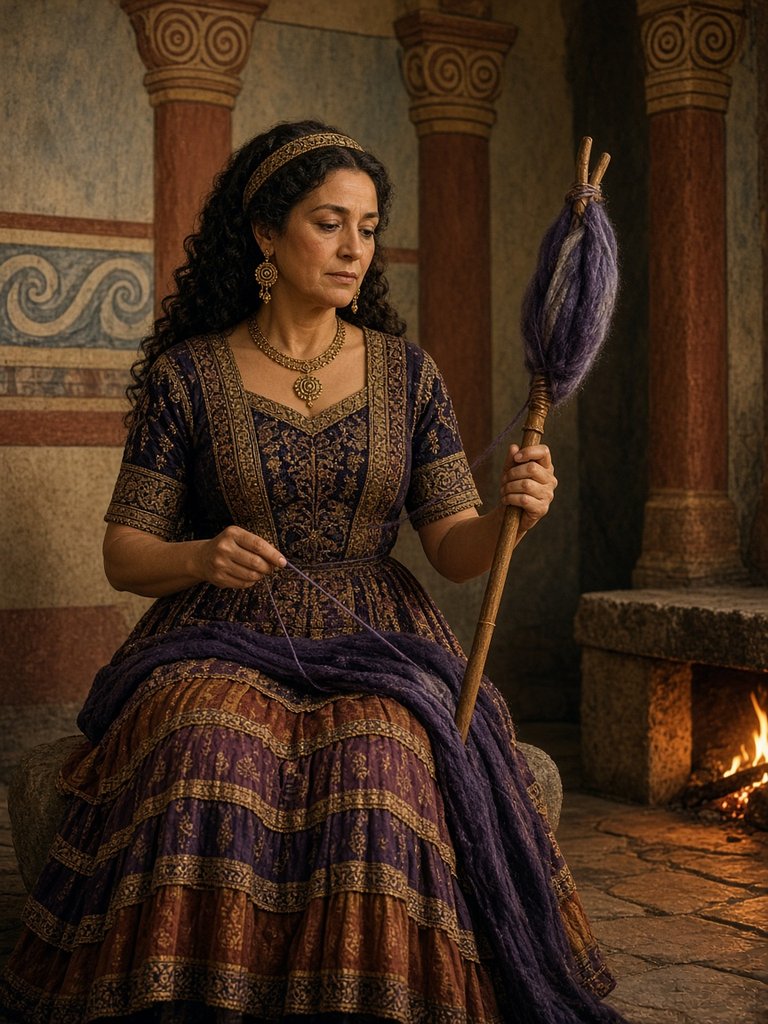
Arete is queen of the Phaeacians, wife and niece of Alkinoos and mother of Nausikaa. Both Nausikaa and Athena tell Odysseus that he must win her favour first if he hopes to get home (Odyssey 6.303–315, 7.53–77, paraphrased).
Athena describes her rank: Alkinoos married her and “honours as no other woman is honoured of all those that keep house along with their husbands. Thus she both was, and still is, respected beyond measure by her children, by Alcinous himself, and by the whole people, who look upon her as a goddess” (Odyssey 7.67–71, tr. Butler). She also settles the quarrels of men by her good sense (Odyssey 7.73–74, paraphrased).
Odysseus kneels at her knees by the hearth. Seeing that he wears clothes made in her house, she asks him who he is (Odyssey 7.233–239), and later she calls on the Phaeacian lords to add more gifts for him (Odyssey 11.335–341, paraphrased).
Epithets
- λευκώλενος · leukōlenos
- white-armed
- βασίλεια · basileia
- queen
Symbols and virtues
Wisdom, authority and the judgment of a good queen. Symbols: the hearth, the distaff with sea-purple wool.
Myths
- Win the queen first. Odyssey 6.303–315, 7.53–77.
- Odysseus at her knees. Odyssey 7.139–239.
- Gifts for the stranger. Odyssey 11.335–341.
In the poets
“Thus she both was, and still is, respected beyond measure by her children, by Alcinous himself, and by the whole people, who look upon her as a goddess.”Homer, Odyssey 7.69–71, tr. Samuel Butler (1900), public domain.
Sources
Homer, Odyssey 6.303–315, 7.53–77, 7.139–347, 11.335–341, 13.56–62.
Quotations in public-domain translations (Evelyn-White 1914, Butler 1898/1900, Taylor 1792); other authors paraphrased.