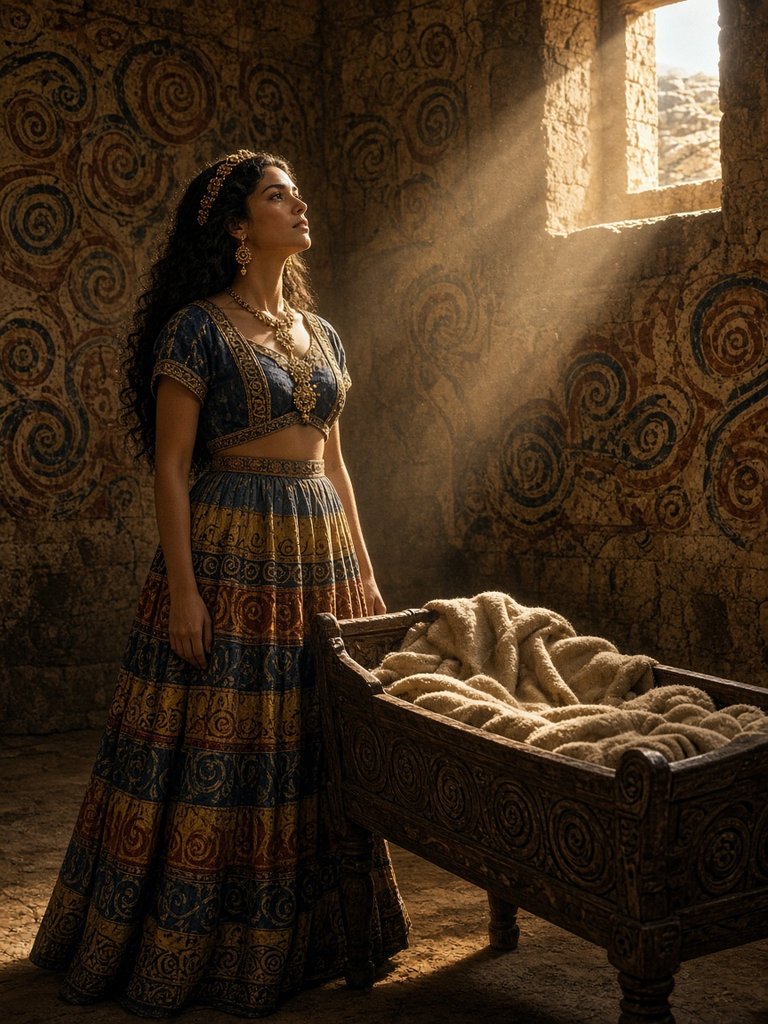
Alkmene, daughter of Elektryon king of Mycenae, is the wife of Amphitryon and mother of Herakles. Hesiod calls her son “mighty Heracles, the valiant son of neat-ankled Alcmena” (Theogony 950, tr. Evelyn-White).
While Amphitryon was away at war, Zeus came to her in her husband’s likeness and made the night long; Amphitryon came home the next night, and she bore twins, Herakles to Zeus and Iphikles to Amphitryon (Apollodorus 2.4.8, paraphrased). In the Iliad Hera delays her labour so that Eurystheus is born first and rules over Herakles (Iliad 19.95–124, paraphrased).
Odysseus sees her among the famous women in the underworld: “Then I saw Alcmena, the wife of Amphitryon, who also bore to Jove indomitable Hercules” (Odyssey 11.266–268, tr. Butler). Pausanias was shown the ruins of Amphitryon’s house and Alkmene’s chamber at Thebes (9.11.1, paraphrased).
Epithets
- καλλίσφυρος · kallisphuros
- neat-ankled (Theogony 950)
Symbols and virtues
Faithfulness, and the mortal mother of a hero. Symbols: the cradle of the twins, the long night.
Myths
- Zeus in the form of Amphitryon. Apollodorus 2.4.8.
- The birth delayed by Hera. Iliad 19.95–124.
- Among the heroines. Odyssey 11.266–268.
Cult and places
- Thebes. Her chamber in the house of Amphitryon (Pausanias 9.11.1).
In the poets
“Then I saw Alcmena, the wife of Amphitryon, who also bore to Jove indomitable Hercules.”Homer, Odyssey 11.266–268, tr. Samuel Butler (1900), public domain.
Sources
Hesiod, Theogony 943, 950; Homer, Iliad 14.323–324, 19.95–124; Odyssey 11.266–268; Apollodorus 2.4.5–8; Pausanias 9.11.1.
Quotations in public-domain translations (Evelyn-White 1914, Butler 1898/1900, Taylor 1792); other authors paraphrased.