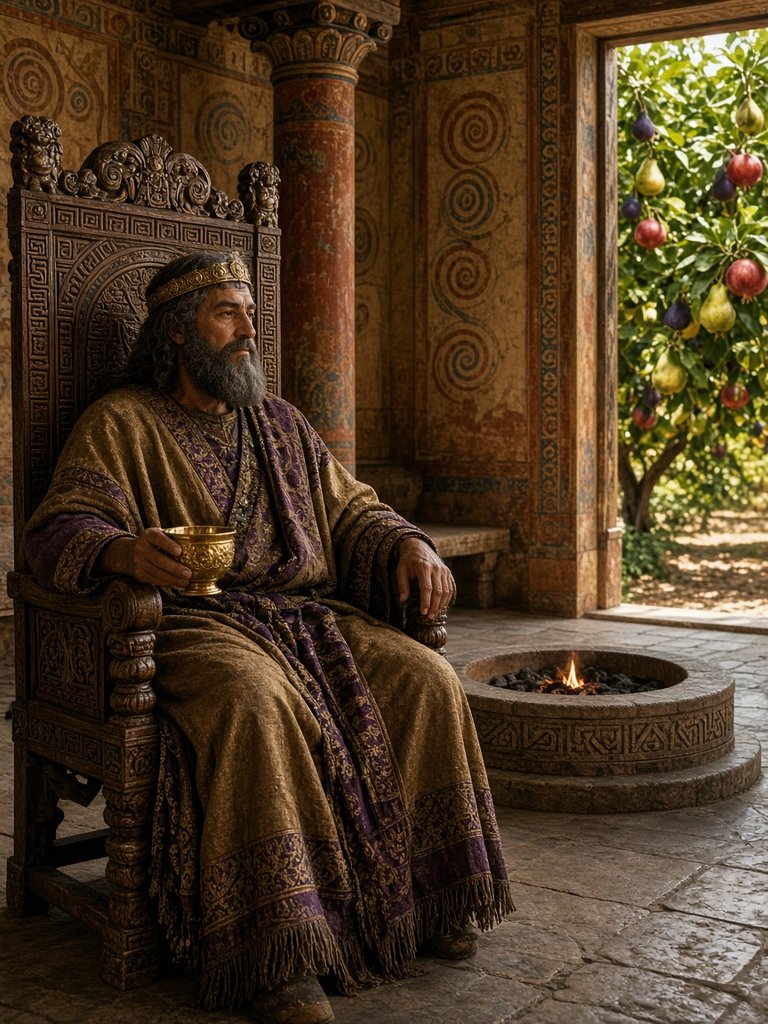
Alkinoos, son of Nausithoos, is king of the Phaeacians on Scheria, husband of Arete and father of Nausikaa. The Odyssey introduces him as “King Alcinous, whose counsels were inspired of heaven” (Odyssey 6.12, tr. Butler).
His palace shines with bronze walls, gold and silver doors and golden youths holding torches (Odyssey 7.81–102, paraphrased), and beside it lies his garden: “Outside the gate of the outer court there is a large garden of about four acres with a wall all round it. It is full of beautiful trees—pears, pomegranates, and the most delicious apples” (Odyssey 7.112–115, tr. Butler), where fruit ripens all the year round.
He receives the shipwrecked Odysseus as a suppliant, holds games and a feast with the bard Demodokos, and listens through the night to the story of his wanderings (Odyssey 8–12, paraphrased). He then sends him home to Ithaka laden with gifts, though Poseidon punishes the Phaeacians for it (Odyssey 13.1–187, paraphrased).
Epithets
- θεῶν ἄπο μήδεα εἰδώς · theōn apo mēdea eidōs
- with counsel from the gods (Odyssey 6.12)
- μεγαλήτωρ · megalētōr
- great-hearted
Symbols and virtues
Hospitality to the stranger and a happy kingdom. Symbols: the ever-bearing garden, the golden torch-bearers, the feast.
Myths
- His palace and garden. Odyssey 7.81–132.
- Receiving Odysseus. Odyssey 7.133–347.
- Games and songs. Odyssey 8.
- The tale of the wanderings. Odyssey 9–12.
- Sending him home. Odyssey 13.1–187.
In the poets
“Outside the gate of the outer court there is a large garden of about four acres with a wall all round it. It is full of beautiful trees—pears, pomegranates, and the most delicious apples.”Homer, Odyssey 7.112–115, tr. Samuel Butler (1900), public domain.
Sources
Homer, Odyssey 6.12–17, 7–8, 11.333–384, 13.1–187.
Quotations in public-domain translations (Evelyn-White 1914, Butler 1898/1900, Taylor 1792); other authors paraphrased.